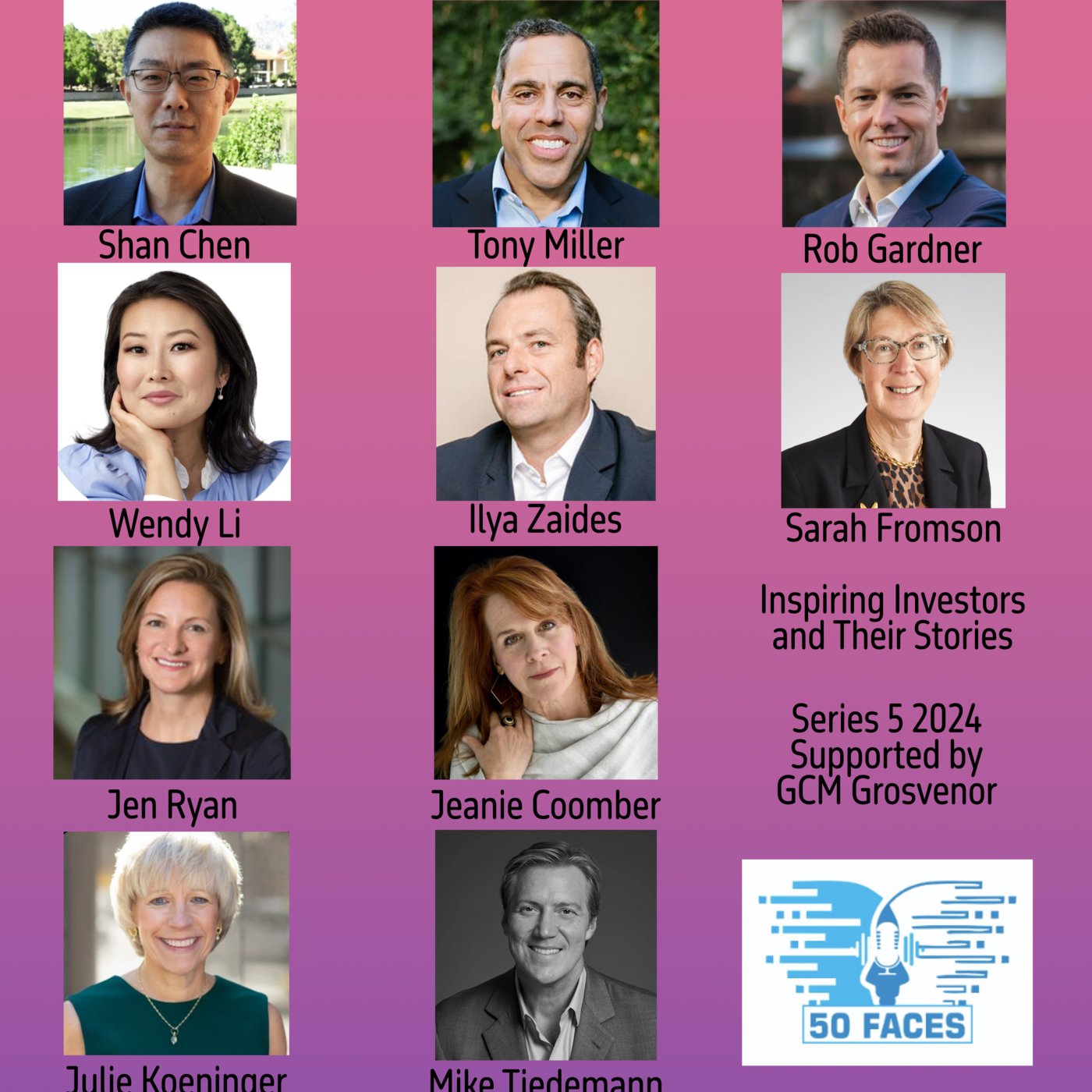
When we created The Fiftyfaces Podcast in 2020, our mission was to tell the stories of a wide range of leaders in the world of investing – to learn about their career arcs, their wisdom and their spheres of expertise.
As our podcasts and sub-series multiplied, we created The Fiftyfaces Hub to centralize this content and optimize its accessibility and also provide resources, insights and coaching.
Now we are relaunching The Fiftyfaces Hub as an interactive portal that can take you on a tailored journey according to your interests – into the world of sales, venture capital, market commentary and allocator’s mindsets. We invite you to learn with us as we map the investment and professional landscape of the future.
Aoifinn Devitt: This series is kindly supported by GCM Grosvenor. GCM Grosvenor is a global alternative asset management firm with a longstanding commitment to supporting small, emerging, and diverse investment managers. For over 30 years, the firm has developed expertise in funding and guiding these managers as part of its broader activity across alternative investments. With over $20 billion in AUM dedicated to small and emerging managers and $16 billion in AUM dedicated to diverse managers, GCM Grosvenor leverages its experienced team, broad network, and proprietary sourcing capabilities to support their success. Through the Small, Emerging, and Diverse Manager Program, the firm creates opportunities for investors to access a wide range of talent while seeking to drive strong returns and impact. For more information, visit www.gcmgrovenor.com.
Sarah Fromson: What you could sense was this kind of frenzy. It came across with the pressure on us to take more risk in the managers we selected, the portfolios we constructed. It was visible in the private equity exposure. It was visible in the scale of the buildings. It was obvious in a variety of subtle ways—marketing, branding—and it just made you uneasy. I can’t blame the pressions, that would just be unfair, but it didn’t feel right. And there was a very great lack of diversity. We all know the outcome, we all know what happened, and with hindsight it’s very obvious. At the time it was subtle, but you could feel the pressure cooker.
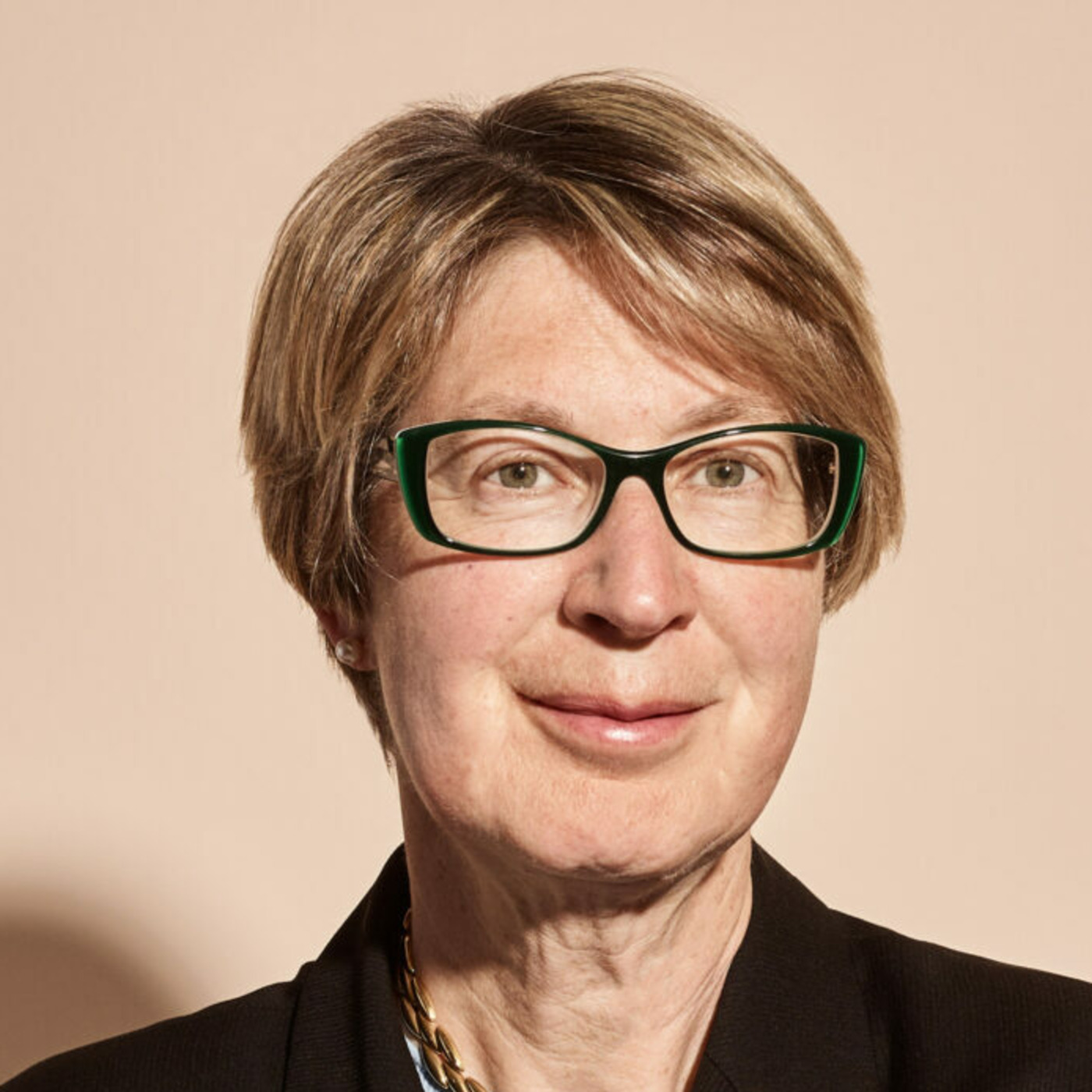
Aoifinn Devitt: I’m Aoifinn Devitt, and welcome to the 50 Faces Podcast, a podcast committed to revealing the richness and diversity of the world of investment by focusing on its people and their stories. I’m joined today by Sarah Fromson, who is Chair of the Cambridge University Endowment Fund Investment Advisory Board. She also holds a number of other non-executive board and committee roles, including at the Calouste Gulbenkian Foundation, Quilter Investors, Capital Generation Partners, and Arrow Street, among others. She spent 11 years as Head of Investment Risk at the Wellcome Trust, and prior to that was the Chief Investment Risk Officer at RBS Asset Management. Welcome, Sarah, thanks for joining me today.
Sarah Fromson: Thank you.
Aoifinn Devitt: Let’s start with your journey into a career in investing and risk in particular. How did that start and did it take any surprising turns along the way?
Sarah Fromson: So it’s a long and winding road to have got here. I started off as a first-generation immigrant growing up in Blackburn and St. Annes in the north of England, and both sides of my family were refugees from Nazi Germany. And my father and grandfather had a scrap metal recycling firm in Blackburn, and it was fascinating to hear their stories over the dinner table. There was a lot to hear. About commerce, a lot to hear about economics, a lot to hear about politics, very little about investments, but it started me thinking about how the world works in an economic and a financial sense. I was definitely not encouraged to join the family business because clearly as a girl that was not going to happen. And I managed to get to Cambridge University, to Girton, which was single-sex then and remained so until my third year. And took a degree in metallurgy. Now, what do you do with a degree in metallurgy? I wanted to work with bright, interesting people, and I wanted a fast-paced environment, and I didn’t want to spend 3 years doing a research project. So I started at the gutter end of the city in commodities. I got an introduction there and started there in 1980, working in commodities in a subsidiary of Beresford, which was the famous sugar trading firm. And I did metals research and I did trading and I did working with clients and quickly worked out that I was good at the research, absolutely hopeless at the trading without a poker face, and okay with the clients. So that was helpful. And then moving swiftly on, stayed in commodities for a while, decided that I needed an MBA at London Business School and moved into pension fund management, and later with Coutts and RBS into manager selection, hedge fund selection, portfolio construction, and then risk management. And I got to the risk management, well, when I really needed it, which was in 2006, 2007. I didn’t know at that stage that RBS was going to go spectacularly bust, but I did feel the testosterone in the air. Fred Goodwin was contagious, and it became clear to me that it was a good time to look for something else. And I was fortunate enough to be taken on at Wellcome Trust to be their head of investment risk. And that was like being on the side of the angels. Because you’re working with an absolutely amazing investment team for a huge endowment that wanted to support medical science and research. And it felt like the best of both worlds and stayed there until the end of my executive career. But it was the risk and the investing that really I loved all the way through. I’ve had less time available and less capacity as a client or development manager, you know, marketing person. But I always wanted to focus on the investing and the risk management.
Aoifinn Devitt: Well, that’s an absolutely fascinating backstory you’ve told us there, and I can’t let a few of those, the nuggets you’ve dropped, go without following up. So first of all, back to those dinner table conversations at the metal business or around the metal business. I’d love to know what attitude to taking risk. You said the family didn’t talk about investing, But they clearly talked about business and politics. And how do you think, in business there are failures, there are investments as part of business that work out or don’t. Did you think you picked up any attitude to taking risk in listening into those conversations?
Sarah Fromson: Certainly, and it was quite an interesting spectrum. My grandfather, who was very Germanic in his approach, believed very firmly in risk management and he was quite a cautious soul. He was the one who insisted on having so much in cash, so much in stock, and so much in receivables and he would vet his clients very carefully. Whereas my dad was the younger and the more risk-taking chap, and he would be looking for fascinating new business avenues. He’d be looking for interesting folk to buy metals off. He was the one who took them into nickel, which was new in those days. It was a new recycled metal, and he was the one who took them into overseas activities. Which I must tell you didn’t always work out. So I learned something from the blend of their two approaches and from the heated arguments that often took place over the dinner table, learning along the way that it’s good to disagree, but if you share a common purpose and you know where you’re aiming for, then those disagreements can be for the common good.
Aoifinn Devitt: Fascinating. And then metals are such a curious topic of focus at undergraduate level and probably not many were choosing that route. And what was it about metals in particular that fascinated you? Was it the scientific aspect of it, some of the physics behind it?
Sarah Fromson: So I did natural sciences, and as you probably know, that means you have a broad base of subjects in your first year and you progressively specialise. And it was serendipity. The metallurgy and materials science department was a modestly sized department with lots of care for each third-year student, really great lecturers, They didn’t have quite the arrogance of the chemistry department, which had a slew of Nobel Prize winners to their credit, as did physics. And I ended up with a crew of great peers in my third year in metallurgy and just loved it. I hadn’t gone into Cambridge thinking I would end up doing metallurgy. I really hadn’t. But it was a good opportunity and a good way of learning.
Aoifinn Devitt: And then just finally, a career in risk management, and we’ll talk a little bit about what investment risk means today, but the words you used about RBS pre-blowup, did a lot of work there, the testosterone in the air. What does it feel like when something is approaching that level of high risk, I suppose? How did you sense that having been in many different organizations? How did you sense that things were just getting a little too much?
Sarah Fromson: Well, I was in the asset management arm and we were managing money for external clients, high net worth, medium net worth clients. But, and I wasn’t sufficiently senior to be best buds with Fred Goodwin. But what you could sense was this kind of frenzy. It came across with the pressure on us to take more risk in the managers we selected, the portfolios we constructed. It was visible in the private equity exposure that RBS had. It was visible in the scale of the buildings that Fred Goodwin was sponsoring, particularly outside Edinburgh, the Gogoburn Building. It was obvious in a variety of subtle ways, marketing, branding, and it just made you uneasy. I can’t blame the pressions, that would just be unfair, but it didn’t feel right. And there was a very great lack of diversity in Ken Goodwin and his best cronies. We all know the outcome, we all know what happened. And with hindsight, it’s very obvious. At the time, it was subtle, but you could feel the pressure cooker.
Aoifinn Devitt: Really interesting because, of course, diversity probably would have meant challenge and perhaps checking of biases, etc. And then that goes to my next question around the evolution of investment risk throughout your career, because I think you’ve hit on something really crucial. I would expect your answer will be around the increasing data we have, the machinery, how we measure and manage risk has clearly changed a lot over the course of your career. But yet you’ve spoken to sort of an instinctual reaction to a growing appetite, which is not something that can be easily measured. There is an art and a science clearly to this. So maybe can you talk a little bit about the field of investment risk, given this is where your last executive role was focused on that, how it evolved in importance throughout the course of your career?
Sarah Fromson: So in between managing pension funds and being at Coutts RBS, I had a shorter-term job in investment risk consulting, and that was in between babies 2 and 3, but we’ll talk about that later. And that was with Quantec. And what was fascinating was to see the evolution of the use of data and the manipulation of data right at the early stages. Computers were gaining in power at that point, and the idea that you could use the risk models that had previously been theoretical constructs and actually use them sensibly within portfolio construction, these were new ideas to most portfolio managers who basically at that stage flew largely by the seat of their pants. The advent of the quants was really the end of the ’90s, the 2000s. Early in the late ’80s, early ’90s, this was still relatively new. And when I moved to RBS Asset Management, We developed a proprietary risk model at that point, which took lots of data, absolutely right, lots of return type data, lots of portfolio construction data, and sought to use it to build portfolios at two levels, one level at the asset allocation and one at the stock selection or security selection level. But I’ve always been very conscious that risk depends on humans, and risk depends on the degree to which individual human beings can take in a risk model and have the intellectual acuity and the humbleness to use it effectively, not to disdain it, not to use it as a Bible, but to say, this is a tool for me. And as we’ve moved on, at Wellcome, the team there was particularly thoughtful in terms of risk management, with a very thoughtful way as to how much they were willing to use risk models and how much they relied also on an assessment of the other types of risk—operational risk, liquidity risk, control risk. Sentiment risk, not all of which, very few of which can be quantified in the same way as sort of traditional investment models, but are nonetheless vital to avoiding the impact of a major blowup. So I’ve never forgotten the mantra that we had at Wellcome, which is for any manager, for any situation, think of the return and the risk that you expect and can deal with but also think about liquidity and think about control. And with control comes the agency issues, the economic issues of who gets paid when, what happens, and to what degree you can influence those. So I think there’s the two aspects of risk management. There’s the quantitative aspect, and there’s the qualitative aspect, which rely on an understanding of calibrating the other dimensions. And that’s not easy. I enjoyed very much the development of my investment risk role at Wellcome because I was lucky enough, for those geeky to understand this parlance, to be both first line of defense in risk terms, in other words, helping management, but also second line of defense in risk terms, which is the oversight role. And there’s not many places you can straddle both. You can’t do it under FCA regulations, but you can do it when you’re managing your own money as for an endowment or for a trust. And that’s a fascinating and a challenging place to be because you’re a poacher turned gamekeeper and you’re helping both sides of the equation. Very interesting and very challenging.
Aoifinn Devitt: It’s so interesting, as you were speaking, the old adage— and I’m going to get it wrong— about the drunk and the lamppost and using a lamppost for light but not a crutch seems how you would recommend using the risk as system, you prefer light but not necessarily aimlessly leaning on it blindly. And equally, my impression of what’s sometimes missing in risk reports is there’s a lot of data, but it’s sometimes an interpretation of that data and sometimes a sense of that qualitative overlay. So I think what you’ve really mentioned beautifully how those two are fused together, and we’ll probably return to risk a little when we go to your now portfolio career. Because clearly that backdrop will be very useful to your current roles. So maybe we could just shift to that now in terms of your portfolio career. I’ve listed a wide range of investment committee roles and NED roles. So why this career pivot? Was it a natural one?
Sarah Fromson: Well, I was coming up to the age of 60 and I felt I’d given some great years to Wellcome, had a wonderful time, contributed and felt I’d, you know, given my best there for that period of time and felt it was time to move into a different set of roles. And so since leaving Wellcome in September 2019, I’ve got a variety of NED and investment committee roles. And the non-executive directorship roles are on the boards of various companies and so on. And that’s where you have to learn that you’re not an executive anymore. That’s when you have to learn that it’s nose in, but fingers out. You want to know what’s going on, you want to be involved, you want to have the final say when it comes to some of the key players, the chief executives and so on, but it’s fingers out, no needless meddling, no getting involved in topics that are properly the province of the executive team. The investment committee roles are fascinating because they split into two types of committees. Some where the committee actually makes the decision. So, for example, at Capital Generation Partners, we’re actually making the decisions at that meeting about which managers and strategies to employ. And some investment committee meetings where the role is oversight and constructive challenge and support to the CIO and the team. And that would be the case at the Cambridge University Endowment Fund, their advisory board, and that would be the case for the Gulbenkian Investment Committee. And again, it’s a complex mix of being fascinated and involved in the investment aspect, but also the soft skills and managing the people and being involved and supporting the people thoughtfully and challenging them come very much to the fore. And I wanted to make that move into that category of roles. And I must say, I started a little bit before I left Wellcome, and I very much enjoyed the last 5 years. It’s been amazingly exciting. I’ve learned a lot, I’ve given a lot, and I’ve had a lot of enjoyment out of it as well.
Aoifinn Devitt: My next question, which I think you’ve already answered, is what makes a good director or chair? Certainly on the director side, this knows In, fingers out, I think is something I’ve heard before. Yes. And knowing how to draw the line, I’ve heard that. And clearly preparation and the usual things you’d expect. And given you’ve seen many committees, the chair role, how have you seen that at its most effective?
Sarah Fromson: So the role of all of these boards and committees often can be summarized with foresight, insight, and oversight. We try and exercise all three. And as the chair or as a director or committee member, what you bring to the table is a combination of expertise and experience and skills, but you also bring the soft skills, the ability to respectfully but deeply challenge, the skill to question, to support, to occasionally cheer up. To coach, to mentor, and to work with your colleagues to provide a coherent team that gives the best outcome for that committee or that board or that enterprise. It’s quite holistic. I think the soft skills are very important. As, as I see it more, you realize even more so how important they are.
Aoifinn Devitt: So on governance, size, board, challenge, you’ve seen a lot of boards. You spoke about the role of a chair, and what is best practice in terms of what you’ve seen, whether it comes to size, kind of building that trust and cohesiveness in a board? Anything that you’ve noticed works particularly well?
Sarah Fromson: The size varies, and it varies according to what you need. I think if you have a shared purpose and you know where you’re aiming to get to, then in your mind as a chair, you need to conduct a skills and— if not gaps, a skills and experience audit and think, what do I need to give the best outcome for this enterprise or this committee or this board? And it’ll come quite quickly. And then you also need a little bit of resilience in case one person’s ill or not doing their best that day. So in terms of size, anything from 3 to 6 or 7 people. More than that, and it starts to disintegrate because people step on each other’s toes. People feel that they can leave it to others to contribute, and you get a lot of— freeloading is the wrong word, but folk who perhaps haven’t had the time to read the papers and develop questions and be thoughtful. You’ve got to be careful about size and to get the complement of skills. And then you want to think about how those people are humanly going to work together. That’s almost like playing an orchestra. Will they humanly work together? Will they enjoy it? Will they stand in each other’s shadow? How do you balance that off? That’s an important part as well.
Aoifinn Devitt: And when you said size, I automatically think of the size of board packs that arrive at times with you the, know, 300, 400 pages. Do you find that needs to be managed carefully?
Sarah Fromson: I do. I think if you’re getting to the 300, 400 pages, something needs to give. People need to provide summaries. People need to be more thoughtful of the papers. I mean, I work with the co-secs and the chief executives that I’m involved with to try and slim papers down. There is a view that if you add in all the last details, then the non-execs are ultimately responsible. You can blame them that they didn’t read page 392 carefully. Now, I do read board packs carefully. Properly, but there’s no way I can take every single thing in. So it’s a constant struggle to say, what do you really need to tell me? What do I need to know? And what haven’t you told me? And those are the 3 questions.
Aoifinn Devitt: Absolutely. Yeah, I know that one issue that I’m seeing more and more is more self-efficacy reviews by boards. There’s a bit more introspection to check that they are in fact doing what they should be doing and that their governance is where it should be. And besides that, what do you find is top of mind for some of the investment committees you sit on today? Just for example, are you spending more time on sustainable investing, on DEI, on focusing on return? Where do you find the focus has been?
Sarah Fromson: So for endowments, it’s perennially on what I call the golden triangle, which is what return do we want to have? What risk are we prepared to take to get it? And at what rate do we want to spend? And that has to be reviewed, and it has to be reviewed regularly and thoughtfully, given evolving expectations of what you can get from different asset classes, or what you might expect to get, and in terms of what you think the downside might be at any point. Because if you can’t bear that risk, then you can’t be taking that asset allocation, and then you have to shade back what you might get for returns over a longer-term period, and then you have to think again about how you might spend. So it’s that constant iteration of how to deal with those 3 issues. And once you’ve got some kind of agreement and understanding amongst all the stakeholders of what that could involve and what it could involve in a nasty year as well as in a long-term reasonable run, then you can start to think about the sustainable investing which feeds in, because the alternative assets are woven into what your asset allocation might be. The ESG responsible investment, I think, has to be part of everything that we do now. We want to leave a world that’s fit for our children, and now I’m also conscious of grandchildren, for our grandchildren to live in, and we have to think about how we manage our assets, how we can be a force for good in terms of the environment, or at least reduced harm. And we have to think about social implications of where we’re investing. Now, the different investment committees and boards I work with are at different stages on this, and often that’s a response to their clients if they are not managing their own money. If they’re managing their own money, then it’s the trustees of the endowment that have to be super clear on where we stand and share that view iterated with the investment committee. And that’s sometimes a difficult path because you have to think about what might you be giving up in the short term if you don’t invest in certain stocks or areas who have refused to improve. You might say that we only invest in companies that are doing the right thing environmentally, or you might say let’s invest in ones that might not be doing the right thing now, but that our managers or we can influence to do better. And I think that’s a more defensible thumb. But whatever it is, we somehow have to get to the stage where we’re not facing 2.5-degree increases in heat. Over the coming decade or so.
Aoifinn Devitt: And I do think regardless of which approach you take, you mentioned you investing with those that are polluting today but are on a path, communicating that is key because that I think, you know, the why often gets lost in the translation because we have snapshots and soundbites and the why might help with stakeholders who would disagree with that position. And I also love what you said about the scenario analysis that you seem to bring in, in terms of ensuring that a strategy is future-proof because you’re kind of almost automatically being the risk manager in you is going through the scenarios that could go wrong, which I think is the important role of a board because often a team, an investment team doesn’t have the capacity necessarily to do that kind of thought experiment, that the day job takes a lot of time. So I think that’s a wonderful example of the use of a board. Building on some of the themes of ESG, if we use that term just in terms of the S part and diversity and inclusion, So your career spanning the investment industry came from a particularly perhaps male-dominated one, commodities and trading, I’m sure had, was well represented or not well represented by women, very well represented by men. Can you talk a little bit about your own journey to a leadership role as a woman in the investment industry? How was that and what did you find as particularly helpful for you to advance your career?
Sarah Fromson: So that was interesting. I joined the city in 1980. And basically it was the era of the dinosaurs. I worked with the first woman on the London Metal Exchange. It was only 5 years past the 1975 watershed when women were able to open bank accounts in their own name. Can you imagine that? Younger women today can’t even think of that, and I’m glad they can’t. I joined a commodity trading firm at a time when the trading floor still had strippograms coming for birthdays. Which was just something else. There was a small number of senior women, but they often didn’t have the time or the energy or the predisposition to help younger colleagues. But I did get support from senior colleagues who were men, and we may talk about it later, but I’ve had excellent mentors and excellent senior folk who I’ve worked for who, who helped me. And I think the key challenge was being able to balance different parts of my life. I’ve always been outspoken, I’ve always been blunt, a northern lass, although the accent’s kind of rubbed off over the last 40-odd years. And so I never— I didn’t find it problematic being the only woman in a room, but I did find it difficult when the odds were so heavily stacked against you, and you just at that point You couldn’t ask easily for help. You just worked harder and did it better and stayed that bit longer. That was a very good strategy. Thank goodness now in most areas that isn’t needed in quite the same way. But now it’s more the difficulties of becoming really senior where the glass ceiling is less apparent in many firms, but it’s still there in some. What have I done to help? I’ve tried to help women wherever I can. I’ve tried to— I’ve mentored a number of women on a formal basis and supported on an informal basis, and also aimed to ensure that hiring shortlists included women and made sure that when we looked for people to do projects, an extra sort of plum opportunities, made sure that women were included in those opportunities. And I felt that that’s, that’s really key because it’s the informal routes for career development that women have really needed and still continue to need. And perhaps now the focus is also on the BAME exposure where the city’s been very traditionally white except for a few small areas.. And I think the onus is, is on all of us to ensure that we include less well-represented groups. We’ll benefit. We’ll benefit from the thought diversity. We’ll benefit from the different approaches. We’ll benefit from just a wider pool of raw talent. But I must say, I’ve never forgotten the strippogram in 1981.
Aoifinn Devitt: Well, that’s exactly why we share these stories. Just a little reminder of how far we’ve come. Even if for many of us it’s still not far enough, but at least some, some things are well left in history. And of course, part of the reason for sharing these stories is because I believe that when we share our stories of setbacks, resilience, overcoming those setbacks, that we, we add to the body of knowledge that can build resilience in future generations. So I’d love if you could share over the course of your career in risk. I know one does encounter ups and downs and volatility. Anything whether it be setbacks or challenges or mistakes that you learned lessons from over the course of your career?
Sarah Fromson: Well, there’s two sides to that. One is the personal and one is the professional. On the personal side, the challenge was always balancing my career with motherhood of three children and changing jobs after each child because maternity pay and leave weren’t then what they are now. It helped me to learn resilience. And it helped me to learn there’s always a way forward and the importance of staying in contact with peers and with industry groups who helped me find the next opportunity and to get back into work. And that juggling continued for many years. And boy, does it hone your time management, delegation, and efficiency skills when you know that you want to be an active parent, but you also have an important and time-consuming and thought-provoking job to do. Helps you focus on the important things. And then I think the risk management challenges have come through the crashes that we’ve seen. You might not remember the crash of 1987 or the tech bubble bursting in ’99, 2000. We all remember the great financial crisis in 2007, 2008. And because of course it started before 2008, there were the warning signs and some issues in 2007. And the challenge was always, did I alert the right people at the right time? Did I foresee enough? Did I highlight the risks sufficiently clearly, or did I react sufficiently thoughtfully in my portfolios? And the answer is not always. And I think that happened to Almost everyone. And it teaches you humbleness, and it teaches you the importance of being aware of what’s going on and reacting with a cool head and working effectively with your colleagues. Because after a while, things improve again, but it just takes its time. And some companies and some folks and some institutions are out of the game, and you want to avoid that terminal failure.
Aoifinn Devitt: And we already touched on some of the mentors that were instrumental in allowing you to progress. Can we turn to them now? Anyone in particular? And I always do say it’s not exhaustive, so don’t feel you have to list everyone, but just any one or two that were particularly influential for you.
Sarah Fromson: I guess there’d be Herschel Post, who was chairman of Coutts UK, who I worked for as a pension fund manager after business school. And then after my third child, I took a 2-year career break and he phoned me up after 2 years and said, Sarah, I think you should come back to work. And he convinced me and gave me leeway to come in on a graduated basis because I wasn’t sure that that was my, my plan and come in, help portfolio construction at Coutts, help me develop the new set of products. And that was just brilliant because he was a lawyer turned asset manager. With a hugely wide bank of knowledge and understanding, and he was just great. And then, of course, there’s Danny Trewhill, the late great CIO of Wellcome Trust, who was a superb horizon scanner, a Catherine wheel of ideas. And I worked with him to protect the Wellcome Trust portfolio in the event of Brexit. I can remember waking— I was on holiday that day with my younger daughter. And I woke up on that Friday morning and saw the news and swore into my pillow— politics alert here— but the truth was that the positioning of Wellcome Trust under his leadership and my help was immaculate. We made a ton of money that day on being underweight sterling because the view was that it probably wouldn’t happen, but if it did, the downside to sterling would be immense. And so it proved. So those were two very key figures in my career, and I’d like to raise a glass to each of them. Unfortunately, both of them passed away, but much missed and well remembered.
Aoifinn Devitt: Well, their legacy lives on thanks to us capturing it here. So, so thank you for sharing that. And throughout this array of, of roles you have now, are there any causes that are particularly close to your heart that, besides advancing some of the endowments that you’re, providing key input into the investment side. Any charities or causes that you’d like to mention here that are particularly important to you?
Sarah Fromson: Well, my husband and I are practicing Jews, so our synagogue and the related activities are important to us. And we’re Zionists and support Israel, and that’s received some of our support and attention and work over the last however many years, and particularly now We pray for the return of the hostages, but also for peace and security for all the people of the Middle East, because that’s such a difficult place to be. So those are the main causes outside of work that I spend my time on in a charitable and general context.
Aoifinn Devitt: I’m coming to a conclusion now. Clearly a career that’s had so many different aspects and started in the field of metals and taken its way through to the field of medical science and research. And now in a portfolio career, you probably have picked up many words of wisdom and already shared some, but a creed or motto or two, anything that you can leave us with in terms of words to live by?
Sarah Fromson: I guess my first boss said to me, be good to the people you meet on the way up because you’ll surely meet them again on the way down, and there will always be downs. And I’ve tried to live by that and to be honest and good to people.
Aoifinn Devitt: Well, very well said, Sarah. Thank you so much. The term Iron Lady didn’t always have great connotations, but given your starts in the metal field, it seems particularly appropriate to apply here. I think you embody everything that is good about iron and metal. You are, you are strong, you are resilient, you bend occasionally, and you’re still here sharing your wisdom with us. And sharing it with the investment committees that you’re participating on. So thank you so much for coming here and sharing this wealth of knowledge with us.
Sarah Fromson: Thank you very much.
Aoifinn Devitt: I’m Aoifinn Devitt. Thank you for listening to the 50 Faces podcast. If you liked what you heard and would like to tune in to hear more inspiring investors on their personal journeys, please subscribe on Apple Podcasts or wherever you get your podcasts. This podcast is for informational purposes only and should not be construed as investment advice, and all views are personal and should not be attributed to to the organizations and affiliations of the host or any guest.


Aoifinn Devitt: Maybe just to give the listeners the scale of the problem in the UK, 1 in 3 have less than 1 month’s living expenses in savings, so they can’t go more than 1 month if they lose their job. The average pension pot of a 40-year-old in the UK is £15,000. That’s not a year, that’s full stop £15,000. That is just way too low. That is definitely sort of inadequate.
Rob Gardner: I’m Aoifinn Devitt, and welcome to the 50 Faces Podcast, a podcast committed to revealing the richness and diversity of the world of investment by focusing on its people and their stories. I’m joined today by Rob Gardner, who’s the CEO and co-founder of Rebalance Earth, which redirects the flow of capital to protect and restore nature at scale. He was a guest on this podcast in 2021, and that show is linked in the show notes. He’s recently written a book with the title Freedom, which advocates 3 money moves to transform your finances: earn it, keep it, grow it. This is just one part of his career-long mission to further financial literacy, education, and investing for a world worth living in. Welcome back, Rob. Thanks for joining us here.
Aoifinn Devitt: Great to be back, and it’s— I can’t believe it’s been 3 years.
Rob Gardner: 3 and a half actually at my count. So yes, that’s been smart. Well, so let’s start with a quick update. Clearly 3 and a half years since we last chatted online anyway in this forum. Can you quickly update us on your career moves when you arrived at Rebalance Earth and something about the vision of that organization?
Aoifinn Devitt: Yeah, so 3 and a half years ago, I was the Director of Investments at St. James’s Place. So responsible probably for about 100, at that time, probably about 120 £125 billion worth of assets on behalf of probably three-quarters of a million individuals, and really about a) getting the right financial, long-term financial performance to deliver their— what they needed, and also embedding responsible investing. And I was really passionate about this idea of how you can make your money as a force for good. So I kind of live by these three mantras: money is a force for good, financial markets is a force for good, and business is a force for good. And just to kind of recap, Reddington, the first business I founded, and Mallory Street, the second business I founded, are both B Corps. And our intention is that Rebalancer should become a B Corp as well. So kind of really trying to demonstrate that, that business can be a force for good. I suppose it was whilst I was at St. James’s Place, we were doing a lot to not just embed ESG, but we were the first wealth manager to sign up to GFANS. And at COP26 launched at the time what was the largest sort of Paris-aligned global equity fund. It was about £14 billion and we’d not only committed to take our portfolio to net zero by 2050, but also to achieve those goals by 2025. And we wanted to do it without divesting. We wanted to do it through engagement, and we wanted to do it thoughtfully across listed equities, across bonds, across emerging markets, and across property. This is the segue because it was at COP26 that everyone suddenly started talking about biodiversity, and this stat just hit me in in the, the face, which is Since 1970, we’ve lost nearly 70% of our wildlife. And it just, I’d seen that stat before from the WWF, it’s called the Living Planet Index, but it was just a real wake-up call. At the same time, that’s when I came across sort of Isabella Tree and her book all about rewilding. And there was the beginnings of a movement around natural capital and how do we put a price on the value of nature. And so from 2021 onwards, I started making personal investments in startups like Rebalance Earth, BZero, Tierra Foods, all foods, all small company startups trying to solve this climate nature nexus. And just, you know, just for context, I’m in my mid-40s, I’m married, I have two girls. And for those listeners in that situation, you probably know that you start to think about your children rather than yourselves. And I kind of started saying, well, like, where do I want to be in 10 years’ time? I had an amazing job and I still had amazing opportunities where I was. The sad truth is, once you really understand what’s happening with climate change and, you know, without sounding too bearish, just how bad it is, I thought, you know what, I’m really lucky. I’ve been working for 25 years. I studied geography. I understand glaciology and hydrology. I’ve worked in investment banking, I’ve worked as a pension consultant, I’ve been an asset owner. I, I have an opportunity to connect finance and nature, which is really the missing piece. So I decided to quit SJP in 2022, a bit like when I quit Merrill Lynch to start Redington. Everyone was like, wow, are are you, you crazy? You had a really good job. Why are you leaving? And sort of fast forward 20 months You know, Rebalance Earth has just taken seed funding from the largest in-house local government pension scheme in the UK, and we’re about to launch as a fund manager, really positioning nature as infrastructure to solve the problems of climate adaptation as, as well as mitigation and restoring nature. And through all of this, obviously we had COVID, and it was during COVID when everyone was making banana bread that I decided to write a book called Freedom: Earn It, Keep It, Grow It. I think last time you had me on, we talked about my first book, Save Your Acorns. And really, I wanted to write a book aimed at young professionals aged 18 to 35, earning money, probably not really thinking about their pension, maybe at some stage thinking, do they want to save for a deposit to buy a house? And just thinking about ISAs and investing. And I cover a whole host of topics. And so it’s really important to remember that that book was written for a younger audience. And actually, just a few weeks ago, I got a book review from a 16-year-old, which made me really happy. His mum had bought it for him, and he wrote a blog that got posted, and he really enjoyed it, which is great because I didn’t write it for 16-year-olds. And yeah, he really— he read it cover to cover, and he wrote a great blog article about, like, how much he took out of it, which is just awesome.
Rob Gardner: Well, I do think that some of those financial literacy themes are ones that we can always be reminded of. We can forget, and I think it’s important to relearn time to time, and we’re going to dive into them. But first, to recap on Rebalance Earth, I think you are one of the few in the industry that really embody your values and has been able to tie together the nexus of, as you said, the financial industry and the good it can do with real meaningful change in in the, the nature sphere as well as elsewhere. So very excited to see what comes of that. And we’ll have to get you back for round 3 when Rebalance Earth is the star. But today it’s financial literacy that’s the star. So yes, it may be organized as designed for a younger audience, but it’s not that basic either. I think there are some pretty core tenets of this book, which is designed as a toolkit. So can you talk a little bit about what a toolkit generally is to fix something? So is there something broken that you think needs to be fixed when it comes to attitudes to money?
Aoifinn Devitt: Yeah. So look, if let’s say this was a conference, I normally start by asking 3 questions. So the first questions I’d ask of the audience is, who here received high quality financial education growing up? And if I was in a room of 100 people, I’d be amazed if I got 5 people put their hand up. The second question I ask is, who here wish they’d received financial education growing up? And maybe two-thirds of the hands go up. And then I asked the third question. I said, I want you to be honest here. Who here, either as a teenager or as an adult, has made a financial mistake that they regret? And I promise you, every hand in the room goes up and everyone starts laughing because every single one of us has made a financial mistake that we regret. Now, you know, most people listening to this podcast probably have good jobs, have good financial resilience, and therefore are able to overcome those bumps. But sadly for many people, those mistakes can become costly. And if you make too many in a row, it can send you on a horrible pathway. And just maybe just to give the listeners the scale of the problem in the UK, 1 in 7 adults have no savings at all. 1 in 3 have less than 1 month’s living expenses in savings, so they can’t go more than 1 month. If they lose their job. The average pension pot of a 40-year-old in the UK is £15,000. That’s not a year, that’s full stop £15,000. That is just way too low. That is definitely sort of inadequate. And currently the state pension is about 5% of GDP. So imagine you’re Rachel Reeves. By the way, that’s projected to grow to over 8% by 2070. So that’s going to have a huge impact that we’re just going to have to tax just to keep that going. And then the crazy thing is, is if you look at mental health, over half of all mental health issues are to do with some kind of money issue, typically indebtedness. It’s a major cause of breakup in marriages and relationships, and this just isn’t sustainable. And I suppose that’s, that’s the scale of the problem. And As you know, since 2012 I’ve been passionate about teaching children about money through Redstart, and that’s why I write Save Your Acorns. And this is just another part of the toolkit in an age-appropriate way, using stories. So it’s not like a tell-you book. I use anecdotes and stories about famous people, about, about people that you probably know, people that I’ve worked with. I’ve changed their names where I share their real-life stories and anecdotes to bring to life, as you say, the kind of key tenets that I think to create financial freedom, which are kind of earn it, keep it, and grow it. And then I kind of break down each of them under those, under those 3 categories.
Rob Gardner: And it’s fascinating because I think if I were in that conference and you were asking me, did I receive a financial education? No formal financial education, but I think it’s true that we’re all receiving an education. Educations don’t have to be good. Educations come from what we’re seeing and what we soak up around us. And the, you talk about wiring. And I think our wiring is set by the environment we grow up in. Some of us are wired to save, some not. Some of us are wired not to spend or not to enjoy spending. And some of that can come from the upbringing that we’ve had. So I suppose when you’re thinking about a toolkit, obviously there will always be individual attitudes to money that will always be different. And therein is the diversity that I suppose makes an economy interesting. And different spending patterns. How do you adapt this toolkit to recognize that there’s always going to be a variation?
Aoifinn Devitt: Yeah, so I very much try not to be tell. I was trying to give guidelines and rules of thumbs and frameworks. So absolutely. I mean, you know, my parents are probably at the end. I just keep telling them to spend their money, you know, but they can’t. They were hardwired because of the way they were born to save everything. They just can’t spend any money. I think what I’m trying to do is just point out the other way. What’s the opportunity cost of not saving and growing your money? And just for context, my mom and dad were both teachers and they taught all over the world. They, you know, I was born in Holland, we lived in Argentina, and a lot of my insight into money came from growing up as a 7 to 10 year old in Argentina when inflation was running at like 30% a month, 1,000%. A year, currency devaluation. And, you know, my parents, very hardworking, very good at saving money, but they had no idea about how to invest their money. So when interest rates started to fall, they had no way to grow their money. And I was very lucky. I started my career at Deutsche Bank, then Merrill Lynch, and then in pensions. And then this sort of crazy idea that you could buy shares and own a little bit of Apple and Microsoft and Google.. And over time, if you could hold on to it and not panic, you could make money. And so hence I thought my parents taught me how to earn it and keep it, but they didn’t know how to grow it. And I just wanted to share, I think I had a successful, good career in investment banking and as an investment consultant. But in 2008-9, I panicked and I sold all of my investments. And I remember saying to myself, I will never make this mistake. Again. And so there’s a chapter called sort of In It to Win It, which is this idea that you’ve got to be invested. But I acknowledge just how hard it is to stay invested, and I tell the story of Ulysses and the sirens because it’s easy to look back and see the S&P 500 go up in what looks like a straight line over the last 10 years, but it’s a bumpy ride. So a lot of the things in the book are kind of easy to say or easy to write or easy to read, but they’re kind hard to do. So it is definitely behavioral. And I’m just, as I say, just sharing guidance on how much money should you have set aside for cash to cover bills, to give you peace of mind, how much you might want to save, how much you might want in retirement. But they’re definitely guides. And crucially, because I was writing for a younger audience, I’ve got 2 chapters on crypto, which many people— some people think that that’s almost sinful that I have 1 chapter on crypto. But I I think you’ve gotta know your audience and you’ve gotta kind of go to where they are. And sort of 2 years on from having written it, I’m really pleased that I think I get the tone right, that I’m not, it’s rubbish, but neither am I, you know, it’s great and it’s gonna save the world. So I really wanted to write a book that was kind of evergreen. And so given it’s coming up to 2 years since I kind of finished writing the copy, I’m quite pleased that it has stood that sort of test of time.
Rob Gardner: Yeah, not addressing crypto instead of unicorns, but tied to the mast would be like the ostrich head in the sand, it would not really be reflecting, I think, the generational priorities. There’s a few kind of, maybe they’re tropes, maybe they’re true, that I’d like to just cycle through to see whether there’s any truth in them and maybe how we tackle it. One is around perceived shifting of priorities of the younger generation in favor of experiences perhaps, and owning less. So whether it’s maybe the property market has become prohibitively expensive and they cannot get on that market, or just kind of the rental mentality and owning less and experiencing more. How do you, would you tackle that? Because that might kind of hit up against some of the, of the growing part.
Aoifinn Devitt: Yeah. So one of the things I did, I wrote the first draft of the book in about 6 months. So June 2020 to December 2020, and then it took me almost 2 years to publish it. I had quite a lot of people working for me at SJP. I had 18-year-olds, I had 21-year-olds, I had 25-year-olds. And so I gave a copy of my book to probably 10 different people under the age of 30 to read it. And I practiced this concept called radical candor, and they all read it and gave me some really good candor. I mean, the basic stuff like, you know, Rob, people don’t use credit cards now, it’s buy now, pay later. People don’t use eBay, they use these other sites. Don’t pigeonhole, don’t pigeonhole us as the kind of avocado and toast generation. We hate that. We hate the way that people position us as that. So I suppose I, you know, I didn’t obviously test 10,000 young people, but I went to a representative audience of the people I was writing it for and got that feedback. And pretty much the feedback from all of them is that we didn’t know any of the stuff you were telling us, Rob, and we wish we’d known, and here’s a better way of telling us these, these things. And that’s my point, actually. I Quite often people talk about this of 3 savings jars, and I use this analogy of a battery. When you have your phone, your smartphone, it’s fully charged in the morning, hopefully, if you plugged it in overnight. And then as you use it, it goes down and then it goes into low power mode. And I kind of analogize your sort of financial freedom. You fully charged, you’re financially free, or you depleting it. And then I talk about your kind of today fund your tomorrow fund and your day after tomorrow. Your day after tomorrow is retirement, but your tomorrow fund is to do whatever you want. It might be go on holiday, it might be to get married. So I’m not prescriptive about is it experiences, are you going to buy a guitar, or are you going to buy a road bike, or whatever you want to do. But I’m just trying to say you’ve got your today fund and you’ve got to manage it, and you’ve got to read your payslip. I mean, I’ve got an entire chapter on reading your payslip because people don’t even understand their sort of payslip. And then I’m saying, well, then you might want to divvy up and think about what are you saving for your tomorrow fund and what are you saving for your day after tomorrow? And by the way, your workplace probably takes care of it, but you probably need to engage with it and understand what’s going on. And let me show you some, some simple maths where actually saving an extra £50 a month because of sort of tax relief, and maybe your company does matching, can be worth hundreds of thousands of pounds when you’re retiring., and you may or may not want to do that, but no, understand the opportunity cost is how I’ve kind of framed everything throughout the book.
Rob Gardner: And then on the this is wiring, again, going to, it’s a related question, but you talked about people being wired to save or not wired to save. And of course, you’re saving your acorns was even an attempt to, to sort of lay that down, the concept very early for, for younger readers. Are saving levels dropping here in the, in the developed world? And is this getting worse?
Aoifinn Devitt: Yeah, I mean, they are in, in, in the developing world. I think part of that is that, you know, we’ve had COVID, we’ve had inflation, you know, so people have been forced to eat into their savings. At the same time, you’ve got to remember that globally we spend billions of dollars. I mean, some of our most valuable companies in the world basically make money from monetizing our eyeballs to get us to spend stuff that we don’t need and make us want stuff. So look, some of the lower savings ratio— I I would, would say there’s probably 3 reasons. The first one, more localized, the last few years, has definitely been sort of COVID cost of living, and all the rest. People are just forced into it. The second is that just the level of consumerism and advertising has never been greater, which is just sort of compels us to want to buy stuff that we don’t need. And the number of people who buy stuff and regret it is, is huge. And then the, the sort of third, the third thing is that people don’t know what to do. So they’re like, yeah, but I don’t know where to save. I don’t know, do I buy a stock? Do I invest in a fund? I don’t understand what the S&P 500 is. I don’t know these brands. Can I trust these companies? So all three of these things are kind of blockers to, to saving and investing. I’ll I’ll show you a lovely anecdote of an example of— so my personal trainer read my book and he said, so Rob, what I do is every time I go on Amazon to buy something, I buy it and I put it in my basket, and then I immediately put that amount in my Nutmeg account, and then I go to bed, and then I wake up and decide if I want to buy it or not. And 8 times out of 10, I end up not buying the thing I was about to buy on Amazon. So I think that’s just a great example. Obviously, I don’t tell him to do that in that book, but that’s what he took out of out of reading the book is a sort of behavioral hack to address a habit he had and turn it into a positive habit.
Rob Gardner: The other trend we’re seeing is a rise in these buy now, pay later schemes, and just which are really just forms of leverage. How do you see them as a danger, I suppose, to young people with rising levels of leverage?
Aoifinn Devitt: I think it’s a huge problem because obviously what credit and buy now pay later is just that on steroids, is it allows you to buy something big that you can’t afford. So for my parents and certainly for me growing up, if I wanted something big, I’d have to save for it and I’d have to save for a very long time to get something. So the idea that I can own a car or buy a new iPhone every year or all the rest on these kind of credit and buy now pay later is horrifying. And I think what is horrifying is that many young people, or many people who use these sort of buy now pay later apps, don’t, don’t really understand it’s credit or debt. They literally just think it’s like free money. And one of the characters in the book who I know really well, she came to work for me years ago at Readington, and when she was in her early 20s, not with buy now pay later but with store card, Specifically, she would just go up, sign up to all these store cards. Typically you get a 10-20% upfront, buy a load of stuff. By the time she started working for me in her early 30s, she was drowning in credit card debt, compounding at 25 or 30%. So the money she owed was like 3 times the money she’d spent in the first place. And of course, all the clothes and things that she’d bought, you know, she no longer used, were probably already already gone and buy now, pay later is just even worse. So it it is, is a it is a big, big problem. But obviously that’s one of the reasons it’s been so successful because it gives people what they want right now.
Rob Gardner: And then when it comes to the actual crisis that we’ve witnessed, because there’s that, we’ve we’ve clearly, already spoken about COVID being a crisis and some of the financial market crisis. Has there been anything learned from that? Is there, I know we all speak now by the fact that most of this younger generation hasn’t actually lived through that. But has there been any way of instilling discipline through some of those experiences?
Aoifinn Devitt: Look, I think like everything in life, there are people, you know, there’s an entire generation of, I think they’re called the FIRE generation, but it’s, I’m trying to remember what it, but these are the people who want to save hyper aggressively before they’re 40 and get to a million dollars and then sort of retire. It’s, I think it, I can’t remember what the F is, but it’s something retire early. You’ve got any extreme, and then you’ve got on top of that, you’ve got all the crypto bros who allegedly made millions of dollars during the sort of crypto run. I think the lessons learned, because obviously this is a personal finance book, are personal. And so what I wanted to do was have enough variety in there that some section of the book would speak to that person where they’re at. Maybe they’ve recently got divorced and they’ve realized that they didn’t know anything about money and their partner knew everything about money. And they’re like, oh, I need to know about money. Or maybe they’re a young person who’s been pumping around on crypto because their friends do, but it’s never felt right. And actually, something really simple like setting up an ISA and just putting in £200 a month in a broadly diversified stock market makes, makes a a lot, lot a lot more, more sense. So unfortunately, by the time it gets down to the retail investors, the number of outcomes is so varied, it’s huge. All I’m trying to do is say have you thought about this? Here’s a toolkit, here’s stuff that you could do differently to take control of your finances. I think what I tap into into the book is the sense that most people are out of control, don’t feel either out of control or don’t feel comfortable in the first place, and therefore are just not doing anything. They’re basically earning their money and spending it, or maybe putting it in the bank. And obviously when I wrote this, interest rates were— it’s before interest rates started hiking and that sort of inflation really really, really took off. So it is meant to be— again, you know, to be clear, I’m aiming this at people who are probably earning £30,000 to £80,000 a year. I’m not writing it— you know, it’s not written for people who are on very low incomes, and it’s not written for people on £250,000 or more. It’s very much that you have a good job, you might be a lawyer, you might be an accountant, you might be working for a big global brand earning good money but not silly money, and what should you do?
Rob Gardner: And then you also do more in the financial literacy space besides writing books for, for two very distinct age cohorts. You also are— you have a Redstart. Can you talk about your involvement in Redstart and KCL?
Aoifinn Devitt: Yeah, so back in 2012 when I was kind of running Reddington, we were really keen to give back, and we started this charity called Red Star. And to begin with, it delivered sort of financial education to secondary school kids. It was very much delivered as a kind of talk-at-type lecture. At that same time, so 2012, auto-enrolment came out, and the problem was that suddenly, all of a sudden, people were in a defined contribution pension, which was nothing like a defined benefit pension. And you might have two employees sat next to each other, both thinking they had a pension, but very different outcomes. And 2013, some research came out from Cambridge University that said that our money-saving habits are formed by the age of 7. And so there was a gap in the market because at the time a lot of the banks gave financial education to kind of GCSE teenagers. And so we pivoted in 2013 to focus on primary school And at the same time, we pivoted and turned it into a game. So this kind of concept called gamified learning, learning through doing. So there’s no sort of talk at— everything is delivered through this game called sort of Money Matters. And we teach concepts like earning money, like growing money, keeping money. We scam the kids. And it’s very powerful. And so we were doing that and then COVID hit and obviously we couldn’t go into the classroom and And so during COVID we created some collateral you could download. I used to read Save Your Acorns and run a session after school like 4 times a month for different age groups. But then as we came out of COVID the CEO of Red Star, a lady called Sarah Marks, she came up with a strategy because her challenge— and it was a good one— is like, look, we’ve delivered financial education to 45,000 children, but there were 4.7 million primary school kids in the UK. And can we look at ourselves in the mirror and say, have we honestly made a difference? So she came up with what’s called the Change the Game strategy, which is in order to get 4.7 million primary school kids understanding money, we need to get high-quality financial education on the primary school syllabus. And by that point, I’d been lobbying and engaging in government a lot of time, and not everyone believes that financial education works, should be on the primary school syllabus, and if you did put it on the primary school syllabus, what would you take out of it? And there’s very little longitudinal research. So we were like, okay, instead of reaching more and more schools, let’s focus. Let’s pick 6 locations: London, Cardiff, Bristol, Newcastle, Edinburgh, and Lowestoft. So some urban, some coastal, and some countryside, all social deprivation 5 and below. So these children come from very poor families, but huge ethnic mix. Some of these schools are almost like 99% white, some of them are 99% ethnic minority depending on where they are in the UK. And what if we did a study that tracked from reception right the way through to year 6? So this is like a 7-year longitudinal study rolling of 18,000 kids. And this can’t be done by us. This needs to be done by high-quality academic research. And so we found a partner with King’s College Policy Institute to carry out this longitudinal study. And so these kids are getting age-appropriate financial education all the way through their school years. We’ve created like a, a bank app where the kids can earn Redstart pounds because these kids don’t have any money. So they’ve got like a little app where they can take math questions and earn money. There’s a shop where they can apply and work in the shop, and there’s a small shop that sells rubbers and rulers and small things, and there’s a big shop where at the end of the year you can buy Lego and, and big items. We’re tracking all of that data, and we’re now sort of into our second year and, and answering two key questions. Can we teach young children about money, i.e., the attitudes, the behaviors, and the knowledge? And two, is there a scalable model that allows us to go from 18,000 pupils to 4.7 million? And the goal is that by 2030, hopefully, if the research carries the way we’re steering and, and everything else, we’ll be able to go to whoever’s in government in 2030 and say, yes, it works, here’s a delivery model to do it.
Rob Gardner: I love it. The scale phenomenon is just exactly finance at its best. I think it’s taking what works and taking it from there. So let’s end on the topic of education. And now I’m going to turn it on you. 3 and a half years ago we spoke, we clearly had it, we’ve emerged from the pandemic, you’ve moved on, you’ve, we talked about Rebalance Earth. Any life lessons that you’ve added to over this time or anything new that you now are living by?
Aoifinn Devitt: I think the big one for me as I get older is my health and just really prioritizing sleep, exercise, and diet. And it becomes harder. I like my food, I drink, but at the same time, I understand that to be a good dad, to be good at my— to be hopefully a good business person, I need to be fit and healthy and vital. And so, so I think that’s as a pillar of what I do. Health is— I listen to more and more health podcasts. I’m much more thoughtful about what I eat. I’m much more thoughtful about how much exercise I’m, I’m doing. So that has definitely been something that’s been a big shift. I put on a lot of weight in, in lockdown, and, you know, it’s taken me a few years to sort of shift it. I think the second one is just reconfirming mantras or kind of concepts that I, that I already knew, which is there’s stuff that you can control and there’s stuff that you can’t control. So focus on the things you can control. So what I eat and how much I exercise and how much I sleep are things that I can control, right? So that’s a good example. And then I think the second thing is that big changes don’t happen. They’re just a series of small steps. REDDStart will be a big change hopefully in 2030, but it will have been a journey from 2012 to 2030 with some really bigger steps. Readington is 18 years old now. You know, Rebalance Earth is sort of coming up to 2 years old. I think it’s just a reminder that you’ve just got to keep taking those steps. And a bit like money and a bit like in the book, these things kind of compound. So You know, one of my mantras in the book is decades, not days. And I apply that to everything. I apply that to my relationship with my wife and with my good friends. I’m trying to apply that to sort of health. And of course, it applies to investing. So yeah, they would— there’d be some classics that I’ve doubled down on and some new ones.
Rob Gardner: Well, fair play for actually identifying those values, because many of us don’t even take the time to go that far. So Rob, it’s been a great pleasure to talk about this. I think an only an interim of what I think will be a series of podcasts we’ll do together because this has been, I think, critical to remind ourselves of some of the most fundamental lessons of financial literacy and reiterate them and remind ourselves to bring them to our children and beyond and to scale what we do know. So thank you so much for sharing this with us. I’m delighted to keep watching the next next phase of this adventure?
Aoifinn Devitt: Well, thank you for having me back. And yeah, I look forward to being back, hopefully in 2027, if not sooner.
Rob Gardner: I’m Aoifinn Devitt. Thank you for listening to the 50 Faces podcast. If you liked what you heard and would like to tune in to hear more inspiring investors on their personal journeys, please subscribe on Apple Podcasts or wherever you get your podcasts. This podcast is for informational purposes only and should not be construed as investment advice, and all views are personal and should not be attributed organizations and affiliations of the host or any guest.

Aoifinn Devitt: This series is kindly supported by GCM Grosvenor. GCM Grosvenor is a global alternative asset management firm with a longstanding commitment to supporting small, emerging, and diverse investment managers. For over 30 years, the firm has developed expertise in funding and guiding these managers as part of its broader activity across alternative investments. With over $20 billion in AUM dedicated to small and emerging managers, and $16 billion in AUM dedicated to diverse managers, GCM Grosvenor leverages its experienced team, broad network, and proprietary sourcing capabilities to support their success. Through the Small, Emerging, and Diverse Manager Program, the firm creates opportunities for investors to access a wide range of talent while seeking to drive strong returns and impact. For more information, visit www.gcmgrovenor.com.
Ilya: My dad was a big influence on me in terms of the way I think. He used to always say, “What do you know for sure?” or take things back to formula. So if you had a question about how something worked, dissect it back to what do I really know for sure here? We tend to avoid looking at difficult problems and assuming around them. And so he was very good at just not doing that. And I think, you know, you find that a lot of the answers you’re looking for are right in front of you. You just don’t want to look there.
Aoifinn Devitt: I’m Aoifinn Devitt, and welcome to the 50 Faces Podcast, a podcast committed to revealing the richness and diversity of the world of investment by focusing on its people. And their stories. I’m joined today by Ilya Zaidis, CIO and founder of 14b. He started his career as a lawyer, eventually transitioning to an allocator role within two leading hedge fund allocators. He then made a switch into fund management, founding the fund 15 years ago. Welcome, Ilya. Thanks for joining me today.
Ilya: Thank you. Thank you very much for having me.
Aoifinn Devitt: Well, let’s start with your background and career journey. Can you start with where you grew up, some of your early interests, and how you came to enter the world of law initially?
Ilya: Okay, well, a lot of that was frankly by accident. So I was born in the former Soviet Union and my family immigrated to the United States in 1975. We moved to Orange County in California, which was where I grew up. And at that time, that was kind of a backwater. It was halfway between LA and San Diego, mostly known for its orange groves. My parents were trained as scientists under the old Soviet system, and my mom is a chemist, my dad was a physicist. But neither of them had any true passion for those fields. And it took them a long time to sort of figure out what they were doing work-wise. And I grew up sort of in a quintessential immigrant family where it was expected that I get an education that was aimed towards a career goal. So I looked around me and saw that all the successful people that I knew in our town were either doctors or lawyers. So I decided I’d be a lawyer. I was probably around 11 or 12 at that time, and kind of off I went. I ended up in law school in New York at NYU, and the first week of law school, I realized I had made a really big mistake. But with sort of my immigrant mentality, I just sort of kept at it for the next 10 years. So that’s kind of how I ended up as a lawyer. And, you know, I practiced for quite a long time, and it really In a lot of ways, you know, the finance was something I sort of discovered, I would say, sometime in college. I distinctly remember reading The Economist article on George Soros and how he broke the Bank of England. And I remember where I was reading that article, and it just sort of set off a light in my head. I didn’t know what to do about it, but it made me feel like there was something out there that I needed to learn more about. And so I spent a lot of time just reading anything I could get my hands on in terms of the finance world.
Aoifinn Devitt: Just love to ask a little bit more. I think we mentioned when we chatted before the podcast that I did spend time in Russia later than when your family left, obviously. But what was instilled in you in terms of values besides that kind of hunger, the hard work that comes from the immigrant experience? Any kind of family narrative from the former Soviet Union that race, your family, that you internalized?
Ilya: Well, so a couple of thoughts there. When I left the Soviet Union, I was 2 years old, so I didn’t get to experience it all firsthand in the same way that my parents and grandparents lived through it. But it obviously was very impactful in the way that I was raised and the way that they thought and the things that went on inside the house. So I’d say that the first thing was a real core belief in that, you know, there was a lot of just— I don’t know how else to put it— fear in the former Soviet Union. And the one way that I think that people equalized for that fear or rationalized their lives for that fear was really to work hard at some kind of task, to be good at something. And whether it took their minds off of the fear that they experienced in their daily lives or whether or not it was truly a method of survival during periods of time when people’s lives really weren’t valued highly by that society. So I think there was a real emphasis on learning something valuable and doing it well. And that translated down to me, I think. And that plus just the general, I would say, immigrant experience is always one I would would I say, of an outsider, where you feel very much that you have to prove yourself, prove your worth. And I think that goes for all immigrants regardless of where they come from, besides the fact that generally speaking, they’re coming from a place where wherever it is that they immigrate to, they’re seeking a better life, right? So there’s a lot that goes along with it, but I think that the general immigrant experience is always one of striving to achieve and really defining especially their early lives by career goals.
Aoifinn Devitt: And speaking of career goals, then, before we move on to what you ultimately pursued, why did you think being a lawyer was not for you? What was it about it in the first year that turned you off?
Ilya: It’s a good question. I remember the moment really well, but what it was specifically, I couldn’t tell you. I would say this: it felt like I was thinking about other people’s issues and not my own. And that I had always felt that there’s a basic concept in, certainly in American legal scholarship and in the legal system that, you know, everyone deserves representation and that you advocate for your client’s interests. And I agree with the idea, but it felt very difficult to me personally I like to believe in something and pursue that something. And it was very difficult to sort of play devil’s advocate all the time, arguing for a specific point regardless of whether or not I believed it was a good one. And the process of that, by the time I got to law school, it was no longer academic. It felt very real and it just didn’t feel right is all I can tell you.
Aoifinn Devitt: And moving then, so you made the move into finance. Finally, all that reading and that passion translated into application. And what then caused you to pivot again to found your own firm? And just in the origins 15 years ago of the fund manager and 14b.
Ilya: Sure. So, so I practiced law for almost 7 years and it got to the point where, and I was a tax lawyer, so I was very familiar with accounting and it kind of got to the point where a lot of the work I was doing for my clients, you know, it sort of started off in the frame of, I don’t really know what’s going on. I’m given a certain task, I can do the task, but the broader picture was sort of elusive. Over the years, I developed a sense of the broader picture. And what also started to develop was a sense that, well, okay, the people for whom I’m working, whether it was, you know, the bankers or other finance professionals, they didn’t see it particularly clearly either. They were also sort of doing their work and doing their task. That sort of stayed with me. By the time I started to realize that bigger picture, that, well, for lack of a better sense, I knew just as much as the guy next to me, right? I, I was working on the same transaction. I’d been doing that for years and years. By the time I got that sense, okay, I sort of had this feeling I can do this too. There’s nothing magical to it. There’s nothing particularly complicated or elusive about it that I can’t participate in. So in order to get into the finance field, I sort of had to take a step back. So, you know, I had had, call it 10 years of experience out of college, 3 years in school and almost 7 years in legal practice. And I took a step back and I was working with people who had maybe 2 years of experience out of college or 3. I was approaching 30 and they were in their early 20s and they had more energy than me and they were okay with working 80, 90 hours a week again. And I was sort of at the point where I was like, well, I’d like to end that part of my life and move on to a you more, know, normal career path. So in a sense, it was just a matter of proving myself in the new field. So after a couple of years, I think that that was done, and I didn’t particularly want to get onto a career path in finance. I didn’t see that as the goal. I thought that the real interesting thing was identifying investment ideas and being able to pursue them, and that required a certain degree of freedom in order to do. There was just simply no way around it. And so that’s really the genesis and why I decided to pursue it on my own. It’s not that I didn’t feel that there was anything left to learn, although to some degree I did feel that way, that the learning had happened, the majority of the learning had happened. And so really it was a matter of finding a spot to sort of develop. And I didn’t think that developing in a large organization was the right move for me, frankly. Or even necessary.
Aoifinn Devitt: And then what’s at the forefront of your mind today? Can you talk a little bit about the strategy in the firm?
Ilya: Well, most of the work we do relates to specific companies, right? So it’s really a bottoms-up approach. But at a high level, I think, you know, we’ve seen some pretty big changes in consumption patterns across a wide range of companies. I’d sort of branded as stimulated excess. A lot of it comes from the decade of zero rate policy. But I think that the pandemic really added fuel to the fire. A statistic I often cite is, you know, during the 2020 to 2023 period, government spending added about 7% per year to GDP while, you know, the money supply grew by about 40%. So I don’t know if all of that was necessary or not. Given the circumstances at the time. But there’s no doubt that that stimulus drove a massive increase in consumption. And I think that it’s hard to imagine that there’s not going to be a very large and significant hangover that’s roughly equivalent to the party that took place. And I think that we’re just at the beginning of that, both in terms of the scale, the magnitude, and the time that it’s going to take And one of the things that concerns me the most about that is that that excess spending has become to some degree habitualized. So now it looks like consumers, you know, especially younger consumers, have taken on a large amount of debt to keep up their consumption habits that they’ve grown acclimated to over the previous sort of, you know, 5 or 6 years. And I just don’t see that ending well. And I worry a lot about the younger generation’s ability to service their debt loads over time, and especially how that affects their ability to make good life choices. I mean, I think that one of the lucky things that I experienced was because of my immigrant background, I was frugal. And when I was in my 30s and still young enough and dumb enough to you make, know, risky changes, I was not financially strapped to the point where I couldn’t do that, or it was just irrational for me to try. And I think that that has been stripped from a lot of people in this younger generation. I don’t see that as a good thing at all, and I think that it’s not likely to end well. It’s likely to end in an exacerbation of social imbalances and general strife that can’t be easily corrected. It’s going to take decades to wean that out of the system. So that’s kind of the thing I’m thinking about from a big picture perspective.
Aoifinn Devitt: And how does that translate then into a portfolio? How do you express that concern of big picture looming strife, I And, suppose? You know, how do you kind of counter that with the short-term exuberance that we’re all feeling?
Ilya: Yeah, well, I mean, that’s the challenge. I think that, One of the big challenges I find in investing is not to allow your personal view of things to cloud your ability to make decisions from an investment perspective, especially over, say, the medium term. Since I was a child in the early ’80s, right, when we had the Reagan-Thatcher revolution, people have been calling for, you know, an end to the debt cycle, right? Maybe because that’s really when the big debt cycle got going. And if you waited on your hands for the last— I don’t know, what has it been now, 40 years? I you think, know, you’ve suffered by sitting still and doing nothing. So it’s a challenge not to take all the big picture considerations into account when making investment decisions. But that said, I do think there are pockets of opportunity that have been created from what we’ve seen in the last few years. I think one of my favorite examples of the speculative excess is in SPACs, which are special purpose acquisition companies. They’ve been sort of a backwater in finance for quite a long time now. Nobody’s really talked about them until fairly recently. Over, say, the 5 years before 2020, you had about $5 billion a year on average in SPAC issuance. And then in 2021, 2022, over that 2-year period, you had $250 billion done. So call it 50 times the average over that previous 5 years. In sum, right, that $250 billion was more than all of the SPAC issuance that was ever done in all history of SPACs. And I would say the vast majority of these companies have absolutely no business being in the public markets. Most of them have little or no revenue. I would say that the vast, vast majority have ridiculous business models, business models that really you can’t hope to achieve any sense of sustainable profitability. Over any reasonable company lifetime. And then there’s frauds, outright frauds. So there is a huge pool of these companies, and typically it takes them about 3 to 4 years to burn off the capital that they’ve raised. So you’re about halfway through that process and that cycle, and I think it’s a ripe place for finding short ideas. So that’s one thing that sort of comes to mind from that speculative excess that’s actionable. I also think that the excesses have sort of a ringing effect in the sense that the baby gets thrown out with the bathwater from time to time. And I’m not talking about just SPACs, but generally that sort of happens with speculative excess. It swings hot and it swings cold. Those are more bespoke opportunities, but they’re still available. And so there is value to be found, but it’s more kind of one-offs, baby getting thrown out with the bathwater type of situations.
Aoifinn Devitt: What is it that you think is creating these excesses over and over again is causing memories to be so short and letting— we see this with governance as well— the same mistakes to basically repeat every cycle? How do you think the excesses aren’t detected?
Ilya: Well, that’s a good question. I do think that it is human nature. A friend of mine likes to joke. He says, you know, we live and we learn, but we don’t. We live and we make the same mistakes over and over and over again. We’re prone to making the same mistakes. I think that’s human nature to a large degree. So I’m not sure that they can be wrung out of the system entirely. I do think that once we started off on a debt cycle, that to a large degree, the road was laid. It’s very difficult, I think, for a society to pull back on consumption, on debt. Those things typically end in either massive inflation, austerity, which is very difficult, and ultimately, probably some forms of civil unrest. I don’t know that that’s really preventable. I think it’s really the human experience. And we’re lucky to have lived in a time of general stability. And if we’re lucky, the period of general stability will last a lot longer than we expect. But I do think that those types of excesses, they’ve been laid, that road has been laid, and there’s not a lot of ways around it. Productivity would help. Great invention, right? Thoughtful spending of capital that drives return. I don’t just mean financial spending, but, you know, innovation and development. Those things will help. But ultimately, I think that the next, call it 30, 40 years, are unlikely to be as calm and peaceful financially as the past 30, 40. I just don’t see that.
Aoifinn Devitt: Well, before we go to fourth turning in this conversation, let’s go back to the business and the experience you’ve had with clients and how their needs are changing, as well as the fundraising experience, obviously 15 years now on your own in some form. How has that experience on the fundraising side been? How do you find that the clients’ needs are evolving?
Ilya: So in a sense, I’m lucky that we’ve been in business since really the end of 2008, early 2009. And we’ve curated a client base that knows us fairly well, and what they expect from us is returns performance. And I think we’ve been pretty successful in delivering that. So I think that is first and foremost in our clients’ minds. I had in, in 14b is really a spin-out of, of my former firm, which is KG. KG, I had a business partner and he and I separated at the end of 2021. And so that was a splitting off, some of our clients left and we’ve been sort of rebuilding ever since. But I would say that for the new clients that we’re speaking to, you know, they have very different sort of issues. They, they certainly look to us and our performance as something that they’re interested in, but they also have particular issues that they’re dealing with. So for example, one of the big ones that I’m sure everybody’s heard about at this point is the overallocation to private equity. And so whether or not that works out okay or not, I’m not here to tell you. But what I would say is that, you know, the illiquidity in people’s books as it’s allocated to equity is a real issue for them. And so that’s something that they’re dealing with that really doesn’t have much to do with us specifically, but it’s difficult for them to reallocate to say public equity, which is what we are known for when they’re so deeply embedded with the privates. Also, I think that the fact that we now have an interest rate, know, you I think Jim Grant put it really well. He was like, well, finally I have an interest rate to observe, right? That changes the dynamic for a lot of investors and their allocations, right? You can make a reasonably good return now in credit and in fixed income. And so I think that that takes up a lot of people’s attention and rightly so. Some of the clients that we talked to over the years have expressed a broader interest in sort of an educational capacity, right? They want to get more information from their investment managers. We’re happy to do what we can in that degree, but it’s really not how we’re set up as a small firm Right? We have our hands full with investing and just making the returns, and we’re happy to explain to people what we’re doing and how we’re thinking. But a lot of them seem to have gone to the larger firms, which they use for educational purposes. So that, I think, is a big theme that we’re seeing.
Aoifinn Devitt: That’s really interesting. And then you’re speaking earlier about the immigrant experience and the feeling of an outsider. And one of the focuses of this podcast series is around the financial services industry, investment in particular. How inclusive it is and how it deals with outsiders and includes them and embraces them. What would you say, just your assessment of the industry, given how long you’ve been in it and you started out in law, which is not dissimilar, how would you assess the inclusivity, the diversity of the industry today?
Ilya: Well, it’s interesting. I would say as compared to the legal profession, the finance profession is terrible at inclusivity. I’ll just give you an example. So today, I think the majority, I think a slight majority, but a majority of graduates from law school are women. And so the legal industry has been, and this has been a consistent theme that’s basically emerged since the 1970s. And so the legal industry has taken that reality into account and it has changed its ways of operating in a way that accommodates women better. Because again, the majority of their professionals are either women or going to be women in the next decade or so. There are meaningful differences that I’ve noticed between the legal profession and the finance profession, even though we’re so closely linked. One obvious example is how the legal profession treats maternity leave, which I think is probably the biggest single matter as it affects women’s careers. I know My wife has experienced that directly where you go on maternity leave and you sort of take a step back and you’re viewed as a part-time professional or you’re viewed as having two jobs or something, something of this nature. Whereas with men, it’s not been the same. And it’s a big divide, I think, between the legal profession and the finance profession. And honestly, it’s ridiculous because all that the financial profession has done is limit its pool of talent. Whereas in the legal world, which is by no means a less demanding field than finance, it’s simply, I think, done a better job. So I actually think they’re quite different if you peel back the onion. And I don’t have easy fixes, but I would say that the notion of maternity leave, both for men and for women, paternity leave, we really don’t have a concept of paternity leave in the United States. We do have minor maternity leave, but I think it really needs to get better embedded in society if you want to take advantage of the broader workforce.
Aoifinn Devitt: So, no, it’s a good point and a good, I suppose, point of differentiation between some European work practices and the US. I suppose not every European country is Scandinavian in its approach. But there’s certainly quite a bit of difference, and I suppose a different level. And I think it probably takes a generation to change attitudes, but maybe the hybrid working COVID has done something, as well as some high-profile tech executives taking— and government officials taking paternity leave. So I suppose it’s about role modeling, which is again getting back to the purpose of this podcast, is role modeling, inspiring people with different approaches and backgrounds. So In that vein, I’d love to move to some reflections now. And we’ve spoken a bit about your background and upbringing. Looking back at your career so far, would you say there were any highs and lows in there that you can tell us about?
Ilya: Sure. Well, I mean, I think one of the biggest challenges I faced certainly recently is the sort of separation from my former firm and partner and rebuilding the new firm. It’s been both very challenging and also gratifying. I think that the best part about it, frankly, is being able to reconstruct an investment firm that I think works for the future. It does incorporate a lot more hybrid work that serves, frankly, everybody. And look, what do we do for a living as finance professionals? We meet people. We can do that effectively either on Zoom, or we can travel. Nothing prevents us from meeting face to face. But the vast majority of the meetings that we do these days are really over Zoom. And honestly, that’s not that much different than what we used to do by phone. But the ability to work from home, I think, is a major change because, I mean, let’s be frank, what do we do? We read and we push buttons for a living. We can do that in almost any location. And I think one of the big arguments that I used to hear was something along the lines of, well, if you’re not watching them, then how do you know they’re working? And my answer to that was, if you’re afraid that they’re not working when you’re not watching them, you really did hire the wrong person. That’s, if your job is to watch people work, I mean, that’s a pretty bad job, frankly. So that’s been both a challenge and frankly a really great opportunity. And it’s been quite rewarding because I think we’ve been pretty successful. We run a, at this point, a completely virtual work environment. And one of our partners, she had a baby within the last 12 months and she was able to work at her pace through that period. And I think frankly, we got much more out of her allowing her to work at her pace than requiring her to commute in, show face time, and work in some kind of framework that served everyone and no one at the same time. It sounds very communist to me.
Aoifinn Devitt: That’s the beauty of a small firm, I suppose. I mean, the beauty and the challenge of a small firm in that wide-scale maternity and paternity leave could not be maybe sustainable. In a small firm, but equally the flexibility, the tailoring of approaches to individual personalities, and ultimately, as you said, hiring the right people and getting it right from the beginning is something that you can ensure in a small firm.
Ilya: Yeah, and I also think it requires a certain level of seniority for it to work because for younger people, they need sort of a forum in which they to some degree need people to look over their shoulder to give them course corrections. Otherwise they spend a lot of time flailing, I would say, you know, working on things that they’re not sure if it’s productive or not because they’re really just sort of learning the ropes. So it’s, it’s much more effective, I think, with a more senior team. But your point is well taken. It’s, it’s also probably much, much more difficult in a larger environment.
Aoifinn Devitt: And then in a similar vein, thinking about setbacks and challenges that you experienced and lessons learned, I suppose, maybe more in the kind of the wisdom of the years now, what have you taken from some of those setbacks and The reason we include this section is because I think that we’re not all going to have the same setbacks. So it’s important to learn from others so we don’t have to step in the same puddle twice.
Ilya: Well, I think that the major life lesson I learned that applies to business and life equally, but certainly in business, is what really matters is the people you surround yourself with and who you’re working with. Your people are most certainly your greatest asset and potentially your greatest liability. So that choice as to who you work with is crucial, absolutely crucial. I have plenty of specific investment lessons, but when it comes to business in general, that lesson is, gosh, it’s like, you know, the 80% rule. You know, if you pick the right people to work with, you’re going to do fine. Now, what constitutes the right people? That, that, that’s a hard question. And different people for different roles, obviously. But at the end of the day, a level of trustworthiness, work ethic, that’s probably 80% of the way there. If you find a trustworthy, hardworking person, the rest kind of does take care of itself over time. I think that would be my biggest, frankly, life lesson in business.
Aoifinn Devitt: Well, that’s actually gets to my next question, which is around any particular person that was a mentor or influence on you? And that could be in your personal or your professional.
Ilya: I try to learn something from everybody I work with. I really think that that is important. I do think that, you know, everybody has something to teach you, good or bad. I will tell you one person who always stands out to me was my grandmother, frankly. Her amazing ability to sort of not focus her attention on trying to figure out what it was that was driving another person. In other words, not to try to figure out what their intentions were, what their motives were, why they were doing what it was that they were doing, but rather shift your attention to surrounding yourself and working with people who you trusted, who you felt that were additive to you, and simply not to spend too much time dissecting problems. That was my grandmother. She taught me that. My former business partner was very good at seeing what I would call things as good enough. He had a great notion for that where, you know, the idea that the great or the perfect is the enemy of the good. So he had a great sense of that. My dad was a big influence on me in terms of the way I think. He used to always say, what do you know for sure? Or take things back to formula. So if you had a question about how something worked, dissect it back to what do I really know for sure here? Usually the problem is fairly simple. It’s just you don’t want to look at it. We tend to avoid looking at difficult problems and assuming around them. And so he was very good at just not doing that. And I think, you know, you find that a lot of the answers you’re looking for are right in front of you. You just don’t want to look there.
Aoifinn Devitt: I love that. I also am somebody who embraces complexity, and I think that taking it back to formula, and before this podcast is over, I want to see if you can remember how your father would’ve said that in Russian, because I do, I have spoken some Russian and I’d love to know what that expression is because.
Ilya: It’S a— Yeah, he would say it in English actually. He would say it in English with a very thick Russian accent. So it would come do out, what you think for sure?
Aoifinn Devitt: That’s wonderful. And I suppose that maybe that gets to the last question, which is usually around creed or motto or advice for your younger self or other words of wisdom you can leave us with. And I think each of those individuals has really endowed their own wisdom, but anything you can leave us with as the last thought?
Ilya: I’ll give you two of them, I guess, or maybe even three. How about three? So there’s a great quote from Henry David Thoreau, and I’ll summarize it. I won’t get the quote exactly right, but he said, ultimately, we only hit the targets we aim for. So aim high. And I think that that’s a great— certainly in investing and in life in general, great advice. I would say again, probably 80% of the mistakes you make in investing have to do with really just not setting your standards high enough. So I think that’s a really good one. I like the Japanese concept of kaizen, which, you know, it basically translates to roughly, you know, continuous improvement. I think that a lot of good work is done simply through continuing to improve. If I were to give my younger self, you know, a piece of advice, I would say stick with it. If you find something that you enjoy or it really holds your attention and you’re interested in, stick with it. Focus on continuously improving your task. The path to success isn’t usually straight or linear. There are usually many, many deviations, and the ability to constantly improve will get you there over time. That’s two good ones I think I try to live with. My fifth grade teacher actually gave me a really good piece of advice that I, I quote to people a lot, and this one I remember verbatim. She said to me, the world doesn’t care about all the adventures you have at sea, but whether or not you brought your ship to port. And I thought that one has stuck with me ever since I was 11. And I think that way too much time is wasted trying to explain the mistake that was made rather than spending that time trying to improve or fix it. You And, know, I think that that’s a hugely important concept. The world really doesn’t care.
Aoifinn Devitt: I love that. And I think I, I listen to a lot of podcasts about entrepreneurs who don’t look backwards, they look forwards. And I think that’s not the same as not learning from that mistake., but it’s about not dwelling on that mistake and I suppose not ruminating and letting it cloud them. So thank you so much, Ilya. This story looking backwards and forwards has been fascinating in terms of your own origins and how that shaped you. And equally, your perspective on finance is refreshingly modern, I’d say. So thank you for coming here and being one of the few to express it that way. Thank you for sharing your insights with us.
Ilya: Thank you so much for having me. It’s been absolutely my pleasure.
Aoifinn Devitt: I’m Aoifinn Devitt. Thank you for listening to the 50 Faces podcast. If you liked what you heard and would like to tune in to hear more inspiring investors and their personal journeys, please subscribe on Apple Podcasts or wherever you get your podcasts. This podcast is for informational purposes only and should not be construed as investment advice, and all views are personal and should not be attributed to the organizations and affiliations of the host or any guest.
Aoifinn Devitt: Don’t resign yourself to what you think you know. I feel like a lot of people make an assumption or an assessment of a situation and then they move on. Don’t resign so quickly. Sit with it and sit with the discomfort. Sit with the tension. What’s that expression? Breakdowns lead to breakthroughs. I’m really encouraging people to be courageous and have tough conversations. And I’m trying to do my best to have those as well. I feel like that’s where the light is.
Jeanie: I’m Aoifinn Devitt, and welcome to the 50 Faces Podcast, a podcast committed to revealing the richness and diversity of the world of investment and beyond by focusing on its people and their stories. I’m joined today by Jeannie Coomber, who describes herself as Chief Warrior Igniter and she is founder and creator of the Warriors at Work platform. With a strong interest in coaching and leadership, she spent 15 years at Alliance Bernstein before founding her own firm, where she coaches a wide range of executives, speaks at conferences, and hosts a podcast. Welcome, Jeanne. Thanks for joining me today.
Aoifinn Devitt: Thank you so much for having me here, Aoifinn. I’m really looking forward to the conversation.
Jeanie: Well, of course, I didn’t mention that you were kind enough to invite me onto your podcast.
Aoifinn Devitt: Yes.
Jeanie: So now I’m reciprocating and looking forward to developing some of those themes further. So let’s start with your journey into a career in coaching, because that wasn’t where you started, but it was where you found your passion. Can you talk about that and whether there were any surprising turns along the way?
Aoifinn Devitt: So my journey into coaching is a bit unusual. So I started to develop an interest in coaching before it was really well known in the US. It was very well known in Canada and Europe. My mother was a psychotherapist, and so I remember sitting down, having a conversation with her to say, I always had this knack for managing and leading people. I’m really good at helping identify what are the skills and attributes that make you powerful in the world. But it just wasn’t lighting me up in the current role that I was in. And so I found my way into coaching just through a lot of research, talked to my mom, and she was like, what are you doing? Go back, get your master’s degree. She was a licensed clinical social worker, had a private psychotherapy practice. And I was like, Mom, I don’t want people looking over their shoulder around where they’ve come from. I want the forward thinking and forward progression conversations. And so that’s how I found my way in. I got certified when I was still working at AB. And the twist to the story is that when I got certified, I was pregnant. And at the time, that was all your certifications were virtual. There was no immersions, there was no in-person stuff. My mom died suddenly when my daughter was about 10 weeks old. And when you go through something like that, it changes your whole perspective in a lot of regards. And she and I were talking about creating a practice together. She’d be the psychotherapy arm, and I would have been the coaching arm. And obviously couldn’t do that because of the circumstances. But I knew this was something that I was still meant to do. And I felt like that loss accelerated my growth because I started to ask myself some very direct questions. What do I really want? What do I want to create in the world? And I had a great relationship with my boss, was very honest with him. I’m going to come back from maternity leave, but I am going to leave in this time period. And so he did a great amount of things to secure my situation. I actually did exactly what I said I was going to do. And mind you, at the time, my husband’s English, he had to reschool as a chiropractor in this country. So he had just completed chiropractic school. I didn’t have any business leaving a corporate job with all the securities and starting my own thing. In a field that was unheard of in the US. I mean, it— when I think about it now, I think I must have been out of my mind, the amount of risk that I took in a short space of time. But I was sort of guided by, I want to play a bigger game. I want to learn from this loss and contribute in a different way. And the corporate gig had run its course for me. I just wasn’t in that place where it was lighting me up. And this was such a natural fit for me. So off I went in 2005. I’m about to celebrate 20 years this coming February.
Jeanie: Well, what a milestone. Well, it reminds me of something I heard in a podcast actually just this weekend, which is that change only comes from a place of pain, whether that’s a pain of hardship and it’s the resilience that it forces. So that is very poignant that you shared that story about your mom. And I’m sure she would be proud to see her psychotherapy expertise living on because I’ve always seen your coaching as really fusing that together, certainly the small that you shared with me. So tell us a little bit then about, before we move into the type of coaching you do, just I suppose the, the sort of energy that you need to bring to coach. How do you find that that energy gets replenished? Because therapy can be seen as a draining sort of a pursuit. Coaching is different obviously, but it is also very much a giving, a lot of giving. How do you get from that?
Aoifinn Devitt: I love that question because it’s really hard to answer and it’s a daily practice. It’s something that I have to have a lot of into. Consciousness Is so the way that I characterize my purpose is I’m here to create space and I’m here to create pause and reflection. And that’s how I know I’m really having a powerful conversation. If I can create a pause where someone steps back and is like, hmm, didn’t think of it that way or didn’t consider that point of view. And so I have a lot of extroverted attributes, but by nature I’m much more introverted. So I have to manage my energy. I have to have quiet. I have daily rituals and practices that I do to stop a lot of the noise. I’m a very ambitious A-type in many, many ways, but I have to preserve my energy. And I use my practices as a way to not only tap into myself, but to ask bigger questions, help me guide myself through different conversations. And sometimes it’s really hard, and especially if it’s going through weird, wild business cycles like we’ve seen really since COVID it can be very, very difficult to not intertwine my energy with the energy that I’m seeing. And a lot of the situations that I’m a part of are really high stakes, a lot of stress. So I rely upon those daily practices that I go back to throughout my day to say, okay, what did I set as my intention for the day? How am I feeling right now? Even just having consciousness to that, I learned from a therapist friend, is just this notion of naming wherever you are normalizes it. And so interrupting whatever I’m feeling and just saying, wow, I’m feeling anxious, worried, I feel drained, just those little, little moments will do a reset for me. And then I have a lot of really cool meditation practices and things that I’ll do throughout the day. Huge believer in just breathwork. In between conversations, will just— just to reset. I also am very active. I’m a big exerciser. I’m one of the crazy pickleball people too now. I wish I could play like every day. I just don’t have the time. So I just do anything and everything that I feel called to do to reset. And sometimes it may mean I don’t talk to anybody at the end of the day. I take an hour or two and I just go sit quietly. My family all knows sometimes I’ll say, you know what, I’m finished with the day. There’s nothing more for me to say or do. I will see you all tomorrow. And that’s just how I do it.
Jeanie: I love it. Well, before we launch into coaching and how it’s evolved as a practice, I just want to spend a minute on your entrepreneur’s journey because you mentioned leaving corporate life to set up on your own and what a big risk that was. Can you talk a little bit about setting up your own firm, how you spread the word? And just your experience with that?
Aoifinn Devitt: So when I— as I mentioned, when I started my coaching business, it really was unheard of. So what I had decided to do is I interviewed a lot of coaches who were ahead of me, who had started some sort of business. So I learned a lot from them. How do I set up a business? Some of the basics. What are the networking organizations that I need? It’s institutionalized by corporate America where you go to certain industry functions. Doesn’t work like that in a coaching capacity. I also had to get really clear on like, what kind of coach do I want to be? Do I want to work with individuals? Do I want to work with companies? And again, it was still so uncharted that a lot of it I was making up as I went. And I relied on various mentors from my corporate life to guide me, remind me of my skills and attributes. And then I had a lot of friends in finance, and there’s no better friends than to have friends in finance where they teach you the basics on how you use QuickBooks, how you do you billing, know, what are some good networking practices when they’re doing business development. And I listened and learned. And I’ll tell you, the, the most crucial thing that I had to learn really quickly is the power of building network and network capacity. When you’re working in an organization, it’s fairly set up for you. You know who you’re going to interact with and a lot of industry people. But when you’re out on your own, you don’t know what companies you’re going to resonate with. You don’t who subscribes even to a coaching mentality. So I learned very, very quickly the importance of reciprocity, getting into dialogue. I ask a lot of questions. I’m very, very curious about people’s stories, their backgrounds. I spend the time always. It’s not something that I do occasionally. It is built into my practice. I’m talking to people weekly that I don’t know. I offer a lot. I’m a very, very generous person. I talk to people constantly in all different stages of life, some that are in transition. I have received tremendous generosity in my almost 20 years of being in business. And so I believe that to be really, really important in the network building. And so I don’t even really call it networking. I just have circles. I’ve created different circles of people and they’re who I go to as confidants and that I ask for help. But then they’ve also become my referral source. And so now, after being in practice for a long, long time, I don’t really have to do any marketing. It’s all reputation and I stay in contact. I’m also very good at keeping tabs on how they’re doing. Where have they grown to? What companies are they leading and a part of? And again, I just don’t lose the thread and I believe in the power of that reciprocity and service mentality. And I try to teach it and talk about it as often as possible because it’s not taught anywhere. And it is your lifeline as an entrepreneur. It is something you cannot stop. It’s not a one-off, it’s a constant practice.
Jeanie: I love that. Very powerful words and already some reflections built in there. We use the term coaching mentality and subscribing to a coaching mentality, and I suppose I’d be sort of surprised if there are places that do not, but I’m sure there are many places that do not because it is becoming more, so much more common to hear about. Every level of executives using the services of a coach. You work with a wide range of executives. What are some of the themes that are emerging today? What are some of the challenges that you hear a lot about, the coaching gaps that they’re asking you to fill? Love to hear what’s on their mind.
Aoifinn Devitt: It’s complicated because the world is so different in the last 4 years. And what I can say to you is the themes that I see— and there’s always going to be a political element. How do I navigate politics? How do I navigate power dynamics? Which is one of my favorite conversations because I’m really good at figuring out what’s the system you’re operating in, where are the influencers, where are the detractors, how do you navigate that? So that’s always going to be there. But what I’ve noticed is that’s much more amplified in organizations and the level of ego that now that is attached to that. But by the same token, because of that, what I’m noticing is this real interest and desire for more human-oriented conversations, real self-discovery, real self-exploration, a lot of considerations and things like— I talk very openly about the power of meditation and breathwork and spiritual, soulful in the same way I talk about intellect and all the various leadership competencies that you see. And I think that’s been the upside of this very difficult time period that we’ve just moved through. It’s given us permission to explore things in ourselves in different ways. And I also think it’s more important, going back to the circles piece, the level of expertise that I need to have around me now is very different than it was 4 or 5 years ago. I’m not as sophisticated with DEI as I could be, but I have lots of people who are always educating me and challenging my thinking, challenging my assumptions, the generation that I grew up with, what are the things I need to say, be sensitive to, where do I need to lean in and be more curious. And that’s one of the things that I’ve really had to notice about myself is, I have to hold back before I make an assumption or a judgment or make a recommendation. I need more perspective than I’ve ever needed before. And it’s really important. And I think that’s one of the other things that I’m really seeing that’s very healthy in organizations is they’re embracing more of that and being more conscious of what are the questions I need to be asking. Do I fully have the full understanding of the situation? The people involved, the interests of the people involved. So it’s a really interesting situation. And the types of calls that I get— I mean, I work with men and women, a variety of industries. And the things that I’m always trying to understand is like, are you ready to work with somebody that’s coming in from the outside who is not emotionally tied to what you’re doing but stands for your excellence? That’s what I see as my job is to help you to see maybe what you can’t see what you can’t sense, but I’m always standing for your best and highest. How do we get you to a place of excellence regardless of the circumstances that you find yourself in and maybe get you to ask bigger questions? So it’s a really interesting time.
Jeanie: It’s fascinating because another thing that I think comes up and is one of the later questions was around how our hybrid working situation has changed what people look for in a coach. And one of the things that I read an article I discussed in my Spanish lesson actually about ghosting. In the workplace, and this is ghosting around the job application process. Apparently this is due to Mexico. There’s been a huge rise in both candidates ghosting prospective employers and employers ghosting candidates, and people just not showing up for their first day or, or not responding, you know, to, you know, giving any feedback after an interview. And to me, that speaks of a much more serious issue, which is a breakdown of trust, trust and respect, because the more this goes on, and I think with hybrid working, less in-person contact, trust is a casualty. And when we’re seeking to build trust, so how do you encourage your executives, especially those who might be new to a company, to build trust in them?
Aoifinn Devitt: Well, there’s a lot of different ways to do that. And I think the, the number one way is when there is any in-person opportunity. And a lot of times what they’re doing is there’s like clustered meetings where they’ll get together for a couple of days. The quicker you can get to more revealing, vulnerable, open-hearted conversation, the quicker you’re going to be able to establish trust. This is Jeannie’s philosophy. It doesn’t mean that you can’t talk about business strategy and operations and all the things that are driving an organization, but your lead-in needs to be connection and people-oriented first. Production and operation— I think about all the buzzwords. We’ll play buzzword bingo like, here, you know, the strategic imperatives and all of are driving organizations, we’re leading with that more than we’re leading with people. And I think we need to reverse that. So even if it mentally we choose, let’s lean into more of the people orientation, what are some of the choices I would make that are different? What are some of the decisions that I would make that are different? And then follow up with the production, the execution, and all the results that are necessary. And I think a lot of people have that backwards. They say, you know, for the sake of all things, it’s all about revenue growth, or, or again, pick your, your buzzword. That you think is important based on industry. And I think those leaders that are really getting the people affiliation and importance right are having a lot more ease and flow. And they’re having powerful hybrid interactions. They have happy employees that are coming into the office for the 2 or 3 days a week, or they’re having, again, these clustered events. So when you’re getting on the virtual sessions, you’ve already established that rapport as a human being. And it’s amazing how much more production value you can get out of it just by recognizing we are human beings behind all of this and we all have lives and we all have feelings and emotions. And I think we need to be seen for that the same way we’re seen for our competencies and our ability to drive organizations.
Jeanie: But is there anything else you find you’re speaking to executives about more and more today?
Aoifinn Devitt: One of the things that I really do encourage, and this comes up quite a bit, is the importance of self-regulation and not enmeshing yourself in all the circumstances you find yourself in. It is not up to you to own or manage all of those situations. How do you come back to yourself and figure out what’s my role, what’s my part, what’s my domain? And just because I’m present or in a situation or interaction where there’s a lot of emotion. It’s usually bad behavior, and there’s, again, paradynamics. It doesn’t mean you have to play into that emotion. How do you come back to yourself and regulate your own response and reaction to what’s going on? So it’s something that I, I’m noticing I’m having to talk a lot about. It’s like, let’s go back here. Where are you right now? Where— okay, where are you? Come back to yourself. What are the questions you need to ask?
Jeanie: Really, really interesting. And I mentioned in the intro that you speak at a number of conferences and host a podcast. Just taking each of those in turn, what topics do you bring up at conferences that resonate particularly with your audience?
Aoifinn Devitt: The most common call that I get— it’s one of my favorite subjects, probably because I was monumentally terrible at it— is I love to talk about what I characterize as communicating with impact. I have an amazing mentor based in San Francisco who I partnered with probably 12 or 13 years years ago and did a lot of work with her inside of organizations around— at the time we characterized it as executive presence. And so I learned the basics of the model and the behaviors, and it’s a term that’s thrown around a lot in business. And so I’ve revised it, if you will, to have more of my particular take, which speaks to my job is to help understand when you’re at your best, when you’re most effective, when you’re most powerful, you know, when you come out of those meetings and you’re like, they need to pay me more money, I’m that good. My job is to help you find what that looks like using the Presence Model. But really what I’m doing is I’m attuning myself to you in a way so that I can help you understand when you do this, you’re getting greater results with less effort. When you do this, it’s noise. So how do we get rid of the noise and bring you up into a higher way of being? And so this subject is probably the most common call that I get to do anything in sort of conferences. Sometimes I’ll do workshops, sometimes I’ll do it more one-on-one with executives. It’s my favorite topic because it’s all about being human. And if you read any of the research around presence— Amy Cuddy’s probably got it, one of the best books I’ve ever read around it is around presence— is that she really promotes this notion of speaking in connection language. But she also always talks about the more we try to manufacture behaviors that are not real, which, again, we’ve all been guilty of this in a business way, the harder it is to maintain because it’s not real. So you really want to lean into your most natural state of being, not the one that is manufactured what you think appropriate. It doesn’t mean that you don’t have to be aware of the cultural norms and the ways that operations or organizations operate. You do, but you don’t become something that you’re not. And so I’m very, very good at just focusing on how do I teach this in a larger group and have everybody walk away with a couple of things that they could apply right away. But I credit my mentor, Amy, for teaching me all of that. She was an amazing person. So that’s probably the most common one that I get.
Jeanie: I’ll go look up some of those sources. They sound fascinating. And then your podcast, Warriors at Work, because I mentioned that I was privileged to be a guest. What do you aim for there?
Aoifinn Devitt: Well, to answer that question, I got to take you back to 2020. Because I had another one of those crazy Jeannie, what are you doing again? So in February of 2020, I decided to rebrand. I decided to take the JeannieCoomber.com. I had a podcast kind of off to the side that it was a little hobby, and I said, no, I’m going to integrate the two. I really want to create a talk show for men and women in the workplace. That was my original intention. And to talk more about, like, spirituality the same way we talk about strategy. Let’s talk about intuition the same way we talk about intellect.. And so that was my big brainchild. And I was like, I’m going to combine the I’m coaching. Going to do this podcast thing. Hired a great branding company, and off I went. Launched it February of 2020. Okay. Not the best timing. And then nobody’s hiring an executive coach. All my travel got canceled. All my engagements got canceled. And I had a big heart-to-heart with my husband. My daughter at the time was a sophomore in high school. I was like, oh my gosh, we have to get ready for college. Our younger one’s still in grammar school. What are we going to do? And I said, I think I have an idea. I’m going to get into service to the business community. So I’m going to take this Warriors at Work idea and I’m going to go out on Facebook Live, which, by the way, I had no idea how to use or had any idea what I was doing. So it was me and a notebook, 5:00 every morning. I would just talk from the heart. What can I talk about? And the whole notion was, how do I serve up things that I’ve learned? And at the time, it was a 15-year-old practice. Of all the people that I’ve ever coached? How do I help people navigate the most insane environment we’ve ever seen? And I got back such return of love and followership, and it blew up, and it became like this thing where I realized I couldn’t do it every day. I had to create some sequencing. I also then figured out how do I stream in guests? And then while I was at it, I was like, well, if I’ve got you here live, let’s pre-record something too. So I have two bits of content. And I did it all the way up until, oh gosh, probably the late 2021 when people started going back to the office. And then I said, well, I have this great podcast, I’m just going to keep that going. So it’s a thing now, and that’ll be 5 years old February of next year. And so it’s, it’s something that I love, but it’s still the same concept is how do I bring ideas, thoughts, perspective out into the business community to help everybody live their best and fullest life, whether it’s inside or outside the office. And it’s no-holds-barred. I’ve talked to CEOs, I’ve talked to shamans. It’s all fair game. It’s all about what is going to help you navigate, grow from, or move through the next thing.
Jeanie: I love that. And it all comes from a start of giving, from a center of.
Aoifinn Devitt: Yes.
Jeanie: And, giving. Uh, and not knowing necessarily what the reciprocity or return will be, but having faith that there will be one. So I love that. And moving to the reflection section now, so I think you’ve told us a little bit about some setbacks and challenges. I think a lot of them have been built in there, some of them around timing. But can we look at some highs and lows maybe of your coaching journey so far?
Aoifinn Devitt: Mm-hmm. Highs. I did not get any— well, I got asked to do a private session. It was a Communicating with Impact session in New York. Just before COVID for the top 1% of the executives that were a part of this network. And I kicked and screamed. I didn’t want to do it. I thought, what? C-suite female leaders, they’re not going to need somebody like me. They all have media coaches. They don’t need Jeanie to come in. And the founder of this executive group is like, no, you need to do it. It’s going to be great. So I didn’t sleep the whole night before because I was in my head. Like, you know, I’m a human being. I’ve got insecurities like anybody else. And I was in my head going, this is a huge mistake. I’m going to flop. I called a colleague on the way. She got me out of my head and she was like, stop it. Just go in there, be you. So I threw my whole script out and it ended up being one of the most rewarding professional days I’ve ever had in my life because I was me. And I just started coaching women live. There were some women that were interviewing for really high-level positions in that week. And I had heads of people, I did CEOs. I mean, see, just fill in the blank. This entire room was so magnetic. And after the session, I had probably 25 people waiting to talk to me afterwards. It turned into tons and tons of opportunity, but it reminded me that I’m here to be me, not to be somebody else. And I have a lot of gifts and talents to offer the world. And it was so fulfilling. And then the feedback that I got from the founders of this organization really— I just never forgot it. Brought me to tears. It was so so fulfilling. I think a low point for me that was probably the most difficult to navigate was less on anything from a coaching or client situation, because sometimes those can be very, very challenging. But my husband had a wild medical issue back in March of 2022, completely out of left field, and it really leveled him for quite a few months. And so I became the primary income earner in our household. It was scary, but again, always went back to, I know my capabilities. I know my talents. I care deeply about what I’m doing. But what ended up coming from it is I developed a panic disorder. I had a lot of panic attacks and episodes. And so they lasted— they were daily, usually twice a day for about 6 months. So it was very difficult to hold this space for other people talking about these highly emotional things while me, myself, was having a very, very difficult time. And I pulled in all of my shamans, Reiki therapists, doctors. I work with a functional doctor. I pulled her— anything and everything to help me look at it and understand what it is, learn from it. And then I was able to frankly openly talk about it. And the more I talked about it, the more I realized so many people suffer from that. And it’s not 100% gone. I’ve just learned even more techniques of self-management. And I know when my energy’s off or when I’m depleted and things that I have to do to care for myself. And thank God my husband’s fine now, but it was a really, really difficult time period to be in this service, helping, transformational space when I was so— I was very half full for a good portion of that time period. But like every pain and loss in life, it was an extraordinary time of learning and growing.
Jeanie: Back to that theme again, and thank you for sharing that story so authentically, because I think that will be extremely helpful to others who either suffer in silence or don’t have the self-awareness to know something is very wrong and to recruit these massive circles of influence and support, which are there, but it’s about recruiting them and knowing you can get through. So my next question is normally around key people that have been mentors to you or have been supportive, and I think you’ve already mentioned some in the form of your mentor based on the West Coast. But is anyone in particular who was particularly formative in your life and career journey? And it’s not an exhaustive list. I always— No, no.
Aoifinn Devitt: Besides the people that I’ve said that were there to lift me up and remind me of my talents, I like to reflect on the most difficult colleagues and people that worked for me that were like the nightmare employees. Boy, did I learn a lot. And I think of them. There’s always a few that always pop up when I’m having a tough day. I’m like, I navigated that one, that one, that was— I didn’t show up great there. Because of course, you make mistakes in that situation too. But I have a lot of gratitude for the really difficult people that I’ve had to work with over the years and how they made me stronger, made me better, made me dig in, learn from my mistakes and how I would fumble things. So slightly different answer than probably what you expected, but I do think of them a lot.
Jeanie: Every cloud has a silver lining, I suppose. So that’s, that’s a very positive way to think about that. And besides the clearly very strong mission that is really embedded in all of your coaching work, are there any other causes that are important to you that you bring this energy, which is abundant, to in your life besides the work side?
Aoifinn Devitt: I became aware of two nonprofits in this last year that I have a lot of love for. One is called One Life to Love, and she’s addressing homeless issues for children in India, which is an epidemic, educating them, clothing them, feeding them, and setting them up for success in life. And then the other one is similar called Mercy Beyond Borders, and they help educate girls in South Sudan, Haiti. She’s had extraordinary results. She’s been doing it for about 12 years. I’ve had both of those founders on my platform because they are extraordinary people who chosen to do this work in life. So I remind myself of people like that when I think I’m having a difficult day or I’m not really sure the outcomes of things, and I find them to be very grounding and just reminds me again of my humanity and how much we have. So those are the two that I think about and give a lot of support to.
Jeanie: Any last word of wisdom or a creed or motto to leave us with? You have littered quite a few generously throughout this conversation. But anything either you wish you’d known as a younger person or that you sum up now?
Aoifinn Devitt: Don’t resign yourself to what you think you know. I feel like a lot of people make an assumption or an assessment of a situation and then they move on. Don’t resign so quickly. Sit with it and sit with the discomfort. Sit with the tension. What’s that expression? Breakdowns lead to breakthroughs. I’m really encouraging people to be courageous and have tough conversations. And I’m, you know, I’m trying to do my best to have those as well. I feel like that’s where the light is.
Jeanie: I love that, sitting with the discomfort. I think we talked about comfort zones in our conversation, our own podcast, and I’ll try to take some of that on board as well. Well, Jeannie, this has been just as much a tour de force as I knew it would be. You are one of the true original warriors You may recruit others, but you eat your own cooking in that respect. Thank you for the work you’re doing in the coaching arena, for reminding us as to what we are capable of and what we need, and also what is around us and the resources around us that we can draw upon. I very much look forward to keeping in touch, and thank you for sharing your insights here.
Aoifinn Devitt: And thank you for putting out such an amazing podcast that provides space to have these types of conversations. It’s really important.
Jeanie: Well, the goal is to have some mini coaching sessions, and I feel we’ve delivered exactly as— so thank you. I’m Aoifinn Devitt. Thank you for listening to the 50 Faces podcast. If you liked what you heard and would like to tune in to hear from more inspiring professionals on their personal journeys, please subscribe on Apple Podcasts or wherever you get your podcasts. This podcast is for informational purposes only and should not be construed as investment advice. And all views are personal and should not be attributed to the organizations and affiliations of the host or any guest.

Aoifinn Devitt: This series is kindly supported by GCM Grosvenor. GCM Grosvenor is a global alternative asset management firm with a longstanding commitment to supporting small, emerging, and diverse investment managers. For over 30 years, the firm has developed expertise in funding and guiding these managers as part of its broader activity across alternative investments. With over $20 billion in AUM dedicated to small and emerging managers and $16 billion in AUM dedicated to diverse managers, GCM Grosvenor leverages its experienced team, broad network, and proprietary sourcing capabilities to support their success. Through the Small, Emerging, and Diverse Manager Program, the firm creates opportunities for investors to access a wide range of talent while seeking to drive strong returns and impact. For more information, visit www.gcmgrosvenor.com.
Shan Chen: I would take more risk on a lot of things. And also be more open-minded to my colleagues’ ideas.
Aoifinn Devitt: I’m Aoifinn Devitt, and welcome to the 50 Faces podcast. A podcast committed to revealing the richness and diversity of the world of investment by focusing on its people and their stories. I’m joined today by Shan Chen, who until recently was a portfolio manager focused on mostly private investments at the Arizona Public Safety Personnel Retirement System, where he spent over 17 years. He previously worked primarily within information technology and did research work in biochemistry. He’s recently retired from the PSPRS and is focusing full-time on developing AI solutions for investment management. Welcome, Shan. Thanks for joining me today.
Shan Chen: Thank you.
Aoifinn Devitt: Let’s start with a little bit about your background. So clearly you didn’t start out in the investing or finance world. Can you talk to us about how you ended up in science initially and how your career took shape from there?
Shan Chen: Yeah, absolutely. So before I come to this country, I got my education in Beijing University, Beijing, China. I come here, as I mentioned, to study chemistry. Did research in biochemistry, actually also get a degree in computer science and be a developer for many years. And around 2004, seeking to broaden my horizon, I went to business school and get an MBA. So after graduate, I joined the PSPRS. That’s Arizona State Pension for Police, Firefighter, and Public Safety Personnel. So my career at PSPRX has spanned over 17 years, quite a long time. So during that time, I actually covered a variety of asset classes, including fixed income, credit, hedge fund, private equity, venture capital, and real assets. So this extensive exposure really gave me diverse and rewarding experience, allowed me to gain deep insight into different asset investment strategies and approach.
Aoifinn Devitt: Yes. And Mark Steed, of course, CIO at PSPRS, was also a guest on this podcast. And I think that kind of rotation has been one of his hallmarks, right, to ensure that the team does get broad exposure. Was that something that you enjoyed, the broad exposure of the rotation?
Shan Chen: Yes, for me, that’s, that’s a blast. So we’re doing that, I think, around year 2010, 2011, the beginning of 2011. So Mark was covering private equity, I was covering fixed income credit opportunity, then we switched. And we have a few other people, we just rotate every 5, 6 years.
Aoifinn Devitt: There’s a lot of a learning curve, but then of course, uh, the ability for cross-fertilization of ideas. And did you always work and live in Chicago, or did you ever work in Arizona? On-site?
Shan Chen: Well, I commute to Arizona for over probably 12 years before COVID And so basically my routine is go there Monday, come back Friday. I still couldn’t believe I did that for such a long time. So it’s very demanding, but this speaks how I love my job and also I love my family. So I have to, I have to do something to make that work.
Aoifinn Devitt: So I’m sure the tickets were a different price in the summer versus the winter, obviously, the Chicago, Chicago-Phoenix commute. And then in In terms of your career pivot, so having started your career in science and investment information technology, how do you think that informs your approach to investing?
Shan Chen: Yeah, so the transition from the IT to investing was a significant and a surprising turn in my career. So it’s really required me to leverage my technical background and will adapt to the nuance of the financial industry. While this unique combination of skills has proved invaluable, you know, especially as the technology and the data analytical became increasingly critical to investment management. So I would say my experience or my background as a science and doing the software development actually helps in a lot of different ways.
Aoifinn Devitt: I know that Mark has always had quite a scientific approach to investing, but he was probably an early adopter down there and you as a team around AI. But when did you first start getting interested in AI AI and using it to inform your investment process?
Shan Chen: Yeah, so markets always be innovative and forward-thinking, and one of the things our group adapted is there’s a program called Superforecasting. So it is the academia program in Northwestern University, and they try to forecast whatever the event, whether it’s the financial or political, And it’s more like calibrate the people who gave the forecast, how confident they are, what kind of information, what the process. So we adopt that approach to our investment decision. So Mark has asked the team to run a similar process, similar exercise for probably 3 years. And we use what they call Breyer score, to keep tracking people’s accuracy, how good they’re making the prediction of certain things, for example, stock price, certain economic like CPI, those kind of measures. So for me, more particularly, this is, this is really nice because I’ve been trained to be quantitative. But later on, we start looking at the AI that was like a few years ago, we have the AI available. And that’s quite interesting. I became interested in using AI partially because English is not my native language. I really use that to improve my writing, my email. So my email can be correct the grammar mistake, make the phrase better. So it’s proved to be an excellent tool for me to communicate with other people. So that’s sparked my curiosity. So now, because my developer background, I use Python, the language, a lot of doing my work because we’re dealing with a lot of Excel. So to use Python to work on Excel just makes the job much easier. Meanwhile, the Python have communicated directly to the OpenAI, what they call API. So instead of just using the web interface, I can write a simple program to interact directly to the ChatGPT engine. So I spent quite a lot of time on YouTube also learning things. So there’s so many free information. People gave their recipe how to do these things. They give you the code so you can basically copy their codes, tweak it a little bit, see how it works. So that’s how I got started.
Aoifinn Devitt: Well, it’s really— we definitely will dig in a little bit as to, okay, beyond it helping with the writing and clearly that that’s a massive enabling effect, how you would use it in asset allocation. But before that, just wanna go back to the prediction exercise that Mark was discussing. What did you learn from that? Did you learn that first of all in terms of how accurate predictions are, but did you find that people when they got the feedback were able to become, to narrow down and become more accurate with their predictions? Did any patterns emerge from those exercises?
Shan Chen: So the whole purpose is not make the prediction more accurate. It’s more like how you calibrate a prediction. For example, you think about employment numbers coming out. So before that, you can make a prediction. You think it’s going to be like, say, below the average, and you’re supposed to attach your confidence level. That’s the trick. You can give a prediction, then then you have to say I’m like 60% confident or 80% confident. If it’s 50% confident, that’s basically a coin toss. That doesn’t give you any information, right? But if you say I’m 60% confident, that means you think that’s going to happen, but it’s not that— you’re not that convinced. But if you’re 80%, 90%, that’s huge. That means you probably know something other people don’t know, or you’ve been doing that a long time, you’re, you’re expert in this area. Let’s tell us something. So by combining the outcome and your confidence level, that was the Breyer score tells you, and we track that. So what do we learn of this process? In the very beginning, our confidence level is really high. It’s like whatever the stock price, economic number, we have 80, 90. When you are right, you got really good score, but when you’re wrong, you got punished because your score is— and that’s not asymmetrical. So you get punished more in your score. And we, as a team, we keep this score for everyone. It’s like competition. Let’s think about Olympic. So in the end, people say, okay, so the best way to improve my score is actually you have to really think about the confidence level. So one of the things I say, investment professional, one of the shortcomings is overconfidence. How to fix that overconfidence problem when you make the investment decision, that exercise really helps. And then the detail is to actually increase your confidence level, you just have to do a lot of hard work and do the study, have the baseline, those kind of lot of techniques how you can make your confidence level and prediction better.
Aoifinn Devitt: And obviously that’s all what we’re seeking to do is, you know, become better at predicting, so therefore we can develop an edge in the investment world. And now that you’re focused on this full-time, it seems, the research developing AI solutions, where do you think AI is going to really impact, say, the allocators’ role? And will it be around prediction? Around things like which asset class to invest in or well, what the— how it’s likely to behave. How do you see it really? I’m just thinking from an allocator standpoint first.
Shan Chen: Yeah, so from allocator point of view, so we have to think about our process. So we get a lot of information as an allocator. I mentioned earlier, when we start today, you know, while I was working, you got hundreds of emails in the morning. Those are the information. And with that, they give you the PDF, the pitchbook. Some, some of them give you the Excel because while you’re in the due diligence phase, they dump you a lot of information. Just think about a data room. So you open any data room, just think about how many files. And the average data room, you’ve got anywhere from 20 megabytes to 100 megabytes of information. And that’s just one fund you need to make an investment. It’s not realistic for a human to review all the documents. Let’s say there’s 50 files and these things are really across a lot of areas like investment strategy, operation, track record, legal. How do you process that information? So one of the things in the early topic we talked about prediction is what would make this focus or decision, we don’t have all the information, right? You only have partial information. You make a sort of informed decision, but you never have 100% of the information. You’ve got probably like 50% and processed or digested. AI can really help. So one of the technology used for that particular purpose is the RAG, Retrievable Augmented Generation. And one of the things what AI good at is you heard about the concept of the context window, like a million token or 100,000 token. That means how much information you can give to the language model and they can process it. So one token is about one word. So you think about one fund, how much worth is there, how much you can give them. There’s a limitation, first of all. So you cannot dump the whole data room to a large language model. Second of all, you probably don’t want to do that because of security reasons. I mean, those are confidential information. That’s to actually doing that, you have to— there’s some risk. So you cannot just uploaded to the internet. You can run your large language model locally, but that’s some technical things you have to figure out. So the RAG, Retrievable Argument Generation, what they do is they take all this information, they chop that to small pieces. Then you ask a certain question. The process will take your question, goes to digest the information. Let’s think about the database. Only retrieval the information related to your question. Then they send that small chunk to the large language model, and they can really write the answer to give you a good, very well-written answer to your particular questions. And you do that many, many times. Think about your DDQs, due diligence questionnaires. You probably have hundreds of that. Different questions. You can do that 100 times. You run that in your background, and that can be very efficient. So with a few hours, you can basically generate the basic understanding of the strategy of the fund. So that’s, I think that’s what they can really help for the investment decision. So here, there you got your information, right? That’s one step.
Aoifinn Devitt: Two main areas that I’m seeing is, uh, certainly RFPs, manager selection comparison, also then the due diligence component. So once you’ve made your selection, getting in there, really shortening. And in a way, it’s probably consultants who need to watch out most because this is often a consultant function as much as an allocator function. There’s clearly that there. And then, is that your focus today, is on the allocator side of things, or are you also looking at how managers themselves say an active equity manager, fixed income manager is using AI in their processes?
Shan Chen: They are, they are. I actually look at a lot of these latest things, especially have been more established. If you— this is resources are constrained, so the larger managers are put a lot of effort behind that. So I just recently noticed the paper put by Man Group. Man is a hedge fund. So they’re trading public equity. So what they found out is they try to harvesting the private information from the private companies to guide their public company trading. And they use AI to doing that because you have to process a large amount of information. So, but again, you talk about group is historically be fund-oriented, have a lot of resources. And talk about private equity, I think Blackstone is making some model internally, and probably all these large ones, they’re all doing that. Smaller ones, I think, is probably disadvantaged. If you have like $500 million, maybe a billion fund, How you justify to have a team to doing these things, but, but their approach is also different. There’ll be more focus on certain industry. For example, if I’m a PE focused on the consumer discretionary, that’s a totally different approach. You have to build a different sort of workflow to harvest that information. So that’s just from the information gathering analysis. Then you have to You know, the decision-making, that’s a different area.
Aoifinn Devitt: Interesting. So then just taking, say, an allocator like a smaller family office, maybe a smaller pension fund, if they’re— I would imagine the OCIO maybe can take advantage of this with scale. But if you’re dealing with a non-OCIO model, are you developing a solution for allocators? What do you— now that you’re at the research stage of your own, where do you think, without letting the genie out of the bottle too much, you would see a niche?
Shan Chen: Yeah, so I’m still debating, should I develop something as a product or just like doing consulting as service, just show people the capability. So these things are technically, if you put some time and I keep mentioning the YouTube video, you could do that yourself. You, you spend a few, maybe like 40 hours to learn a programming language. Presumably Python, and you spend $20 on OpenAI, you just buy the account, and you can play around with that and see how is the technology, see if you’re comfortable with that. One of the issues is, are the people really comfortable to get this information out there? And if you’re not, you have to find a way to run the model in your own computer. That can be done. So for people to use that, I think there’s still many, many years away to make that like real, be integrated to your sort of the day-to-day workflow or process. That’s going to take time. So I don’t know exactly where, where’s the, how to do it. It’s not like I have a product and say, okay, this is a product. You can use that. Maybe somebody have that, but That’s, that’s what I’m kind of worried about.
Aoifinn Devitt: Well, it’s interesting because I know as a public, previous public fund employee, you would’ve been aware of the emerging manager you problem, know, the manager, emerging manager focus. And from what I’m hearing here, scale matters, size matters when it comes to embracing and putting the time and resources into AI. So do you think when you think about the investment management industry and its evolution, you know, we have the, the Mag 7 on the stock market, we have clearly a, a consolidation into the very large names. We have on the barriers to entry in the investment management industry leading to more consolidation in the large names. Will this be a barrier to alpha as well as a barrier to entry that the small funds won’t have a chance to get on this train that is going to be the key to excess return?
Shan Chen: Yeah, that’s a really good question. I never thought about that. I would think that’s going to be an opportunity. Because the bigger funds, you think about the KKR, Blackstone, Apollo, World, they’re huge. They can put a lot of resources behind that. Now, what is against them? What’s their disadvantage? Because they’re already very successful, so the new things are going to be disruptive to their own model. So their business is successful for a reason. They follow a certain model. You put these new things in, you run the risk. So smaller funds do not have that issue. Whatever the tool they can get to make them more competitive, they just should do it. The only problem is they need funded people. They need have the conviction to do that. I think the resources is actually not that— it shouldn’t be an issue because technology-wise it is very cheap to do that. Think about all these like virtual private net, not virtual private server, all this cloud, those are infra— technical infrastructure is available. You you can, can access that, take advantage of that with not a lot of capital. You’re not thinking about like buying the box. You you can, can go to the cloud, subscribe that some of the things is even for free if you just want to try it. The problem is, I think you need to find the people have kind of the full stack technical capability a little bit and also understand the industry. Then you try different things, see what work. And that’s, that’s going to be interesting. So that’s kind of reminded me like the year 2000. At that time I was in the IT industry. There’s a lot of different opportunity. You just never know. You have to, you just have to get into that, work some projects, see how it works.
Aoifinn Devitt: And talk to us about machine learning because we’ve spoken a little bit about AI. What impact do you think machine learning can have on the investment process?
Shan Chen: So one of the things what Mark had been pushed, and just recently I completely get that, is the machine learning. So the machine learning and the AI things is not exactly the same. AI is like a black box. You ask some question or you give some information, ask them to comment on that. They give you a great answer. However, you don’t know what’s going on behind the scenes. It’s just It’s amazing, but it’s a black box or magic, whatever you call it. Machine learning is not. Machine learning, you can explain what’s going on very clearly. It’s not easy. It’s mathematics, but you can explain what’s going on. So machine learning actually can really help the investment decision. A simple thing will be like decision tree. One of the examples or one of the projects we did before I left is we make manager selections. How you make these manager selections more active? Take buyout, for example. We basically, every vintage year, we say this manager ABC’s first quartile XYZ is third quartile, we gave these. This is known, there’s a database. And these managers, you have certain information. For example, the fund size, the team size, and the previous— if it’s the same fund series, same firm, you have the previous history. You can have this information run the decision tree, and our preliminary result is actually increase the prediction accuracy probably by 20 to 30%. ‘Cause think about before, your prediction is you have 4 quartiles, right? First quartile, second quartile, third quartile. That’s how industry score, gave the score to the funds. So you got 25% of chance if you just do that randomly. If you make a very simple decision tree, take some input, for example, the previous fund’s performance, you can increase the prediction to like 33%. I mean, this hasn’t been really tested for the upcoming farm, but at least from the historical data, it seems to help a little bit. So you can use some of these technologies to help your decision-making. That’s, that’s another piece. So there’s actually quite a lot.
Aoifinn Devitt: Machine learning. And then of course the AI itself.
Shan Chen: Yeah. Yeah. The AI getting information, machine learning, help make a better decision. 2 snaps.
Aoifinn Devitt: Just before we finish on the investment management industry, so you’ve been in the industry now over 20 years, with one entity 17. What would you say in terms of— we do focus a little bit on diversity and inclusion in this podcast, in terms of, you know, I spoke about emerging managers, any comments on the industry and its diversity, any thoughts as you were navigating your way through it?
Shan Chen: Yes, yes, I love that topic. And if you ask Mark and my team, I actually have a presentation on that internally. Just talk about that things. I mean, it’s a trend and it’s a reality right now. You see more and more diverse people entered into the investment decision or in investment industry. Like, I’m an example. Given my background, I’m not have the typical track record or the career progress as in the investment industry, right? So that shift makes a lot of sense because people from different backgrounds, so they bring different perspectives and also opportunities. For example, because of my background, I’m really interested in how the AI, the machine learning, going to impact this industry. So I will use a simple analog. That would be a group of people decided where to go for lunch. I think it’s about lunchtime. Well, for you, it’s late days. This is probably different. So go to lunch.. And there is more diversified group, it’s likely consider wide range and ultimately discovered really a great restaurant. So that’s how I look at diversity. You just use those analogs. Of course, there’s other things you have to think about the cost of diversity, because you have people potentially have different, a lot of different background, how they communicate each other, right? That can be things to those details. You need to work out those details to really take advantage of the diversified team.
Aoifinn Devitt: I love that analogy, and at any time of day we can discuss restaurant choices. Always, always fine by me. So looking back at your time at Arizona PSPRS, what were some of the highs and lows there? And also, how did the investment approach evolve? Because you did cycle through the different asset classes. Any takeaways regarding the relative attractiveness?
Shan Chen: Definitely the highs and lows during my time, but reflect on them, I see them all as a valuable experience, even the lows. So the investment approach has evolved tremendously since 2007. So we started like 60/40 public-private, and over the time we add hedge fund, private equity, real estate, and real asset. So today it’s just like $20 billion. There’s also doing the co-investment, separate management account. So, and my focus has always been private equity, seeing even I take over responsibility on different asset class during this time, occasionally when we need more coverage. So really, I think the challenges would be you always have to learn new things. I wouldn’t call that low. It just sometimes you’ll feel It’s overwhelming, but in the end, you’ll find it’s really rewarding.
Aoifinn Devitt: I love that, and it really echoes what we’re hearing about sport now and young people and how specializing too early is a real downside, that actually some of the best sports people are the ones who played every sport as a child and did not specialize too early because there’s always, whether it be strength benefits or coordination, that can come from one angle to another. And I I really, also think sometimes in an organization, there can be challenges with ambitious people who want to grow and learn. And if you keep them in one specialist role, there may be a ceiling there. But if there is that rotation aspect, there can be sort of no ceiling and unbounded opportunity. So really interesting. Looking back at your career, were there any setbacks? You mentioned some of the lows of having to learn. Any investment mistakes that you learned lessons from?
Shan Chen: You’re bound to make mistakes. Think about investment is we’re taking risk and it’s quite common your investment not perform as you expected. And I wouldn’t consider that a mistake. But so what I think about a mistake is there’s something you think you could do differently. Like for me, it’s like the risk-taking. I would take more risk on a lot of things and also be more open-minded to my colleagues’ ideas. So those are the two things. For— I’ll give you a clear example. One, you mentioned Mark wants to do the quantitative things. I’m totally for it. And early days, he’s talking about like decision tree, this type of stuff. I kind of didn’t really take that seriously until I decided I want to retire. So if I taking that seriously and really communicate with you colleagues, sometimes you just, there’s so much good ideas if you just open to communicate with, really be humble, and you can make things make things better or just more productive. Yeah.
Aoifinn Devitt: Yeah, no, I love that. Take more risk. That is definitely good advice. And just as we’re in the advice section, and before we get to the last question though, I’d like to ask about key people. Was there anyone in your career or personal life that had a real impression on you and was formative?
Shan Chen: Yeah, there’s a lot of people, all the people I’ve been working with, I’m really impressed. I want to spend more time with them. And let’s start with the early one, our CIO, because you’re working on the investment team, the CIO is most probably the most important one. And for me, I got like 3 incredible CIOs. The last one is Mark. That’s the longest time I’ve been working with. A lot of ideas and also the style. The style is really amazing. I would argue working on investment and making investment decision is a high-pressure job. And you’re dealing with a lot of the stakeholders. You’ve got to be very, very cool. Not that emotional. And so I learned so much from Mark. You’ve handled all the situations. Don’t get too, like, knee-jerk reaction is definitely a no-no. So that’s why to have a good sale is so hard. That’s kind of really unique combination of talent. Then the first sale we have, one of the things I learned, and he’s keeping telling us, just humility. You just be humble. It took me a while to really to understand that. You know, be nice to people, be open to ideas. That’s the industry really needed. You need teamwork. And we’re dealing with a lot of really smart, successful, good people in the industry because our job is talking to managers. And basically those people are all incredible people. You learn so much and you do that day in, day out. I see the difference after I working there probably 5 years. I feel the difference after 10 years. I realized We’re in a really good position. I’m talking about a public pension, right? Then just take advantage of that.
Aoifinn Devitt: Absolutely. And any last question, any words of wisdom? You’ve already littered this conversation with quite a few around teamwork, around risk-taking. Any creed or motto that you live by or advice maybe for your younger self?
Shan Chen: Again, to my younger self, be open-minded. Seeking feedback, asking people what they think I should do better. And just, you have to build the trust. People are so polite, they won’t tell you anything if they think that’s going to offend you. So be nice to people. And I will also be better organized because before I left, I look at all these emails I which have, is just not very good organized. Again, that’s tied to the information. We’re in the information business. And part of how to make a good decision is how you organize the information. So yeah, those are my advice.
Aoifinn Devitt: Well, thank you so much, Shen. This has been a great conversation. You’ve always been, as we were colleagues in the public fund arena, you were always one of the most helpful and approachable fellow allocators, just like Mark as well, in terms of being generous about sharing ideas, lifting the hood a little bit on the massive innovation going on down there and really being a shining light in the world of public funds. So thank you so much for coming here, for letting us in a little bit on your next chapter, and for advising us of the possibilities that lie ahead. Very much good luck with that, and thank you for sharing your insights with us.
Shan Chen: Yeah, it’s really nice talking to you. Thank you.
Aoifinn Devitt: I’m Aoifinn and David. Thank you for listening to the 50 Phases Podcast. If you liked what you heard and would like to tune in to hear more inspiring investors on their personal journeys, Please subscribe on Apple Podcasts or wherever you get your podcasts. This podcast is for informational purposes only and should not be construed as investment advice, and all views are personal and should not be attributed to the organizations and affiliations of the host or any guest.

Aoifinn Devitt: This series is kindly supported by GCM Grosvenor. GCM Grosvenor is a global alternative asset management firm with a longstanding commitment to supporting small, emerging, and diverse investment managers. For over 30 years, the firm has developed expertise in funding and guiding these managers as part of its broader activity across alternative investments. With over $20 billion in AUM dedicated to small and emerging managers and $16 billion in AUM dedicated to diverse managers, GCM Grosvenor leverages its experienced team, broad network, and proprietary sourcing capabilities to support their success. Through the Small, Emerging, and Diverse Manager Program, the firm creates opportunities for investors to access a wide range of talent while seeking to drive strong returns and impact. For more information, visit www.gcmgrosvenor.com.
Wendy: Give first. It’s a big part of how I have built meaningful non-transactional relationships. What that means is be helpful within reason without the expectation of something in return, and that will serve you well throughout your career.
Aoifinn Devitt: I’m Aoifinn Devitt, and welcome to the 50 Faces Podcast, a podcast committed to revealing the richness and diversity of the world of investment by focusing on its people and their stories. I know today about Wendy Lee, who is co-founder and chief investment officer of Ivy Invest, which is focused on creating more wealth for the average American. She started her career as an investment analyst at the Metropolitan Museum of Art and worked in a series of endowment and foundation roles before joining Ivy Invest. Welcome, Wendy. Thanks for joining me today.
Wendy: Thank you, Aoifinn, for having me today. It’s a pleasure to be speaking with you, and I love the work you’re doing here at 50 Faces.
Aoifinn Devitt: Well, thank you so much. I’m looking forward to hearing about your career journey. So let’s start with talking about how your career started, and did it— your journey take any surprising turns along the way?
Wendy: Yeah, so I grew up in a small city in Pennsylvania. It’s where my family wound up after immigrating to the US. My dad came to the US to pursue his doctorate, and growing up, I had a very typical, you know, immigrant experience. My mom, who had been in accounting and was in management after she immigrated, her degree and her experience didn’t translate. She came to the US and had to learn the language and to start all over. My dad was a full-time grad student with a comically minimal stipend, and my mom waitressed and took on other hourly work. And that’s, that’s really what our family lived off of. So growing up, I went to our neighborhood public school and I had in my mind the same ambitions that I think a lot of immigrant children would relate to. The professional career paths that I knew about were lawyer or doctor or like my dad, engineer. And after finishing his PhD, my dad did go into industry and our family circumstances certainly changed eventually. But by this time, I was toward the end of middle school, entering high school. And my public high school was wonderful in many ways. My closest friends are still my childhood friends. But it was— how should I put this— not a Westchester or Connecticut-type public high school where families move into the zone to send their kids. So lucky for me, I was a strong student, a naturally good test taker, and I went to Columbia. And Columbia was a shock to the system for me. I was surrounded by students that were as ambitious as I was, but far more sophisticated than I was at that time. My college friends are the ones who introduced me to this industry called finance, which, by the way, pays really well. So it was, it was easy to get drawn in at Columbia, and all the usual suspects recruited there. This was pre-GFC, so really the heyday. Anyway, I’ve probably made two surprising choices along the way in my career. The first was actually right out of college. Instead of the usual finance or consulting job, which is where I was heading, I chose to join something called an endowment investment office at the Metropolitan Museum of Art. I got a lot of confused looks from friends at the time, and this was 2005, 2006, when professional internally run endowment and foundation investment offices were less common. And I candidly didn’t really even know what I was getting myself into, but I chose the role at the Met Museum because it sounded different and interesting. And that proved to be the case. It led me down this wonderful career path of being an institutional allocator. And so the second surprising turn happened really last year when I left that compelling allocator role at the Mother Cabrini Health Foundation. I took a sharp left turn and I started Ivy Invest, which is a fintech asset management firm. So that story is still being written.
Aoifinn Devitt: Well, we’re definitely going to dive into that, and I’d love to just get back. That is fascinating. First of all, thinking about your experience in Colombia, I swear there was a lot of adaptation you had to do, and there’s the typical, I suppose, this inclusion factor, which is important when you do come from a different background. And then moving to be an allocator, Metropolitan Museum of Art sounds like it could have some other attractive aspects. Did you get to brush shoulders with the art world, or were there any other aspects besides their allocation? And maybe can you just give a few facts around the size of that endowment and its kind of positioning?
Wendy: So the endowment when I joined was about $3 billion. They were already very broadly allocated across alternatives. The Met Museum, when I joined, already had an established, long-running, high-performing investment program, one that was just consistently top quartile, if not top decile performance over multiple time periods. And then in terms of the other benefits that you might have alluded to, certainly I was not a particularly— I didn’t have strong expertise in art. For me, it was more of a nice to be in that environment. I will say this: when I was at the Met Museum, the museum was closed to visitors on Mondays, so we did have the museum all to ourselves, and that was really just an extraordinary experience to be able to walk through the halls when it was closed to everybody else and really just enjoy the artwork quietly. That obviously a little bit of a deviation from the other aspects of the role, which were unusual really starting out at institutional allocator role. And there’s definitely aspects of that piece of it outside of the art that was interesting.
Aoifinn Devitt: And just before moving on to discuss Ivy Investee, starting your career as an allocator, as you said, it was an unusual route. It wasn’t something that, you know, was traditional, but how would you recommend that as a learning ground for other graduates who have this potential, because there often are quite interesting entry-level roles there.
Wendy: Yes, it is. It’s definitely unusual. And actually, I’m not sure that too many investment offices really hire right out of school. And I think part of it speaks to sort of the experience that I had, which is I was the first analyst at the Met Museum when I joined. There wasn’t a formalized training program or group of peers, and I think there’s a lot of value to both of those things. I needed to figure a lot of things out on my own. I had to sit in front of spreadsheets and models and just figure it out. And I did. The trade-off was that I was exposed to some incredible investment managers across hedge funds, private equity, natural resources, and so on, right out of the gates. A really steep learning curve. But I did become grounded in this particular way of thinking about portfolio construction, manager evaluation, decision-making processes, risk management. And so it is, as you know, this is an apprenticeship business, so it matters who you train with. Lauren Mazur, she is the museum’s current CIO. She actually hired me back then, and she’s an excellent, very astute investor. Lauren trained at the Yale Investment Office, and I trained with Lauren, and I learned so much from the way that she and Suzanne Brunner, the CIO during my time there, I learned so much from how they navigated the museum’s portfolio through the global financial crisis. The decisions they made, the ones they didn’t make. Those are lessons that really have stuck with me. But back to your question, while there are all these aspects of starting out at an institutional allocator office that are really extraordinarily interesting, I don’t know that starting as an allocator is really for everyone. It is, just speaking from my own experience, it can be a really highly unstructured environment. But that said, if you can do well with that and you have the good fortune to train at a great investment office. To your point, there’s really nothing like it.
Aoifinn Devitt: So can you talk a little bit about your experience of founding your own firm? How has that gone so far?
Wendy: It has been the most challenging and the most rewarding experience. I think the cliché that you often hear is spot on. The highs are high and the lows can be low. One of the hardest things about building a thing that doesn’t currently exist is that there isn’t a blueprint. You make a lot of decisions with partial information. And I think anyone that has been an entrepreneur can relate to the challenges of making decisions in what can feel like a vacuum, for lack of a better term. That is until you actually put your product in front of people, and that’s when the real feedback loop begins. So my co-founders and I, we felt this immense urgency to start the feedback loop, to get that going, to get out of the vacuum. And fortunately, that’s, that’s where we are now. We are putting our product and our company in front of people, which feels very vulnerable, but it also feels very real. Our work is tangible, and that’s very exciting. The other thing I’ll say is that I can’t imagine building IB Invest with better co-founders. I feel super fortunate. There’s a bit of conventional wisdom around what qualities make for successful founders. And I now viscerally understand why, and I have to agree. My co-founders, Matt Palkar and Arash Khodose, they embody a lot of those qualities. Matt and Arash, they are focused, they’re optimistic, they are relentless problem solvers, and together we just keep moving the ball forward. We laugh a lot. We really do enjoy working with each other. So a lot of ups and downs, but Fortunately, mostly a lot to be grateful for. And one more thing I’ll say, one of the unexpected upsides has been I’ve had friends in our business who are or have been entrepreneurs or who have entrepreneurs in their family. And I wouldn’t have known about that otherwise, but now they share those experiences with me and it’s been this whole new way to relate to people, which is fantastic.
Aoifinn Devitt: I love that. I didn’t think of that actually as opening up a new channel of communication when you add that to your bank of experiences. But of course, it takes one to know one. And I think you have to have lived it to understand the kind of stomach-churning nature of the beginning, and probably more than the beginning of being an entrepreneur. Well, let’s dig into the focus because, you know, fintech is your focus. You have an app. Tell us what exactly Ivy Invest, what problem it’s designed to solve.
Wendy: Yeah, our focus at Ivy Invest is to give every individual investor the type of portfolio that billion-dollar institutions and family offices use for their wealth. At our core, our message is ultra-wealthy institutions manage their long-term investments differently, way differently from the average investor. Let’s take that knowledge, that investment approach, that access, and distill it down to one decision point. Do you want that for your long-term wealth? And if you do, here it is. Ivy Invest provides it in the form of a single product that is easy to use, easy to access with no accreditation requirement and $1,000 investment minimum, right? We provide one product and we provide it through a modern fintech web and app-based experience. Now, in terms of the problem that we’re solving, it’s a pretty well-known problem. We’re looking to level the playing field between your average consumer investor and large-scale wealthy institutions and family offices. There are certainly other platforms that have preceded Ivy Invest, and these platforms almost exclusively focus on access, which is great. I’m a fan of creating access points, but we think that leveling the playing field requires more than simply providing access. For your typical individual investor, what do you do with that access? How do you make sense of being offered a private loan or a real estate investment? And forget for a moment, just forget for a moment about the negative selection bias piece of it, which is definitely an issue. And just think about the burden that’s putting on someone to make decisions that we as professional institutional investors don’t make. I’m not out here trying to cherry-pick individual loans or commercial buildings to underwrite. It’s wild when you think about it. So we provide access, but we also take on accountability. I don’t think it’s a stretch to say that for our average customers, I’m in a much better position to build a sophisticated portfolio than they are. That added layer improves the experience for our end customer. And so as I said before, our customer just experiences a single finished product. Now, someone might say for themselves they’re not interested, and that’s okay. We’re providing one option, one solution to the problem. Where I do take umbrage though, is that There is a subset of professional investors that feels really strongly that individuals don’t need or shouldn’t even have access to alternative investments or more sophisticated portfolios. And my reaction is sort of, are we really in this day and age still having this debate? The argument is that retail investors are fine with the existing options. They say, yes, the retail options are lesser, but they’re fine. And that strikes me as fundamentally insincere. If the existing public market options are good enough for individuals, then they should be good enough for institutions. But we know that wealthy institutions and family offices have long since moved on from stock bond portfolios, and they’ve reaped the benefits of their more sophisticated portfolios, and they’re not going back.
Aoifinn Devitt: Really interesting. And I’d just like to take that, so, because I agree with you completely around the need to add value, providing access. The sophisticated experience you’re bringing in terms of asset allocation, and about why should this be an exclusive club? It provides essential diversification, essential access to talent and skill that is not available elsewhere. And I think it is an essential way to mute volatility. Well, in terms of though, some might say that there is the evolution of the investment management industry to be not just a product industry, but a service industry, and that many of these relationships are really sealed with the service provided by, say, an asset manager. And the fintech piece is fascinating because I think we all thought we’d be disintermediated in private wealth by robo-advisors that fintech would govern. How do you find your clients embrace the app, say the fintech component, but also need the service from you?
Wendy: I do think there’s different types of investors, and I do think there is a subset of investors that is well served by high-touch, high-service wealth advisors. I do think that there are folks who either from a level of wealth standpoint or for younger generations, just a personal preference standpoint, don’t necessarily want a high-touch experience or they don’t have the wealth to be eligible for a higher-touch service experience. And so I think there is a certainly large enough subset of folks who deserve to have that sophistication in terms of investment management, who deserve to have the type of access to a portfolio that we know is capable of generating better risk-adjusted returns and better returns overall. And there is an element of, again, sort of leveling the playing field, providing access to those investors. Who, for whatever reason, personal preference, level of wealth, don’t have access to higher-touch service providers, who can still access a really high-quality experience from a fintech standpoint, from a platform standpoint. And I do think that robo-advisors certainly have generated a lot of interest, and they’ve brought in new investors who previously weren’t investing and have provided them an option and a pathway to taking advantage of the returns in the public markets. And I think these are all trends in the right direction.
Aoifinn Devitt: And speaking of trends, tell us how much you think fintech will start to be present in the investment management industry. Do you see that we will do more, and even broadening beyond fintech, the use of AI, etc.? How do you see the investment management industry as evolving?
Wendy: I think it’s interesting to think about it from a tech and AI standpoint, and I think I see a lot of companies being built right now in what’s considered the wealth tech space, folks who are providing technology to help service wealth advisors and independent advisors. There’s a lot of both companies being built in this space and experimentation and the types of services that can be provided from a purely technology standpoint. I do think that it’s going to be a long time before, to your point, any of this technology or AI really supplants human judgment, whether that’s human judgment in terms of what I’m providing from an investment judgment standpoint or human judgment that’s being provided by a financial advisor in the way that they engage with their clients. So I think what we’re seeing, or at least what I’m seeing, is that there are a lot of companies being built to further supplement and provide additional resources and efficiencies to the existing folks who are in this space. But I think it’s going to be some time. And honestly, one of the things— this is purely anecdotal— I think this is going to be an area where, because of the consequence of getting things wrong with your personal wealth, I think this is an area where a lot of individual investors will still want to know there’s a person at the end of the day behind a lot of the decisions that are being made here.
Aoifinn Devitt: And let’s get into then some of the other aspects of the investment industry, given that the person is at the center, whether that’s on the advisor side or on the client side. How well do you think the industry has adapted to reflect its client base in terms of the diversity of the industry? Does fintech make that irrelevant because it’s an app and it doesn’t matter if it’s who, who the client is on the other side? How do you think, I mean, having been a woman in the industry yourself, the industry embraces inclusion?
Wendy: I do think there’s certainly a lot of, there’s a lot of room for improvement on this front. And what I mean by that is I think investing is fundamentally a more nuanced exercise and there’s complexity both in the strategies that are being executed and complexity in the underlying investments themselves. And so I think breaking down that complexity for investors is important. And what I mean by that is there’s a piece of the challenge that is like a pure communication standpoint. A lot of the investment world is publishing information that’s intended to speak to other parts of the investment management world. And so a lot of how we communicate is really industry shorthand, mutually understood frames of reference. And so that’s one piece of the puzzle is just really figuring out how to speak to everyday investors. But back to the diversity point that you made, I think another part of it is that the individual investor base is broad, it is diverse. And part of communicating effectively has to include meeting investors where they are, metaphorically speaking. I think having shared frames of reference and shared backgrounds, that’s really where I think when you have greater diversity in the investment management space, you will be able to communicate more effectively with investors. And I do think, you know, there’s an element to your point to what you alluded to, that as a woman in this industry, it’s wonderful that I do think there are a lot of young women who are entering finance or entering investments who are rising through the ranks, but it is still more limited at the senior levels. And I do think it’s important to have different voices that can speak to different experiences, especially when you’re talking about communicating with a broader investor base like the individual investor base.
Aoifinn Devitt: Just moving on to some reflections. So having— now that you’ve embarked upon this entrepreneur’s journey, One of my favorite podcasts is How I Built This by Guy Raz that takes many entrepreneurs now successful through their ups and downs and, and just reflections. Have there been any key setbacks or challenges that you can talk about now where you maybe learned lessons?
Wendy: I do think that part of being an entrepreneur is experiencing a lot of challenges that are very unexpected challenges. And what I mean by that is you anticipate that certain things will be difficult. And so we anticipated that starting and launching an SEC-registered fund would take time and would be difficult because now we’re operating in a regulated environment. What we didn’t anticipate is that our onboarding process, for instance, for our customers, when we were building out our initial onboarding process for our customers, we had a series of questions where we were asking customers to put in their own information. And then part of that is, as a financial product, all of our customers, if they’re opening a financial account, they need to go through what’s known as know your customer, anti-money laundering processes. And so with that, when we were collecting information that was being entered directly and manually from our users, what we found is that the rate of user data entry error was really high, which created a lot of, let’s just call it, unscalable issues on our end. And so we had to refresh that account opening process and that data collection process. And it’s, you know, it was one of those learnings where, as we’re talking about it, it seems so obvious, like, of course, folks make mistakes when they enter their data. And it’s important that the data is accurate. That can have consequences. And so it’s one of those areas that I laugh when I talk about it because it’s both so obvious in hindsight, but it was also one of those things that it was very unexpected as we were dealing with it at the time. And there’s just so many, there’s so many of those examples as you build the company.
Aoifinn Devitt: I can certainly relate to that. And I think, you know, you can handle the challenges that you foresee. It’s these unforeseen things that trip you up that I think are what cause that kind of entrepreneur’s dilemma as they embark. And thinking about people, so you mentioned having two co-founders as well as other mentors throughout your career. Were there any key people who had a particular influence on you throughout your career and in what way?
Wendy: I mentioned Lauren and Suzanne at the Met Museum earlier. They were and are excellent investors with incredibly high standards across every aspect of running an investment program. And I was at the Met Museum for 4.5 years, so it was a formative experience. I then worked with Colin Ambrose across two institutions over the course of 13-plus years, including most recently when we started the investment office at the Mother Cabrini Health Foundation. So I would consider Colin my most significant mentor and easily the person that has had the most influence on my career. Colin is an exceptional leader and chief investment officer. He has strong investment judgment, clear foundational principles, all the usual things you would expect from a great CIO. But I think the thing that sets Colin apart is his ability to bring out the best in every member of the team. He knows how to develop talent. He encourages professional growth, and it’s easy to tout the benefits of open discussions and intellectually honest team debates, but it’s actually really hard to foster the kind of environment that allows for those things. It requires a leader that is open-minded and transparent and humble and really trusted by the team. And so, when I think about key people who have influenced me throughout my career, I think of Colin as a great example because that’s really now how I aspire to lead. And he’s had such an influence on me as both an investor and just a professional and now a leader.
Aoifinn Devitt: Before we get to closing question, I always like to ask if people have any other interests that we don’t capture here in the career journey. Anything for you outside the office, say, that is an important cause that you hold dear?
Wendy: Yes, I love this question. I would highlight two smaller nonprofits that both in different ways look to level the playing field in their respective areas. And there’s clearly a theme here in terms of the types of missions that speak to me. The first nonprofit is called EWAB, which is spelled E-W-A-A-B and stands for Encouraging Women Across All Borders. It’s a college mentorship program primarily supporting women in STEM majors. EWAB provides academic mentorship and professional development opportunities for young women who would otherwise not have access to that kind of guidance. And I’ve seen it be a very impactful program for these young women many of whom come from less advantaged backgrounds as they prepare to navigate male-dominated industries in STEM. The second organization is a little bit different. It’s called Flightpath Dance Project, and Flightpath is incredible. It is a fully tuition-free dance company and preparatory program for high school dancers in New York. Flightpath provides training and workshops and experiences, and they prepare these high schoolers for college and a career in the performing arts. These are, to be clear, young men and women who otherwise wouldn’t have the option to train and reach for these opportunities. It’s hard to describe the level of talent that is clearly nurtured and captured by Flightpath through this program, and several alumni of this program are now professional dancers, which is really remarkable. So I’ll point to both EWAB and Flightpath as great organizations that mean a lot to me. They both address this common challenge of talent might be equally distributed, but opportunity isn’t, and widening access to opportunities is so important.
Aoifinn Devitt: I love that. And one of our previous guests, Sonali Patel-Wilson, also mentioned EWOP. I’m not sure if you know her, but she’s now at Wellington and a very, very important— it’s lovely to have the same connection. And on the dance front, we’ve had a number of guests who actually were former dancers who now have ended up in the investment world and that the poise and the choreography and the learning to work within a team and learning to perform, all of these are such critical skills. So I think it’s really important to just sort of circle back to the arts as training grounds for what we may do later because it’s rare to be able to be a dancer your entire career. But I love that, that this flight path has given rise to opportunities that wouldn’t otherwise exist. And my final question is around advice, whether there’s any key word of wisdom or creed or motto that you live by or advice for your younger self that you can share?
Wendy: I have one really simple piece of advice that I was lucky to receive early in my career, and I continue to find it invaluable. And it’s the one piece of advice I give to younger folks coming up in this business. Give first. Give first. It’s a big part of how I have built meaningful non-transactional relationships. And I tell younger investors as they look to grow their networks, When you meet folks, give first. What that means is be helpful within reason without the expectation of something in return. And that will serve you well throughout your career. And then the second, if I can offer to, there is something I do remind my kids of a lot. And this is more of a personal motto, which is that you don’t always get what you want, but you appreciate what you have. And so I always think about how I’m very grateful for all that I have from my family to my friends. To my co-founders.
Aoifinn Devitt: Well, I’m nodding here because that advice around networking is something that I have also started to internalize and pass on because everybody has something to give. And I think it’s and very— just in summing up here, your story is one in which humility runs through it. But I do think that certainly you noted at the beginning that you didn’t come from the same privileged, perhaps high school background that some of your Columbia peers did, but you knew even then that you had something to give. And it was actually through some giving of advice on LinkedIn that I was drawn to you. So I’m, I’m so happy to see that you’re continuing to give back to our industry. And thank you on this podcast, you’ve shared a lot about the fintech and the new frontier that that brings. So thank you so much for coming here and sharing your insights with us.
Wendy: Thank you, Aoifinn, for having me. This was a pleasure.
Aoifinn Devitt: I’m Aoifinn Devitt. Thank you for listening to the 50 Faces Podcast. If you liked what you heard and would like to tune in to hear more inspiring investors and their personal journeys, Please subscribe on Apple Podcasts or wherever you get your podcasts. This podcast is for informational purposes only and should not be construed as investment advice, and all views are personal and should not be attributed to the organizations and affiliations of the host or any guest.
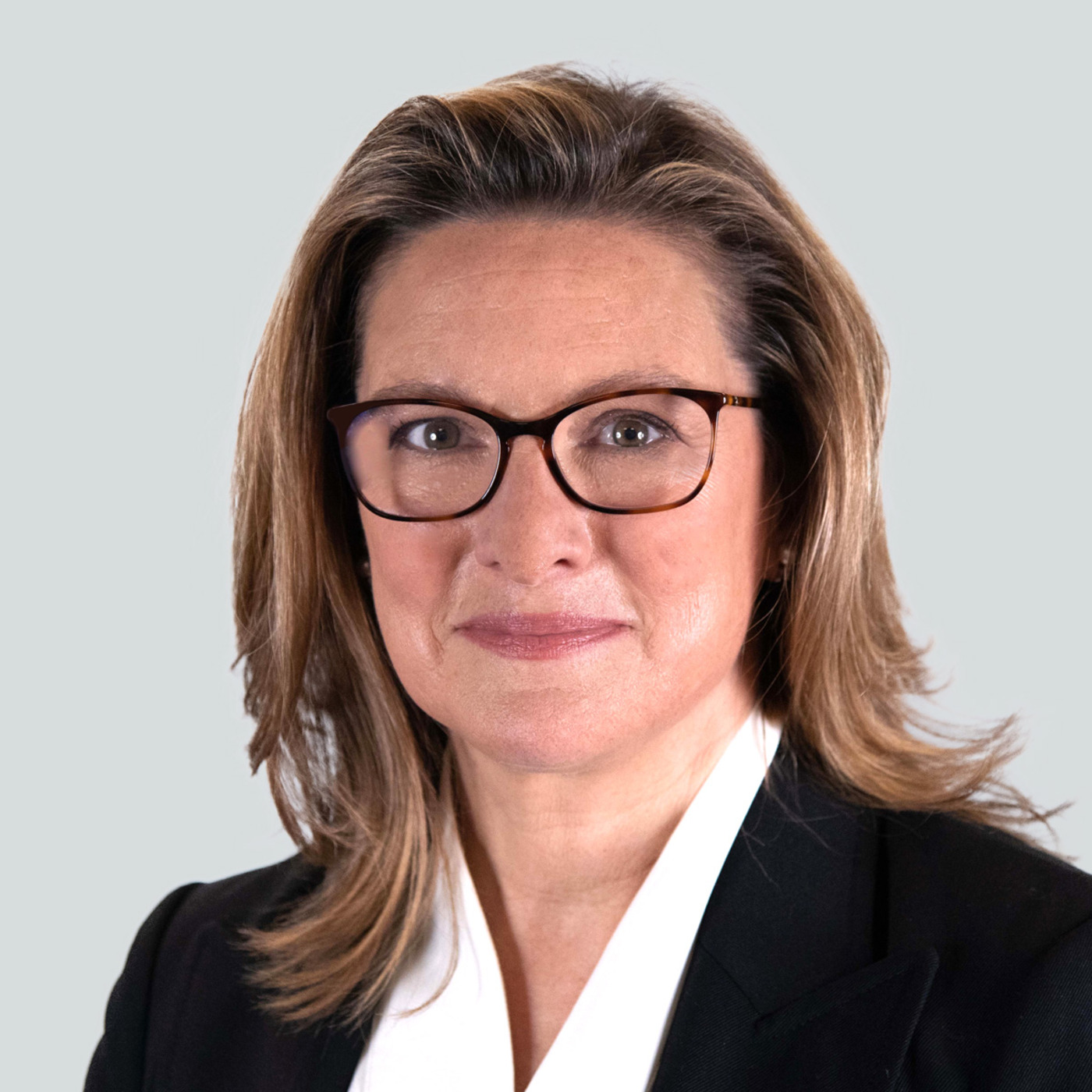
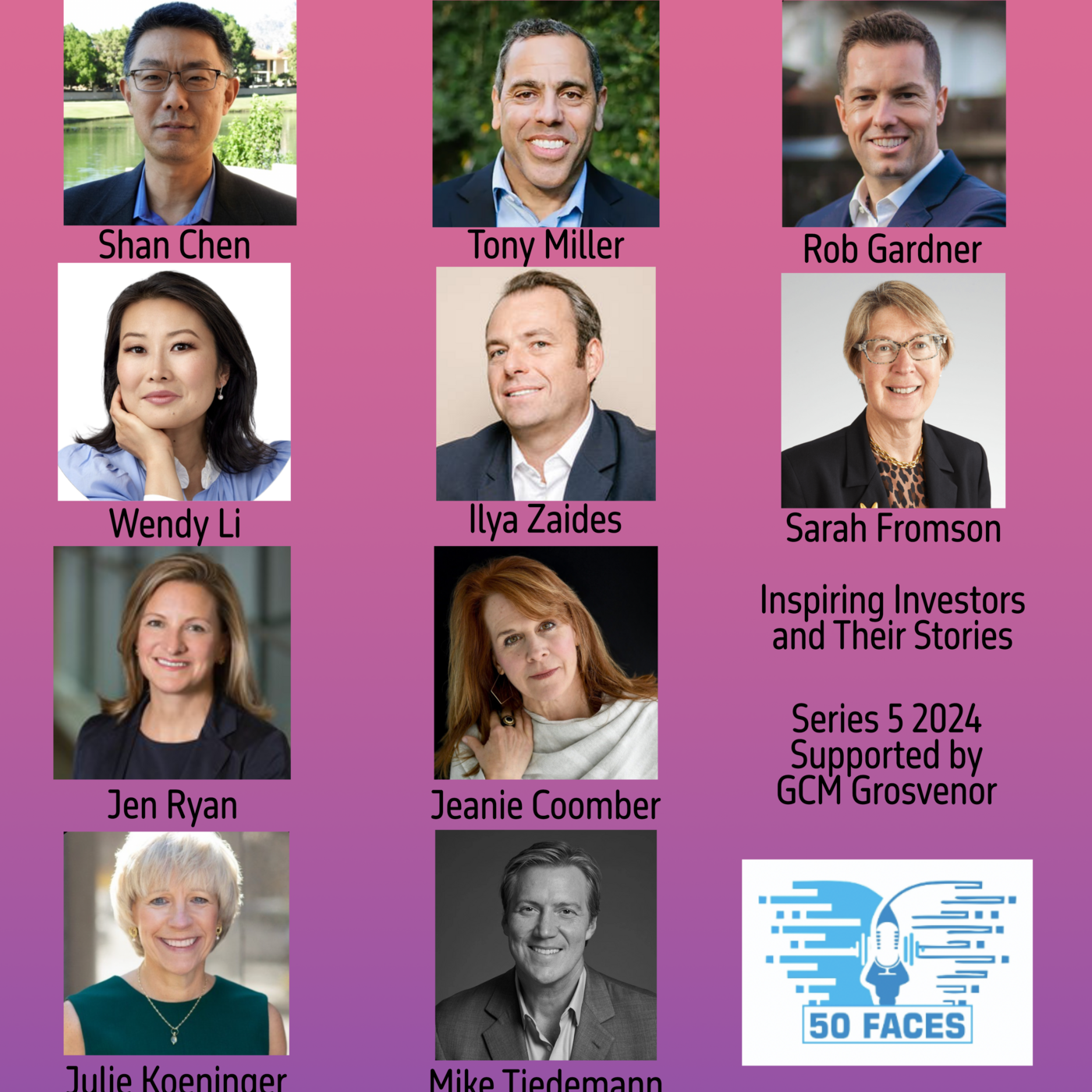
Tony Miller: It has been a highly charged summer between the big year of elections, a series of political and geopolitical surprises, and a few market shocks. It has been anything but the silly season. We’ve launched a few episodes of 50 Faces TV focused on investor identity and responsible investing, and we have continued covering the issue of maternal mortality women in sports, and other matters close to our hearts. Now we are back to our main series for Series 5, and we are delighted to bring you another 10 inspiring guests who share their insights on careers, markets, overlooked opportunities, and advice for fulfillment in life and career. First, on investment topics, tune in as we cycle through investment opportunities in fintech and consider the implications of AI as an advisor.
Speaker B: I do think that It’s going to be a long time before, to your point, any of this technology really supplants human judgment.
Tony Miller: And think about how it can help allocators.
Speaker C: We get a lot of information as allocators. You got hundreds of emails in the morning, the PDF, the pitch book. In the due diligence phase, you open any data room, just think about How many files? It’s not realistic for a human to review all the documents. AI can really help.
Tony Miller: We go back to school with Tony Miller of Excolare, exploring the opportunities in investing in education.
Speaker D: I think one of the challenges in education in particular, human capital broadly, is having an innovative solution, having a better product, right, is necessary but not sufficient. It needs to be a product that can improve learning, but it’s got to be a product that improves learning and can scale across 10,000 school districts if you’re talking K-12, across 3,000 higher education institutions.
Tony Miller: And talk about how we can learn from incentives and what really matters.
Speaker E: First two letters of merger is me. So you absolutely need to recognize that everyone is evaluating the change and what it means for them individually first and foremost. And if you don’t respect that, then you’re not really fully grasping what that change means to every single person in the organization.
Tony Miller: We hear about the challenges of being on the front lines and dealing with clients.
Speaker F: I do think that in the role of being on the front lines, your job is to really distill down messaging, make it easily understood, tailor it to your audience, understand what they care about, and then let them guide you in terms of where they want to take the relationship.
Tony Miller: We discover opportunities in investing in agriculture.
Speaker F: The whole idea of natural capital, farmland and timberland, you know, sequestering carbon. We’re, we’re able to feed the world. We want to do it sustainably. We’ve got to do more with less. And farmland has also proven to be an inflation hedge. So there are a number of reasons to include it in a portfolio. However, because it’s illiquid, it’s been difficult to develop products that really fit a retail market.
Tony Miller: Some of our guests speak about how they have navigated through some uncomfortable cultures.
Speaker G: I joined the city in 1980, and basically it was the era of the dinosaurs. It was only 5 years past the 1975 watershed when women were able to open bank accounts in their own name. Can you imagine that? Younger women today can’t even think of that, and, and I’m glad they can’t.
Tony Miller: Rob Gardner speaks about the woeful situation around savings and pension pots in the UK as he advocates for better financial literacy through a formula of earn it, keep it, grow it.
Speaker H: Maybe just to give the listeners the scale of the problem in the UK, 1 in 7 adults have no savings at all. 1 in 3 have less than 1 month’s in savings, 1 month’s living expenses in savings. So they can’t go more than 1.
Speaker C: Month.
Speaker H: You know, once if they lose their job. The average pension pot of a 40-year-old in the UK is £15,000. That’s not a year, that’s full stop £15,000. That is just way too low. That is definitely sort of inadequate.
Tony Miller: And finally, you won’t want to miss the wisdom that is liberally scattered throughout this podcast series, including wisdom from parents.
Speaker I: My dad was a big influence on me in terms of the way I think. He used to always say, you know, what do you know for sure? Or take things back to formula. So if you had a question about how something worked, dissect it back to what do I really know for sure here? You know, usually the problem is fairly simple.
Tony Miller: And from an executive coach, don’t resign.
Speaker B: Yourself to what you think you know. I feel like a lot of people make an assumption or an assessment of a situation and then they move on. Don’t resign so quickly. Sit with it and sit with the discomfort. Sit with the tension. What’s that expression? Breakdowns lead to breakthroughs. I’m really encouraging people to be courageous and have tough conversations.
Tony Miller: We look forward to sharing Series 5 with you. You can find all of our podcasts on the 50 Faces Hub, Apple Podcasts, Spotify, or wherever you get your podcasts.

Aoifinn Devitt: Public awareness is not just about education and textbook and this happened in this far distant country or to this one person or this one athlete. This is something that is happening to all of us that we are not being heard, right? So we’ve constantly talked about amplifying our voices, being brave about doing so. So I would just want to pull that caveat into what we mean by public awareness I’m Aoifinn Devitt, and welcome to the 50 Faces podcast.
Tiffany: In this focus series, we are focused on women’s health and maternal mortality in particular, and I’m delighted to be joined by Tiffany McKeever, who’s the founder of Consensus Healthcare Consultants Inc., which provides strategic advisory and innovation in the healthcare industry. As an entrepreneur focused on population health, equity, and women’s health, Tiffany’s innovation has been acknowledged by HIMSS with an appointment as one of the future top 50 Class of 21-22 innovators in the patient leader category for maternal health strategies and applications, and the top 200 femtech personalities globally. Prior to founding CHC Inc., Tiffany gained extensive experience in strategy and technical operation with experience over 20 years in big pharma. She’s passionate about startups in Israel and serves as president of Philadelphia-Israel Chamber of Commerce, which supports collaboration between regional US partners and Israeli companies. Welcome, Tiffany. Thanks for joining me today.
Aoifinn Devitt: Thank you for having me.
Tiffany: Well, this is a series about maternal mortality, and I’d love you to set the scene for us a little. Can you talk to us, starting from a high level and getting into definitions, about the scope of the maternal mortality problem in the US as we sit here in 2024?
Aoifinn Devitt: Sure, most certainly. So I just want to give a little bit of background to our listeners. So maternal mortality in the US is a significant public health issue with multifaceted causes. Federal agencies in the past have been quoted by saying it’s a very complex system to look at. And what I understand just from research is, is that in addition to the healthcare service delivery itself, our social systems themselves are actually complex and ever-changing. So this causes lots of challenges in the maternal mortality problem. If we actually look at the formal or universal definition of maternal mortality, it’s defined as deaths due to complications from pregnancy or childbirth occurring during pregnancy within, I guess, 42 days is what the global component is. We’ve since had some legislation that has changed in the United States that has moved that end of pregnancy date through 365 days. We can talk about that at a little bit of a later time as I just wanna go over some definitions right now. And maternal mortality ratio, which is also known as the MMR, is the number of deaths per 100,000 live births. So when we look at the current statistics in the United States, one of the highest maternal mortality rates is what we have among developed countries. And the MMR has been increasing over the past few decades, contrary to trends in many of the other developing nations. And what we’ve even seen is, is that some of the metrics that have come out post-COVID have significant concerns for us that those numbers have somewhat, in fact, doubled, particularly in the African American community with most of the maternal mortality deaths now over 80% and all of them likely preventable. And that was just actually published this month. And the United States, I guess, overall still continues to have the highest rate of maternal deaths of any high-income nation. And just to give you an example, some of the last metrics that we have, because the way this is bundled, we get the mortality review boards that review this each year or so. And some of the latest numbers that we had over 2022 is, is that approximately 22 maternal deaths in every 100 live births in the United States, which is far above rates for any other high-income country. The US maternal mortality is lowest in Asian American women and it’s still highest in African American women. So, someone like myself was very passionate about Black maternal health. I want to just talk a little bit about how I actually found myself in the space. If you don’t mind, we can chat about that a bit. In 2018, I was moving around. I’d started Consensus in 2017. Really, as you mentioned, me leaving the pharmaceutical space to really look at healthcare disparities and population health in our community and find out how I could better serve the community. And of course, in 2018, the maternal mortality numbers were published quite significant that I was 3 to 4 times more likely to die in the maternal health space here in the United States. I live in New Jersey. Our number is 47 out of the 50 states. So quite significant concern there. And at the time, I had 5 children. So as we looked at these stats, it’s the first time that you sort of catch your breath and say, wow, is that significant risk in some places? But I think what stood out most to us was the fact that highly educated women who actually had access to resources were still part of this number and still part of this preventable number. So that’s what really made me carve out a segment in Consensus Healthcare and population health specific to women’s health, and then of course specific to maternal health, focusing on healthcare inequity. So all of these numbers and these statistics that we see are quite alarming across the US in general for women’s health. But to just see it exacerbated, you know, in the community.
Tiffany: Just one of the areas in terms of definition, which you pointed out to me at our first discussions and I thought was so relevant, was that we talk a lot about death, but actually maternal injury, you said, is something that rarely gets measured and that can in fact be as certainly quite traumatizing and, you know, can be debilitating. When you speak about these numbers, are these just death numbers? Are we talking injury as well?
Aoifinn Devitt: So the injuries number, some of the numbers that we’ve seen in some of the zip codes, particularly in New York State, has an injury rate of 60% for African American women, which is a huge percent. And, you know, all of this really starts to tie into our experience in healthcare overall, right? And if those are some of the complex situations that we see, I think we have to get less sensitive about the structural components of healthcare, how it’s delivered in the US. We have to get truthful about racial bias that we have in the system. And in addition to that, you know, when I’ve done some of my studies here in the healthcare analytics program at Rutgers, we really started to look at the future of patient adherence and what that would look like from a policy standpoint and really where we’re able to sit with that. And is that a risk to us as African American women who are injured at 60%? How are we ourselves responsible for those white coat syndromes and all of the things that come with that where the onus is constantly pushed back to us about our healthcare system in the system that we somewhat don’t control. So those injury rates are where we start to hear the community start to talk about healthcare outside of the US healthcare system, where doulas and birth partners and all of those things, those advocates start to come in heavily. And we’ve had some sense of response for that with expansion of doula care, particularly in our state, but still have some access issues that we’re hearing in the periphery. So thank you for bringing that up because that 60% injury, right, we can come home and still have these issues in terms of how healthcare was delivered to us. And, you know, back to 2018 when we, we received the stats, it’s interesting when we talk about birthing partners because we were going through some of the things that were happening to the women at the time. And I have these 5 children and, you know, I’ve been married and I’m with my husband now 32 years. And I remember him saying, you know, Tiff, you went through some of that. Like, you were having the baby, but I was with you. And I remember the nurse not giving you pain medication. I remember them in a nurses’ meeting just as you delivered our first child, and someone forgot to write your script for your anesthesia. You just came directly off of anesthesia. It was my first delivery. It was quite painful. And my husband was running around trying to find the nurses, right? This mistake had happened. So that birthing partner piece, doula, whether you’re coupled or not, is very important. And he’s talking about a birth that I had at that time 23 years ago.
Tiffany: With a 23-year-old daughter myself, I know that time. And I suppose one of the conundrums that we’re facing is it’s one thing not to improve because we all know that improvement takes intentionality, it takes dedicated policy response, it takes follow-through, it takes funding. But to disimprove in this way, for the numbers to deteriorate, To what can you attribute that? Because you would think with the more connected world, more media coverage of these events, or maybe not, but certainly more awareness in medical education, that these at least should be becoming more front and center. Why are we deteriorating in terms of these numbers?
Aoifinn Devitt: Well, I think we look at the medical education in the US and, you know, we’ve been quite critical of the medical education. And candidly, I’ve had physicians say to me, We have challenges dealing across multicultural communities. We really need help and support in doing this. Some of the comments that I’ve received is, is that they spend a large amount of their time on social determinants of health conversations. When that walks through their door, they have a percentage of it that is clinical, which is a small percentage of it, particularly in the maternal health space. But the rest of the conversation is really around cultural congruence and social determinants of health, which is where you talked a little bit about the HIMSS award. What we really looked at from those insights— I can’t change the medical associations right now, how they roll out healthcare in the United States. But what I can do is provide tools that give patients early access in education. I can connect them to social determinants of health to take that out of the physician space. And then from there, I can connect them to community components where we’ve looked at some research where peer-to-peer engagement through healthcare service delivery helps increase some of our numbers. So depending on what it is that your state is doing and what your hospital system is doing, and then how much your physician group and the leadership and administration is advocating for that, particularly in safety net hospitals, right, where we see under-resourced, underrepresented patients. That is what is causing some of the numbers because that’s the crux of the healthcare system. The social components ebb and flow. So this is somewhat what I call the ghost in the system, which is really evident to us. And we cross out of healthcare from this point and get really honest about wealth in the United States, about payer models in the United States, about the iron triangle and triple aim around cost, access, and quality. And whether we really believe that for you to get good healthcare, it has to cost you lots of money. For you to get quality healthcare, it has to cost you lots of money, and those different types of things. So of course, in the economics, transportation, nutrition, education, behavioral health, which is a significant component of that, which we really haven’t talked about too much in the US. I don’t think that we’ve done a great job around mental health in the US, but that postpartum depression pieces of it is what’s extending us down into that 365 days. So we have to get much better about that. I think we can do better in talking about suicide rates and things like that. But if I was to pull us back through a clinical standpoint, we know the comorbidities that we have in the healthcare space, particularly in maternal health. And we do have some ghosts in the system like preeclampsia. It’s very scary. Like when we see these, when we get beyond the wealth and we say people have money and there’s physicians and You know, in 2018, African American women were the most educated. I think we may still hold that space in terms of the maternal mortality deaths. Most educated, most wealth at the time, still had this stark disparity. And you see it in athletes and all of these other things. And you say sort of, sort of what is that? I start to look at the structural pieces of the OB-GYN bundle. Now, there’s been some conversations that are from OB-GYNs to say, we almost want you to go to high risk because then we can see you more often and we can get over the addendums and all of the other kind kind of things. But that’s not really the way that I want to do healthcare. And we talked a little bit about my time in Israel and startup, but prior to going into that startup space, I was with academia and research in a very public healthcare system in Israel. They have 4 HMOs, but because they’re not actually run by ICD codes like we are here in the United States with bundles and different time points that we have to wait to see patients they’re able to research in a different kind of way. And some of that research, just to give an example, is a biomarker that sits at a time point that we never look at in the United States that is very much tied to hemorrhage. Now, if I was able to bring that biomarker, put it in a technology, source for it, and then find that at a certain time point, when we look at these maternal deaths and hemorrhage being one of the second or third in terms of what happens with unnecessary C-sections. We save so many lives.
Tiffany: And when it comes to funding, so you talked about if there seems to be a biomarker that relates to hemorrhage and if you could get, I suppose, the funding or the support to research that and to actually get that tracked. How do we bridge that gap? And I know we’ve spoken with other innovators and entrepreneurs, including from Israel, on this podcast, Karen Leshem, Maura Rosenfeld, And this is an ongoing problem. We’ve compared the status there and their healthcare system. They, they still have people who fall through the cracks there. Some of it’s cultural as opposed to based on, on race, but there’s still gaps. But there’s also a much more, I suppose, joined up nature of these efforts. What do you think is the funding gap? What would it take to get at a national level the attention to this area? Because every so many different strands of medicine are competing for funding.
Aoifinn Devitt: Mm-hmm. Yep. And when I created United We Raise during the COVID era, I talked to a lot of companies that work with payers. And the payer said to me, Tiffany, you’re 10, 15 years ahead of us. We’re not ready yet. The funding is not ready yet. We’re not ready. We’re not ready. We’re not ready is what we heard. What’s interesting is that as I’ve traveled globally, these researchers are actually in DC with us. They’re at the NIH. They’re at the CDC. They’re sitting on these steering committees. So my question to them was, so how are you here in the US with us, and for some reason or another, this has not moved to policy, this has not moved to the payer groups, this has not moved to the funding sections, these metrics? And I think what you have probably heard from Karen and from Maura, who are good colleagues and brilliant women in the space that they are, is, is that it’s really around the tension that we get in women’s health or the tension we don’t get in women’s health, right? I worked in the pharmaceutical space for, as you mentioned, over 2 decades. And I’ve run clinical trials, serious adverse event reporting, all of those different types of things. And it’s really about how we look at women in society, first of all, right? How we look at health outcomes research in ICER, how we price drugs for us, if they’re for us, right? How are we in clinical trials, all of that. So those are some of the root cause pieces of that. So to pull that all the way into funding where us as startups go into a funding space primarily with male funders talking about something in women’s health, it’s to somewhat of a degree a foreign concept to them. And those are, those are some of the challenges. So I’ll say, do these institutions have an equivalent ear, right, to it when these experts say something like, We see a biomarker at week 17, and in the United States, that patient isn’t coming in until week 20. And when she comes in through week 20, we know what happens at week 20, right? We take the diabetic drink, we do our diabetic tests, we get some genetic screening, those different types of things. But we would have had the option to see that biomarker 3 weeks earlier and then have that reported to us, right? Should you be high risk and need a cesarean section? These are some challenges and some things that we need to look at for you postpartum. And, you know, we wouldn’t go home in 3 days’ time and then wait for a 1-month checkup.
Tiffany: I suppose what would you like to see as action items? We know and we’ve discussed on previous podcasts some of the funds that have been put aside by the Biden administration and committed to women’s health. We have private philanthropists like Melinda French Gates, who is dedicating a fund to female founders that may flow through into women’s health through the tech venture that they perpetrate. What would you like to see as a list of action items that you think would gain bipartisan traction?
Aoifinn Devitt: Yeah, so I think some of the pieces since we dived a little bit into women’s health and down into maternal health, into Black maternal health, I’d like to move through this ladder of inference and the way we talked about funding and we talked about research down into funding. What I want to also talk about is the policy pieces itself and how we actually change that, which is how we distribute the money and how we look at underrepresented and under-resourced populations and why we do it that way. When we look at this funding and you hear it in the startup world, you know, Europe and the US, you’re going to have your ROI there. And I often talk about funding below the equator. Is how I, how I think about it. And it’s a little bit of a paradigm. Obviously, it’s not directly under the equator, but I think people understand what I’m saying about it. Some of the comments that we received when I actually moved into this space was because we were African American women, no one would invest in us. No one invests in African American women, and no one definitely invests in African American women health. So we looked at it as under-resourced, underrepresented, and of course they categorize us immediately as mission. And I think that when we look at it in that lens, when we look at research in that lens, when we look at funding in that lens, when we look at distribution in that lens, that is what is the crux of the issue of what is happening with us, right? And I think the design of looking at the African-American woman who can be wealthy and still be found in these places is some of the issues that those organizations have not looked at yet. Look, I was in pharma for 2.5 decades. Our household was at $500,000. If I lost that and lost COBRA, if I lost my job, lost my transportation, all of these other things, and then suddenly found myself in a federally qualified health system just so that I could get healthcare, pregnant, and then loss of life, you may not see that full trajectory of how that actually moves. And I think those nuances is what the United States actually misses when they distribute this money, because there’s no governance around weighting the population and how the actual healthcare is delivered. We just go right back into the medical textbook.
Tiffany: Fascinating. So tell me more then. So that’s perhaps African American women as a whole. What would be on your wishlist to change this?
Aoifinn Devitt: There definitely has to be policy change advocating for things like cell gene therapy. And we look at personalized medicine. I would hope that we would have some personalized social design that actually happens as well. We don’t need it person to person. Do we need it as group to group? That’s fine. Let’s stratify us in some kind of way that we at least feel whole. We’ve looked at healthcare reform in the United States. We looked at Obamacare. And yes, people got access. Was it really far away from home? I mean, I have a disabled father that I take care of. Yes, he had access, but I had to take him 55 minutes away for the services that he needed. Someone else may not have that opportunity to do so. So I think some of those policy access in a comprehensive way to match if we’re going into the future of personalized medicine has to happen at a social standpoint as well. And this is really about healthcare system reform and improving healthcare delivery. In addressing those systematic inequities that we have. And then as I mentioned before, you know, the onus is on us as well too. I mean, I say that sometimes in these spaces and women say, you know, we really don’t like that narrative. This is some things that are happening to us. And, you know, Consensus has taken the stance that it’s our responsibility too, but it’s our responsibility to educate and provide public awareness, which is why I do what I do, right? Why I’m passionate about what I do. So increasing awareness and education around things and maternal health issues is critically important. So when we see these startup companies that are doing that in multiple ways, in all of the parties that are doing healthcare service delivery, that is another degree of the design that we really have to look at when they are distributing money to people. It can’t go to just friends. It can’t go to just large systems that are part of the lobbyist group that look at it. I’ve looked at large amounts of money go to zip codes where We aren’t even there, and the number is not as disparaging as other places where they could be distributed. Has anyone looked at where there isn’t access down in the lower South, but they’re under the Bible Belt and birth control and all of those issues? So all of these things sort of lead up, you know, the debates were just last night and we were looking at somewhat of this discussion around Medicare, which I wish was flushed out a little bit more. Giving me really deep concern. But even those distribution channels need to have that sort of comprehensive look about how this money is used and how it’s distributed. And I think it’s important not to just distribute money for the sake of distributing money, which is— I don’t want to get too political, but for sort of tax curves or tax harbors in the space or sort of feel-good mission work. But we really have to get to healthcare and change our lens to do this for America.
Tiffany: And I think you make an excellent point. It’s almost like this needs to be a pincer motion in the sense that we cannot wait for policy change to get where it needs to get to. We cannot wait for equity in distribution or in recognition or in funding. There should be equity. I think we all know that. Whether we’ll see it in the next decade is another question. But what we can do is grassroots community movements. And one of the previous podcasts, Adonica Shaw, who spoke about My Wing Woman, again derived from her own experience. And I think that her own experience in receiving less than adequate healthcare led her to seek out a community whereby they could put language on their trauma, educate, heal, and build awareness and visibility. And that just came from grassroots. And it seems that it needs to be this kind of a pincer movement because unfortunately waiting for one side to get to where it needs to get to will not be adequate. So I have been, I think, humbled by what I’ve seen in the community of women who have suffered through negative healthcare events to rally and use this experience to do the better good in terms of ensuring that other women don’t have to go through this trauma.
Aoifinn Devitt: Yeah, I just wanted to just pull back a little bit to the point where you mentioned Wingwoman and Adonica Shaw. Since we’re talking a little bit about our global access and reach, I was one of the managing directors of the MedFemTech Congress. In Paris, France in May last year. And somewhat of the design that we did for this particular conference, which was important to Consensus at the time, was Voice of the Patient, which is where I met Adonica and I was able to interview her and to put these 6 women on the stage to really talk about what our healthcare experience is like. I can tell you that by the time these women finished with various experiences, I mean, all different cultural country differences, on this stage, there were physicians standing in front of us who had walked up to the stage because it was so powerful what these women had experienced in healthcare service delivery. And I think we need to talk about it more. Public awareness is not just about education and textbook and this happened in this far distant country or to this one person or this one athlete. This is something that is happening to all of us. That we are not being heard, right? So we’ve constantly talked about amplifying our voices, being brave about doing so. So I would just want to pull that caveat into what we mean by public awareness. And then I very much agree, United We Raise is very much grassroots. We realized that that was really the only way short of delivering babies at our home, right? But still really realize that should there be an emergency, we would go into that Western healthcare system. So where consensus at that juncture really sat on the spectrum of the maternal health space was really around data. 1 1 is always 2. I’m not gonna have these bipartisan arguments or nonpartisan arguments around what Democrats are saying versus what Republicans are saying. Are these numbers really real? Are they inflated? Was COVID real? All of these different types of things that happen in the healthcare space. That really stop and halt the conversation. And in Consensus, we’ve seen that because even in the sales cycle of United We Raise, a particular hospital that we were working with, just the 2 years past COVID, we lost a woman every month in that hospital system, every month. And then there’s another— I want to say there was another 6 or so that were really at high risk that were able to be saved. So these are real numbers that we are looking at, and we’re just really trying to— really, really trying to find the solution. There are instances where we are given information, just to pull back a little bit to the voice of the patient experience, where we can think we’re really educated, and a physician tells us something. And we had someone on the stage actually lose her children because where she read the medical paperwork She thought that she could just go to a clinic for some blood work the next day, and it was actually supposed to be translated as stat, like right now, go to the emergency room. So these mistakes that happen, how she could go a whole evening without that physician saying, we didn’t get a report from the emergency room, those types of things are just gaps and errors that are happening in the healthcare service delivery design. All of that to say of what I would like to see in the future, I don’t want postmortem reports from the maternal morbidity board that just sort of says, this is what happened, this is what our numbers look like, this is what we’ve seen. And then we do that again next year. We need some practical components where we are actually tying our investors to those outcomes that we saw and saying how we’re solving for them. And I think there’s significant opportunity. We can tell from this podcast lots of things that we can do just to pull us back to what is being defined as so complex. And in recent, I guess, months or so, probably about a year and a half or so, I’ve looked heavily more at policy and having some function down in DC because I can see great technologies that are coming to the forefront that are just not making it through because of the very lenses, the multiple lenses that we have talked about on this podcast.
Tiffany: Thank you so much, Tiffany. This series started 10 months ago with the tragic story of Tori Bowie, the Olympic sprinter who was found dead at her apartment at 8 months pregnant, having gone into premature labor. And my hashtag I used at that time was #RememberHerName. And I think you mentioned postmortems. I also don’t want to read any more about any more postmortems. I think we have to remember the names of the victims, that the cases, their case studies and their details, because it is only by remembering and these stories that we will be reminded of the triggers and not to have that happen again. So thank you so much for the work that you’re doing, both on your own, but also by supporting startups and founders who are committed to new technologies in that arena. And thank you for bringing together so many advocates of this important cause. Thank you for coming and sharing your insights with us.
Aoifinn Devitt: Yes, thank you so much for having me.
Tiffany: I’m Aoifinn Devitt. Thank you for listening to the 50 Faces podcast with this particular focus on maternal mortality within the framework of medicine and science. If you liked what you heard and would like to tune in to hear from more experts in this field, please tune in to Apple Podcasts or wherever you get your podcasts. This podcast is for informational purposes only and should not be construed as investment advice, and all views are personal and should not be attributed to the organizations and affiliations of the host or any guest.
Aoifinn Devitt: So that sort of drive to do your best is an amazing thing, but it also, it can have a negative side to it as well.
Tammy: I’m Aoifinn Devitt, and welcome to the 50 Faces Podcast. A podcast committed to revealing the richness and diversity of the world of investment and beyond by focusing on its people and their stories. I’m joined today by Tammy Parlor, who’s the co-founder of Women’s Sports Trust. She works with leaders from across sports, media, and business to understand how to practically raise visibility, increase impact, and create a stronger women’s sport ecosystem, and was awarded an MBE in 2019 for services to gender equality in sport. She’s a master in the Korean martial art of Hapkido, having practiced for over 40 years, and currently runs a club in central London. She loves learning and is a club rep on the FA Women’s National League board since the end of 2023. Welcome, Tammy. Thanks for joining me today.
Aoifinn Devitt: Oh, it’s lovely to be here. Thank you.
Tammy: Well, let’s start with a little bit about your background. Can you tell us about your journey into sports and now the work you do as an advocate for women in sport? How did it start and did it take any unusual turns along the way?
Aoifinn Devitt: Gosh, I think life is unusual sometimes. I think beginnings of something can sometimes be quite subtle. So it wasn’t about ever really about creating an organization or creating transformational change of a system. It was just life. I grew up in America. We moved there because of my dad’s work. There’s a phrase that I’ve heard called third culture kids, and I really think that applies to me. These are people people who are raised in a culture other than their parents or their country of nationality during a significant part of their child development years. And for me, that was age 11 to 22. And one of the challenges of being a third culture individual is sometimes a feeling of being other or not belonging. But it also means that you’re aware of other perspectives and may look at things slightly differently. And these factors can play a big part into identity and self-esteem when growing up. So I don’t know where it came from, but age sort of 12, 13, I suddenly decided that I wanted to do a martial art. And it so happened that there was a Korean grandmaster who was about a 20-minute drive from the, the suburb of Chicago where I was growing up. And I started there and I never stopped. I found my identity there. I found I grew in self-esteem doing this martial art, and it became a massive part of my life. I left America unexpectedly. I had immigration problems in ’93, and by that time, Hapkido was just— as I say, it was part of my identity. It was a big part of my life, and the only way really to continue it and to continue being a student of this, um, amazing grandmaster was if I started to teach. And by that time I had been teaching classes at his studio. I was black belt multiple times by that time as well. So I started a club and I just continued. And come— I think it was around about 2004, I— for a long time I had felt that I want to be a master of the art. I wanted to do this full-time. I just— it was me.. And I, I thought, if I don’t do this full-time, I’m gonna get to an older age and I’m gonna regret it. So I took the plunge and started full-time running my martial arts academy. And I you was, know, incredibly successful. I still run that academy, not on a, a full-time basis anymore. Being a sportswoman, a coach, was my identity. But when London 2012 hit, the Olympics, I came to London, sport took on a totally different, an additional purpose to me. And that’s where the sort of foundations of the charity that I run, the Women’s Sport Trust, started to develop.
Tammy: That’s fascinating. Well, I want to dive in quite a bit to martial arts and what it does to a personality and how it infiltrates the rest of one’s life. But you mentioned you made the decision to go full-time But did you have other interests and other professional pursuits before you made that decision?
Aoifinn Devitt: Yeah, so my background is learning development, which I suppose that the constant thread in my life, you can look at my career and is, it it’s kind of a bit, some maybe a bit higgledy-piggledy, for instance, but I think the constant thread is that learning and that desire to unlock potential. So first in my learning development role, I spent, gosh, almost a decade with The Prince’s Trust, which was all about young people and unlocking potential. Then as martial arts master, now as Chief Exec of the Women’s Sport Trust. So this has been— that whole learning has been a constant sort of side to me. I mean, when I was a kid, I wanted to be a computer programmer, an accountant, or a teacher. And I think actually all of those bits are actually in what I do. I’m, I’d say, a little bit of a jack of all trades. I’m a bit of a geek, but this theme that runs through is just all about unlocking potential in the individual, and, and now in my role with Women’s Sport Trust, in a system.
Tammy: Well, let’s go back to that now, the unlocking of potential. So I also know intimately the suburbs of Chicago and finding that studio to find hapkido. What I suppose drew you to martial arts and how did it form you?
Aoifinn Devitt: Gosh, I don’t know what drew me. I mean, I often get asked this question. I have no idea. All I remember is I woke up and I was saying to my parents, I want to start karate. I hadn’t heard of hapkido before, so I, I honestly don’t know where this came from. But what I found within the studio was not just the physical pursuit, but also its martial arts, particularly the way where I was learning with a Korean grandmaster, was very much about mind and body. So he is the son of a Buddhist monk, and very much, as well as the physical side, very much lectured on Taoist philosophy, Buddhist philosophy, etc. So I was quite an unusual kid. So from, well, once I began to be able to drive by myself, which is in the US at 16, I would be at his daybreak meditation classes that started at 5 o’clock in the morning. I mean, that’s unusual for a 16-year-old, but there was something that— it really spoke to me on every level. And what I love about it now, it continues to challenge me. It’s a martial art that has many different aspects to it, and so there’s always something that you’re bad at, there’s always something that you improve. And intellectually, it keeps me interested. It’s, it’s all about how a body moves, how a system moves, and how by just the principles of things like non-resistance, circular motion, etc. It’s about life, it’s about understanding life, and, and the club and the school is almost a petri dish for life. So it’s really touched me on so many levels. And also, if we go back to my original story about sort of moving to another country, it was— it touched me on identity. It was where I, I felt comfortable as an immigrant. It was somewhere where I was accepted. I’m an introvert, so it was a place where I could quite happily just sit there and not talk, but people would still like me. So yeah, funny old thing.
Tammy: And I suppose when you think of martial arts, there’s some initial things we think about in terms of, say, discipline, respect for oneself, for the self as well as for the master. I suppose goals, resilience, Any of these things that you think are particularly important today for young women and for the work world we’re in today?
Aoifinn Devitt: Yeah, I think martial arts are really interesting. As I say, the petri dish, the idea of discipline through the Buddhist and Taoist philosophy, etc., the importance of self-awareness and introspection, the, the importance of mastering oneself, letting go of attachment to external conditions, whatever, whatever you want to call it, and, and the Beauty with martial arts as well is this grading system, whether these goals— you go for another belt, etc. So there’s that motivation is almost sort of built into it. And the other thing, particularly in the traditional martial arts, is there’s an expectation as you move towards black belt, and definitely as black belt, that you start to become a leader as well. The simple things, but they’re massive. Like, for instance, whenever anybody comes to the club to watch a class, to, to see what it’s about, Everybody will go up and introduce themselves and please welcome, et cetera. So there’s a real culture about helping others and being interested in other people’s improvements, which is a wonderful, wonderful thing to develop.
Tammy: It’s so interesting. It’s that whole lift as we climb philosophy that a lot of women on this podcast have demonstrated in their work life and basically kind of climbing the ladder with one hand stretched behind you. Is the image I have in mind. And then in your own competitive sport journey, tell us a little bit about that, maybe some of the high points and low points that you experienced competing at the level you did.
Aoifinn Devitt: Yes, well, my martial arts— I was going to say unique, not necessarily unique, there are others as well— but it doesn’t actually have competition in it. The competition is— it’s, it’s a martial art of self-defense, so it’s about constantly improving, but the competition is seen as yourself and not somebody else. But that definitely been highs and lows, and there were many days that I didn’t want to go, many, but I never gave myself a choice. It’s a funny old thing. I just, this is what I did. So even on those days where you don’t feel like it, etc., that is, you just continue to do. And also through that whole belt system, as a black belt or as, as a master, for me it’s sort of, and I noticed this when people get different color belts as well, they start to inhabit that level. So as you get your black belt, a black belt does certain things, and it was the same with me, you know. I might lack confidence in leading a class, but a black belt does lead class, so I’m just going to have to do it. So those kind of things. When you talk about sort of low points and things, a big struggle was when I had to leave America and had to leave my grandmaster, and it was a case of For me, I thought that was the end. Well, kind of. I also knew that it couldn’t be. Again, this idea of I didn’t ever give myself choice. I was always going to do something. I just had to figure out how. So that, I suppose, the positive side, because it’s driving you forward. But also there’s a negative side to some of that, if I’m totally honest. I was a driven perfectionist, very self-critical of myself. I suffered from anorexia and bulimia between the ages of 19 to, I think, around about 24. So that sort of drive to do your best is an amazing thing, but it also, it can have a negative side to it as well. It’s the joy of learning and striving and teaching, and also the loneliness of, I suppose, when you’re in that leadership position as well, there’s a loneliness that sometimes can come in. So a real mishmash, but I think that’s life as well. I think that’s sort of how life kind of unfolds.
Tammy: And the rough with the smooth, the lows and the highs. And it’s so interesting. So you kind of touched on it a little, but I would imagine there are some mental tricks that you need to stay the course there because, I mean, it’s particularly martial arts is a resilience almost embodied in the practice. So how did you have mental tricks that you use to— it doesn’t seem like you had much motivation issue in terms of going to practice, but in terms of moving on, progressing, sticking at it, which I think for especially for teens, for women in particular. I see this through my own children. There’s a big fall away of women from sports into their high school years and beyond.
Aoifinn Devitt: Absolutely. There’s a big drop-off then. And I’ve been doing my martial arts now consistently for 40 years, which I recognize is unusual. There’s so many points where you can decide not to, and I didn’t. I just kept doing it. It goes back to the one thing what I said before, that idea of for a long time I, I didn’t realize I had choice. I thought that if I made a decision, well, then that was my decision. So I had had to, I to stick at it. So I didn’t realize that. I mean, I know it must sound absolutely bonkers, but that was kind of the approach that I took. I’ve decided, so I would. Later in life, I know I have choice now. I do know I, I could, I could stop it, but I recognize how good it is for me. It’s, it’s not just about the physical practice. It enables me to create good both mental and physical practice. And if we want to be healthy in life, we do need to keep practicing these things. So understanding the benefits, I suppose.
Tammy: I’d love to talk then about the work you’re doing to build a women’s sports ecosystem, and you’ve been recognized for your contribution and services to gender equality. Tell us about the challenges there. And I suppose, what does that look like? And I just harken back to your US background as well, because there is, of course, Title IX there and I funding, suppose, mandates around women’s sport. We also hear a little bit about the increased attention to, say, women’s basketball, women’s tennis, although we’re not there yet with all the sports. Where are we on the spectrum, maybe, of where we could be? And what is Women’s Sports Trust aiming to do about that?
Aoifinn Devitt: Yes, when we started, when we founded the Women’s Sports Trust in 2012, we had this phrase. It was my co-founder Jo that actually coined the phrase, that we wanted to move women’s sport from worthy to irresistible. And really, over the past decade, that has been our journey and our goal. And you look at women’s sport now, and it is in, oh, such an incredible space if you compare how we were 10 years ago, 20 years ago, etc. So we— the charity focuses on the visibility, commercial viability of women’s sport, and also role models. So role models, the media landscape, and the funding landscape as well. What we’ve done over the past decade has really changed as the industry has grown as well. At the start, it was around bringing the ecosystem together. We recognized that the system was in silos. People were pointing fingers, blaming each other. You know, the media isn’t doing this, or brands aren’t doing whatever, but no one’s actually talking together. The other thing was that a lot of the focus on women’s sport was all around grassroots and participation. Now, that’s incredibly important, But what about the elite side? What about leadership? What about commerciality? These parts of the, I suppose, flywheel of the women’s sport industry were in atrophy, or weren’t really being— it wasn’t a space where women’s sport occupied. So the charity, that was our goal, to focus on those areas through elite athlete role models, media, looking at media coverage and, and then the commercial landscape as well. We started by bringing the ecosystem together through awards campaigns, et cetera. Once they started to coalesce, then we were recognizing that the platform for elite athletes was growing, but they didn’t necessarily know how to take full advantage of that. So we developed a program called Unlocked, which was all about giving them a place to understand their voice. Get them heard by senior decision makers, etc. Most recently, we are focusing on data and insight. We did some research, I think it was 2021, that really pointed to the lack of data within the industry. So we took it on board to start bringing this data together, broadcast data, visibility data, and using that as a way to bring together the broadcasters at BBC Channel 4, ITV, DAZN, Sky Sports, whoever, and then the rights holders, social platforms, etc. Everybody, all the decision makers involved in visibility and have those behind closed doors conversations around what’s, what are the blockers, what are the opportunities, and start to sort of shift mindsets. We also started pushing this data out into the ether, and what that’s done is started to change the narrative in that area as well. It’s given the system confidence. And encourage them to take advantage of the opportunity that was being missed. Now we’re also working in the commercial space because, um, there’s still a lot of work to be done. We’ve come an extraordinary journey, women’s sport, but still— there’s we still need more investment, we still need visibility in more prominent spots, etc. As an organization, success for me, for us, is about seeing women’s sport valued, seeing that the industry being inclusive of society, and also seeing women’s sport as leading society positively.
Tammy: And how about the visibility point? Because obviously we are on a journey here to build awareness, get more visibility. How important is it when you have maybe a— the likes of Caitlin Clark in the or, US, you know, Serena Williams, when you have these outstanding performers to move the needle that way, it’s so important.
Aoifinn Devitt: Visibility creates engagement. If you haven’t got a platform, if people can’t see you, they don’t engage. So having that platform in prominent spots, and also these amazing role models— women’s athletes are fascinating, often because they’ve had to get to that point through so many hardships, etc., because of the differences in support for women’s women’s sport sport versus men’s sport, et cetera. So having these role models such as Caitlin Clark sort of come to the fore is really making a difference.
Tammy: And I’d love to move now to speak on another aspect of sport, applied sports psychology, which you’re studying. And psychology, of course, is not only infiltrating the world of sports, but also the world of investing and pretty much every world. But what is it about that What is applied sports psychology anyway? What is the definition and how is it gaining more traction across all sports?
Aoifinn Devitt: Well, I’ve long been interested in psychology, how understanding how, how the mind works and how to again unlock potential in that way. So of course the applied sports psychology course was something. So a decade or so ago, I did decided to do a master’s degree in strength and conditioning. Which really pushed me to the edge. It was a fantastic program, all to become a better coach, a better martial arts master, that I would understand more. After completing that, I still had the bug and I loved learning. I wanted to do more, and I decided to start another master’s degree, the Applied Sports Psychology. I didn’t finish that one. I completed the first year. The second year was all about doing another dissertation and things, and I thought, I’ve just done a dissertation, I I can’t, can’t put myself through another one. So decided to stop that. That said, as a layman, I am incredibly interested in the area, and it’s all about motivation and confidence and dealing with stress and anxiety and those psychological techniques. And it’s essential in sport. It’s all about wellbeing in sport and improving performance. And with the Olympics coming up, I’m sure it’s a, a key part of every athlete’s program to be the best.
Tammy: And I know we’ve seen a lot more attention on mental health as well as also performance in sports through menstruation, which is a problem unique, I suppose, to female athletes. So I think getting more attention of the nuances of women’s sport is also a sign of progress.
Aoifinn Devitt: Hmm, definitely.
Tammy: Moving to some reflections of your own now. So were there any setbacks or challenges across the course of either your practice of sports, your work within sport, or just in life in general that you think you learned lessons from that you can share?
Aoifinn Devitt: Oh my I, gosh, I, I don’t know whether I’ve got a, a set of top 10 lessons or anything, but I can tell you there’s been loads of setbacks. So decided to— after being inspired by London 2012 and the— hadn’t really seen female athletes and, and women’s sport before, knew had to do something, so decided to set up a charity having never done that before, but thought, you know, I’m not stupid, other people have done it, I’m sure I can figure it out, I’m sure that— I’m sure there’s a YouTube video on that somewhere. So it’s been a massive learning curve, from getting charity status to building boards to networking within and understanding an industry that I wasn’t directly involved with, to leading an organization. And I’d say I don’t think the podcast is long enough to list all the challenges and mistakes I’ve made along the way, but thankfully motivated by constant learning.
Tammy: Yeah, so you mentioned working with a grandmaster in hapkido, and I found when I interview anyone who’s played sports at a high level that there is often a massive influence of a coach in terms of the life lessons, just the learnings that come from them, whether it be a grandmaster or other teachers or anyone else. Was there any particular mentor along your journey?
Aoifinn Devitt: Yes, definitely. I started with him when I was 12, 13, so he you became, know, almost like a, a second father. He was very influential. And when I started my club here in the UK, well, I remember writing to him and said, I want to stay your student, I don’t know what to do. And he called me and the conversation went, you set up club, I visit. That was it, that was the conversation. So, okay, okay, I’m setting up a club now. And since that time, 2 to 3 times a year he would come over and grade my students, etc., for many, many years. And that is— that’s huge, especially when you’ve had immigration problems and you’ve been brought back to the UK by yourself. That was a massive, massive influence on my life. We’re setting up the WST. I mean, there’s an industry full of trailblazers, too many to name. That have taught me so much about the industry and so much about how we— and what we need to make change in. But perhaps unusual, but probably a massive influence as well, is my ex-wife, who I set up the Women’s Sport Trust with. She’s a leadership— she runs a leadership consultancy in diversity and inclusion, and, and still an important person in my life. And she has a way of seeing into people and pulling out their best qualities, which has been massive to be able to be seen and the good qualities be seen. So that, that’s sort of huge as well. But I’m motivated less by people and more by vision. If I see purpose in something, then I can see how it can unlock potential.
Tammy: I love that this focus, this core focus on unlocking potential. And I suppose just as a, as a final question, it’s maybe it’s relating to that purpose, But any key creed or motto or purpose statement, word of advice?
Aoifinn Devitt: Yeah, I want to do Nike’s “Just do it,” probably, as most.
Tammy: Well, I think we will leave it in the quiet wisdom of your master, Iviszett. I think that that is, is enough in terms of the vote of confidence and the absolute trust in you and your enterprise. So thank you so much, Tammy, for the service you are continuing to provide to women’s sports to raise visibility and for continuing to rise to the tremendous challenge we have. But I think it’s, it’s so wonderful to have a role model of your stature flying the flag for women in sports and moving it to the next level. So thank you for coming here and sharing your insights with us.
Aoifinn Devitt: Oh, thank you for having me.
Tammy: I’m Aoifinn Devitt. Thank you for listening to the 50 Faces podcast. If you liked what you heard and would like to tune in to hear more inspiring personal journeys, please subscribe on Apple Podcasts, wherever you get your podcasts. You can find all of our content on the 50 Faces Hub, where you will find a library of role models, resources, and other solutions to enhance your career. This podcast is for informational purposes only and should not be construed as investment advice, and all views are personal and should not be attributed to the organizations and affiliations of the host or any guest.



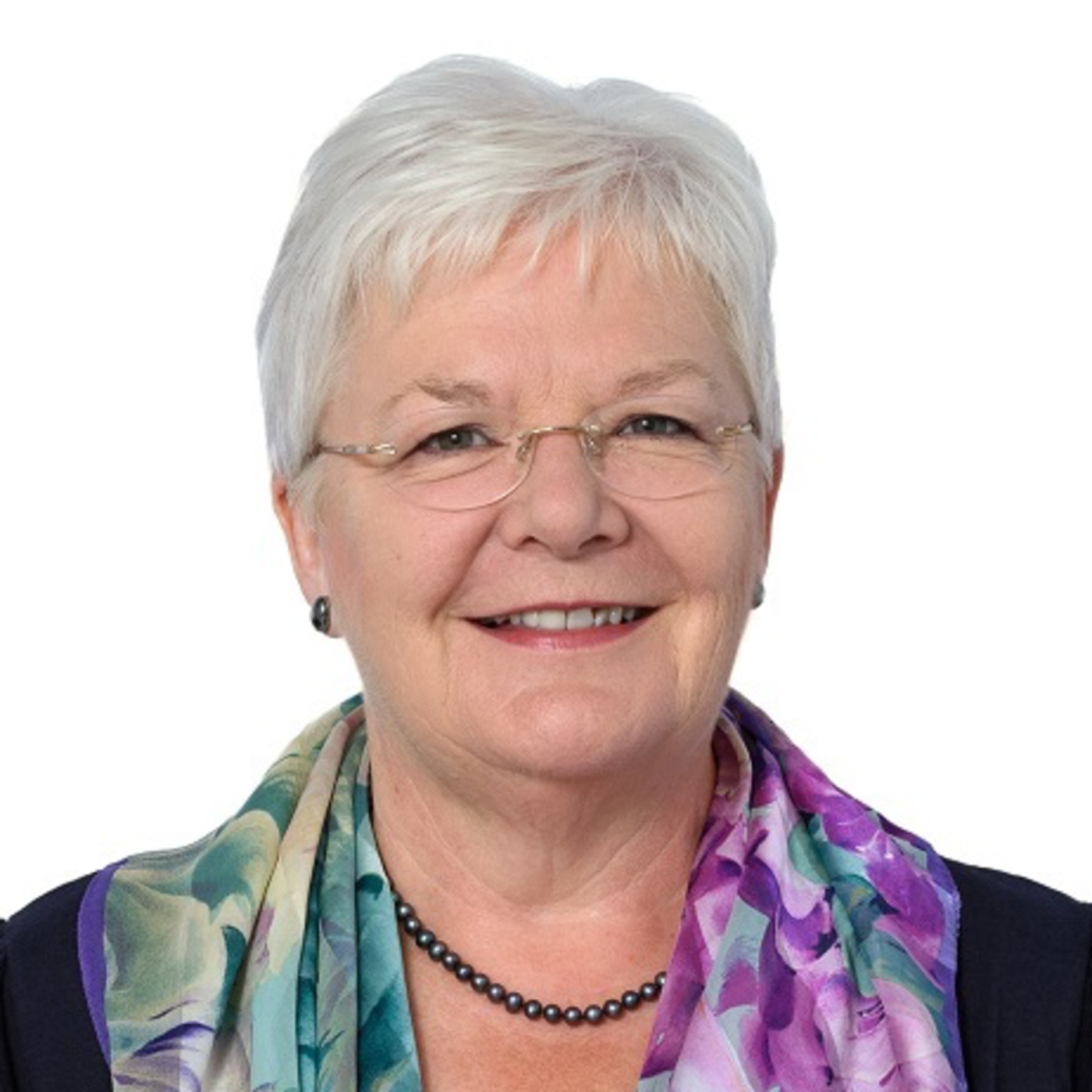
Aoifinn Devitt: This episode is supported by PIMCO, a global leader in active fixed income with deep expertise across public and private markets. PIMCO invests their clients’ capital in income and credit opportunities that span the liquidity spectrum, leveraging their decades of experience navigating complex debt markets. Their flexible capital base and deep relationships with issuers have helped them become one of the world’s largest providers of traditional and alternative investment solutions a valued financing partner. Visit pimco.com to learn more.
Penny Green: One is never ask anybody to do something that you yourself wouldn’t do. One is to know yourself and know your strengths. Someone pointed out to me a long time ago, they said that this is a really big ask. And I said, but I’m not asking anybody to do something that I wouldn’t myself be able to do. Said, yeah, but you can do things so much more quickly than other people. And I hadn’t recognized that. So I think recognize your differences in working style, treat people as you would like to be treated yourself, respect people, and in the pensions arena, put members at the heart of what you’re trying to do, and that will bring it all together. I’m Aoifinn.
Aoifinn Devitt: Devitt, and welcome to the 50 Faces Podcast, a podcast committed to revealing the richness and diversity of the world of investment by focusing on its people and their stories. I’m joined today by Penny Green, who’s retiring from the investment industry at the end of this month following an over 30-year career. She started her career in pensions in 1987, spent a long stint at TPAS where she was Deputy Chief Executive when she left, then became Chief Executive of SOL where over the past 4 years I’ve had the privilege of working with her on the Investment Committee. Upon retiring from the Chief Executive role in 2014, she became an independent trustee with Best Trustees and her portfolio included a trustee role at SOL and chair of an organisation focused on raising standards of pension administration. She was President of the Pensions Management Institute for over 2 years. Welcome, Penny, thanks for joining me today.
Penny Green: Thank you, thanks for having me.
Aoifinn Devitt: Well, let’s start with a bit about your background and how you ended up pursuing a role in the investment world and pensions in particular. Can you just take us through the start of your career and were there any surprising turns in there?
Penny Green: Well, I suppose in some ways my career in pensions started, I’m not unusual in this, it started almost by accident. I actually didn’t know anything about pensions or investment, but I saw a job advertised in HR and applied for that, and the company contacted me and said, well, we’ve got another job for you in pensions which is paying £500 a year more. Would you be interested in that? And bearing in mind that I was not being paid at that time, in ’87, I think my salary had just scraped over £10,000 a year, an extra £500 a year made a big difference. So I said, yes, thank you very much, I will I will take that. I went through the interview process, got the job, and discovered that I was going to be working in pensions, which I did know about. But we were going— the pensions world was going through a massive upheaval at that time because we were transitioning from an era where membership of pension scheme was compulsory, and that was being abolished from the 1st of April 1988. So I joined this firm in 1987, at the back end of the year, and within 4 months was presenting the pension scheme, the new pension scheme, to the employees who previously had been in a non-contributory scheme, and the scheme had been completely rechanged before my time, and presenting them this new contributory scheme. And that’s how I ended up in pensions, and I absolutely loved it. It’s highly technical, which it obviously is. It’s much, much more complicated now than it was then, but it is highly technical. But you’ve got that huge people element, which is so engaging. It doesn’t really matter what you do if you’ve got a retirement. Each retirement is different because everybody’s experience of their work and what have you is different. And I just love that combination of the highly technical stuff and the human element and found my niche and took it from there.
Aoifinn Devitt: And it’s great because listening to you at retirement speaking about this members-first mission, and drive that’s always guided you through this career. How would you say that developed then, and how has that kind of evolved and as a center of why you do this?
Penny Green: I think, you know, I’ve always wanted for people to understand, so that was sort of quite important. You know, why are you writing a letter if the person at the end is not going to understand a word you’ve written? You’ve wasted your time. But the members-first thing really came to its fore when I worked at TPAS, when We were looking at complaints, some justified, some not, some less so, but the underlying theme of everything that came through is people just did not understand. And I’m thinking, well, you’re paying for this, you’re paying with your contributions, and even if you’re in a non-contributory pension scheme, your salary has probably been adjusted a bit to reflect that. So you’re paying for this, and yet you don’t understand, and you feel that something’s gone wrong. And then when you did find— and it wasn’t very often, but you did find occasionally real malpractice— that’s absolutely wrong. That’s really not the right way to go. And so having sort of had a member focus to start with, I think my time in TPAS really, really strengthened that and said the pension scheme is here for the members. An employer doesn’t set it up for no reason whatsoever, as employers don’t establish pension schemes because it’s out of the— necessarily out of the goodness of their hearts. There’s a commercial reason for that, as there is for any business making an expenditure decision. There has to be a commercial reason for it. But at the end of the day, the employer is spending a lot of money on this. The members should be put at the heart of it so that they understand the value of that. So I think that’s where it started.
Aoifinn Devitt: And have you found— this is the challenge I’ve heard some other pension industry advocates mention— the challenge of getting member engagement? As you said, they do pay for it, it is directly impactful to them what the outcome is. But do you find that member engagement is difficult to establish?
Penny Green: Oh, it is the perennial challenge. You do get engagement, but invariably it’s probably when it’s too late to make significant changes to what your pension outcomes are going to be, unless you get really lucky with the investment trust. But I think as an industry, we spend an awful lot of money, and I do question how we can change that, the engagement of younger people. But I do also wonder whether we’re not just trying to do the impossible. You know, if you’re 30, you can’t retire now till you’re 68. So that’s a whole lifetime, more than your lifetime ahead of you. And in the meantime, you’ll be grappling with student loan, possibly a mortgage. You’ve got young kids coming up, which are expensive. And something that is not going to happen in your life for over a lifetime away for you. I think it’s very difficult for us to try and say, we know it’s more than your lifetime before this event happens, but actually you should start thinking about it now. I think we beat ourselves up that we don’t get the engagement we should have, but I, I think that we’re being unfair to ourselves because if you look at people’s lifetimes and, and people’s lives, what they’re experiencing, something that’s going to happen a long time off is really not high priority. You know, it’s like if I’m going on holiday in 3 years, you know, I might be planning a holiday for 3 years off. I’m not actually going to put an awful lot of thought into that, as opposed to the one that I’m taking in 3 months.
Aoifinn Devitt: It makes perfect sense, and you’re right, there is a bit of beating oneself up about it. I suppose that places then the onus onto the trustees to do their part.
Penny Green: Yeah, I think it is. You know, I’m not saying let’s just sit on our hands and do nothing. I think that’s absolutely wrong. But I think we just need to reflect the audience that we’re looking for. And technology is fabulous now. I mean, when I started, we would write to people, we’d write a letter, and then they would have to write back. And occasionally, if it was urgent, you’d phone. An awful lot of stuff that was produced was written as if it’d been written in the 1970s. I mean, it just wasn’t engaging. We weren’t telling people much about their pension schemes. The first change in that was really when we had what we called the disclosure regulations, which I’ve never really liked the expression disclosure, but someone pointed out to me that when we disclose something, it’s almost like we’ve got some information and we’re just going to give you a little bit of it, we’re disclosing a bit to you, rather than actually telling people what they need to know. So I think we do need to, as trustees, think about what information we’re giving. People and addressing the audience. And now the technology allows you to sectionalize and compartmentalize your membership so that you can change the messaging of what you’re doing and try and find those hooks that will get people interested.
Aoifinn Devitt: And that’s a great segue to just a discussion of a little bit of pensions industry, where we are today in terms of state of play. You’ve spoken about evolution and would like to think it’s in a state of constant improvement, continuous improvement, evolution, especially with technology. But regulatory oversight and reach has increased as well, the burden on the trustee has increased as well. Where would you say now, as you leave the industry, we are in terms of the right balance and thinking about the regulatory burden as well?
Penny Green: So looking at it from the member engagement perspective, I think the regulatory burden is just too much. It bemuses me. We all know, doesn’t matter whether you’re a civil servant or working at the regulator or a trustee or just a normal person going about their daily lives. We all know that if you give people more information, the more confused they get, and the less likely it is that someone will read something. I mean, if you go to a supermarket and you’ve got a choice of 4 washing liquids, then that’s easy to make the choice. If you’ve got a choice of 30, it’s impossible. That’s just normal human experience. And yet the regulatory environment is such, particularly when it’s about talking to members more is better than less. And I think the TCFD report is a prime example. The authors want it to be accessible to members, and when you look at the sheer length of it and the complexity of it, no member is going to be reading that, let alone understanding what they’re reading. And I think the regulatory environment has lost its way when the regulator asks for more information to be provided for members and That’s not working, that’s not helping us at all. There was a reason why in the ’80s we started doing member annual reports, because members were not reading the formal report and financial statements from the trustees, so we did a summary of it. And then the regulators got involved with that by saying, if it’s a summary, then you need to check that it’s accurate and it’s not misleading members. And it stems from a good motivation—you don’t want members to be misled—but it ends up when actually I think they probably are because they’re just not reading anything. But when it comes to actually how we run our business, how we as trustees, I think we’re probably about where we ought to be. But I do think that we are going to see an awful lot more regulation coming down the line, and I do question whether that is going to add value, particularly when you’re in DB world. Then fundamentally, the employer will be picking up those costs. But actually now, the more cost you heap onto DC through regulation, through demands on trustees, that directly impacts the member bottom line. And I am not convinced that what I think is going to happen is going to be value-additive to members. And in DC, that really matters, right?
Aoifinn Devitt: Every basis point counts, of course. And just speaking of being a trustee, so you mentioned this additional regulatory burden and How do you think that’s going to affect the attractiveness of this role and the burden, I suppose, of continuous education and training?
Penny Green: I think it will make being a trustee much less attractive. One of the really great things that I’ve found is, is getting the lay trustee, particularly from the membership, involved. And you look at what’s required to be a trustee now and the professionalisation of trusteeship And I think that we are in danger of losing that member engagement because it is complicated, it’s difficult. You look at the investment universe, particularly when you’re looking from the DC perspective, and for members, you know, lay trustees, to get to grips with that on top of their day job, I think is becoming an increasingly challenging objective. But equally, there aren’t enough professional trustees around to fully professionalise the trustee board, so I think there’s a big challenge that we face with the regulatory burden, the requirement on training, on education, on keeping up to date. I think that we have got to keep that member involvement, which I found personally throughout my pensions career, so positive. It’s really value-additive to members because it comes back down to members at the heart. It just reminds you who you’re being a trustee for.
Aoifinn Devitt: And of course, it then pushes some burden back to advisors to translate this into plain English and conduct the training. But the more advisors we add to the mix, again, the more the cost burden. Let’s ask a few questions now just about your leadership style and your ascent to that leadership, because that was remarkable over the course of time. It gets to get into the deputy CEO role. Was that an intentional progression on your part, or how did that work until you got to the CEO position ultimately?
Penny Green: I would not describe myself as an ambitious person, although I think there are a lot of people that would disagree and say that I don’t know myself very well from that perspective. All I ever tried to do was to find a job that interested me and stimulated me. So I’d got to the point prior to joining TPAS, I’ve got to the point where I felt that there was nothing more for me to learn in the previous role, and I saw the TPAS job and applied for it and got it, which was fabulous. And it was such a— it was a massive step change in many ways. Partly there was the responsibility of running the business, which coming from a larger organisation to a much smaller one was a big change, and I’d loved that bit. I found that I enjoyed doing that. But TPAS looks at every sort of pension fund. So I’d gone in being, you know, knowing contracted-out final salary pension schemes inside out and upside down, to discovering that actually there’s only one part of the pensions obviously we know that now, but I went into that quite naively, I think. And I found that, you know, learning was very stretching, it was very challenging, but I thoroughly enjoyed that. But after 5 years, frankly, I’d got fed up with members as complainants, because every member that contacted us was complaining about something. And I wanted to go back to a role where I could talk to members as members. And so I looked around and found the job at SOUL, applied for it, and was appointed and never looked back. It’s been a fantastic time. But to say that I didn’t sort of get out of bed 30 years ago and map out a career, it’s evolutionary again. Lovely.
Aoifinn Devitt: And then your leadership style at SOHL. We spoke about the members first, but how would you describe your leadership style with your team?
Penny Green: I’m quite directive. And in fairness, when I arrived at SOHL, there was a hunger amongst the staff and the trustees for things to change, but there wasn’t a clear vision of what that change should look and so when you’re implementing that sort of change, a directive style was appropriate. The challenge that I found was that, and this is probably a function of time, but over time that was what became to be expected of me. And so when Seoul STC needed something that was much more collaborative, I was not the right person to deliver that because everybody was so used to me being directive, or bossy if you like, which is one of the things that pointed it out to me that it was time. Well, I thought myself, nobody actually said anything. In fact, quite a lot of people, when I said I was stepping down as CEO, said, why, why? And the answer was actually because the organization needs that, that we need a fresh perspective, we need somebody coming in from outside with new ideas. And so it was absolutely the right time for me to go, and I think we can see how SDC has developed subsequent to that and the leadership of Sue, which has been brilliant, absolutely brilliant. I’m in awe of what she’s achieved.
Aoifinn Devitt: And that’s interesting because not many people would describe themselves as directive, but I think many people are. And I suppose it’s particularly a challenge for women who describe themselves as directive because, as you said, that can be translated into bossy. And one of my questions usually on the podcast is around diversity in the industry. And you did ascend in an industry probably at a time, and continues to be a time, that is not very well represented by women. Was that ever an issue for you, being a woman in a relatively male-dominated industry? Did it ever factor in any of your career choices?
Penny Green: No, I was brought up from day one to think that, you know, I’m as good as anyone else. So I’m sure that there was probably some things, some words said about me behind my back that was, you know, I’m a pushy, bossy woman and, and I should get back in my box. But I can’t think of any instance where I’ve felt that I’ve been impeded, or my gender has been an issue, which is, as you say, in an investment industry which is driven by men largely, although it is changing, but certainly when I started it was a male-dominated industry and remains that way to a large extent. I can’t think of any instance where I felt that that was an issue for me, and maybe I’m just very thick-skinned and didn’t notice it. Which is entirely possible. But now I think you just go and you do the job to the best of your ability, irrespective of your gender. And I expect to be respected for that, and I will respect others as long as they’re doing the job to the best of their ability.
Aoifinn Devitt: And one other question about career progression, just before we go on to some reflections: any mentor or sponsor in that mix? You mentioned being driven by where the job is interesting and what stimulates you. And did you have any leadership representatives that you looked to for guidance, or that had a role?
Penny Green: No, no, I didn’t. I mean, the closest I got to a role model was Dennis Buckley, the chair of SOAR, but I didn’t have any particular mentoring. You know, maybe I should have done a bit more of that, and I could have evolved my leadership style at STC, but I didn’t. So I think it would have been really helpful actually to have had somebody to bounce ideas off, but I did have a very good network of people that I could talk to. So there’s not one individual apart from Dennis that I would pick out, but you’d sit down and talk with the people I work with at the Raising Admin Standards, now PASA. When I was president of the PMI, there was a group of people there, people that I’ve remained in contact with subsequently, but not one specific individual.
Aoifinn Devitt: And it’s interesting because Dennis was of course chair of the Board of Trustees at this time. So I think if I’m correct in that, so this would have been a nice example of, I suppose, how a CEO and a chair can interact in a very positive way.
Penny Green: Yeah, it was.
Aoifinn Devitt: And then moving on to some reflections. So I’m sure you’ve been having many opportunities to speak to a group as you now finally retire and think about your career. What would you say were some of the high points and low points looking back, whether it’s Sól or otherwise?
Penny Green: I think the high points— been all high points, to be honest. Can’t possibly all have been high points. The high points have been watching teams grow and develop. You know, when I first started, there was a desire for change, but people couldn’t see how that change could be implemented. And actually helping people see what could be done and see people grow into roles— I remember one member of staff saying, ‘No, I’m very happy doing the job that I’m doing.’ And this has happened on lots of occasions, actually. And then you just test them, offer them something a bit extra, and they go, ‘That sounds interesting, I’ll do that.’ And it sounds weird, but to watch people blossom as they develop and understand what they can achieve, I think, is always the highlight of anybody in, in a management role. From a technical perspective, seeing SDC get Master Trust authorisation, which was just such a grind, it was such hard work for the executive team, but for them to achieve that on our behalf as a trustee was also a massive, massive positive. We all celebrated that. It’s the second time I’ve done it. I was on a Master Trust for a commercial master trust, and when we got authorisation, when the regime was brought in, the funder was so thrilled. Us trustees all got vast bottles of expensive whisky, which was a great treat. But again, it was the executive team that had done all the hard work. But to achieve that when it is such a complex thing to achieve is great.
Aoifinn Devitt: Well, I suppose that maybe on the low point side, another way to ask the question is around any setbacks or challenges that you overcame. Because I think for someone with a career as long as yours, I’m sure the learnings from overcoming a setback would have a lot of wisdom in there for those of us still with many, many years to go. Anything that comes to mind that’s any kind of hurdle you overcame?
Penny Green: The worst thing in my career, which has guided me, was actually when I joined TPAS as Deputy CEO. And when I arrived, I didn’t even have a desk. Let alone an office. I had to move around, so I would sit in the CEO’s office until he had a meeting, when I had to pick my papers up and move somewhere else. And I felt really quite unwanted. And then to discover, because he— we went out to lunch the end of the first week, and he said, well, I didn’t really want a deputy anyway, and the person I chose wasn’t you, but I got overruled by the other appointment committee. And that didn’t fill me with a great deal of joy, I have to say. But you’d never go back because you can’t ever go back, so you have to go forward. And I just— okay, well, we are where we are. You’ve got me. I’ll just work as hard as I can and learn as much as I can, because by then I’d already worked out that there was a huge amount for me to learn and prove my worth. And as it happened, he then unfortunately went off ill for a while, so I actually had to step into his shoes. And so when he came back, he could see that there had been some value. In having a deputy, you know, so it was positive. But in so many ways, that made me create a sense of creed: treat others as you wish to be treated yourself. Everybody’s employed for a reason. No companies— I said earlier, you know, companies make decisions on a commercial basis, so if they are going to employ someone in a role, that’s because that role is needed. And it doesn’t matter if that means that you’re the most recent recruit or the CEO, you’re all needed for that organization to function and function effectively. And the other aspect is, as I say, definitely treat people as you would wish to be treated yourself and respect people for what they bring. It’s just served me quite well, and.
Aoifinn Devitt: It’S a very empowering message as well for everybody at every part of that organization, knowing the power that being hired gives you. Because the very fact that you were hired, as you said, just gives you some aspect of being needed. Now you are, I think we’ve all heard from the LinkedIn message and speeches that this is it in terms of the final retirement. What does the next chapter hold for you? What are some of the things you’re looking forward to doing?
Penny Green: So I’m looking forward to not having anything in my diary other than things I want in it. I’m looking forward to doing quite a lot of traveling. We’ve got trips to Madeira and to Singapore and Australia already lined up. We’re thinking possibly Spain and Japan next year. And there’s an awful lot of Europe that we’ve not been to. I mean, we’ll be living in France. There’s a lot of France we’ve never visited. There’s huge swathes, you know, I’ve been to Germany on business, but I’ve never visited Germany. It’s a country that I know nothing of and would love to visit. So there’s a lot of Europe that we want to visit and travel. So it’ll be a mixture of travel and seeing friends and family and sitting on our terrace reading interesting novels.
Aoifinn Devitt: Well, happy and excited as we are for this chapter for you, as we are facing this, those are your colleagues, I say we, with some sense of loss, we are losing an absolute beacon of learning, of commitment, and of pensions knowledge. So as we lose you from the industry, are there any kind of parting words you can leave us in terms of maybe words of wisdom, a creed or motto that has stood you in good stead that you have lived by that you may be, or advice for your younger self? A few different options there, because I’m sure that there is a lot of a well of wisdom to draw upon.
Penny Green: I think there are 3 things that I would say. One is never ask anybody to do something that you yourself wouldn’t do. One is to know yourself and know your strengths. Someone pointed out to me a long time ago, they said that this is a really big ask, and I said, but not asking anybody to do something that I wouldn’t myself be able to do. Said, yeah, but you can do things so much more quickly than other people, and I hadn’t recognized that. So I think recognize your differences in working style, treat people as you would like to be treated yourself, respect people, and in the pensions arena, put members at the heart of what you’re trying to do, and that will bring it all together.
Aoifinn Devitt: Well, I think it’s so appropriate that we’ve ended where we started because that is Focusing on what really matters and never losing sight of that, I think, has been really a hallmark of your career and an amazing stimulation for the rest of us to do the same. So thank you so much, Penny, for coming here. I know we’re in the last week, so I feel very privileged to have snatched an hour of your time. Thank you for coming here and sharing your insights with us.
Penny Green: My pleasure. Thank you for inviting me.
Aoifinn Devitt: I’m Aoifinn Devitt. Thank you for listening to the 50 Faces podcast. If you liked what you heard and would like to tune in to hear from more inspiring investors and their personal journeys, please subscribe on Apple Podcasts or wherever you get your podcasts. This podcast is for informational purposes only and should not be construed as investment advice, and all views are personal and should not be attributed to the organizations and affiliations of the host or any guest.
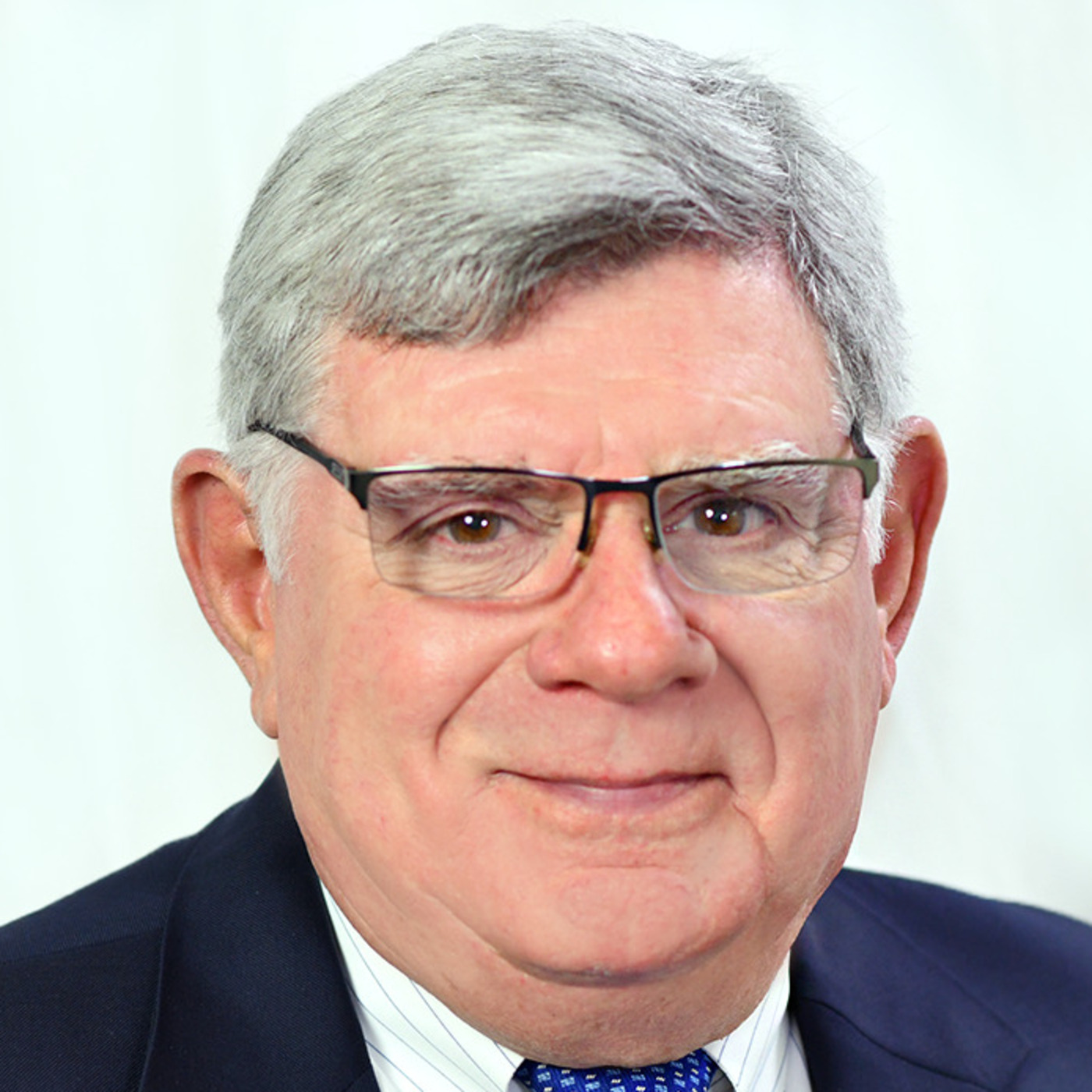
Aoifinn Devitt: Public awareness is not just about education and textbook and this happened in this far distant country or to this one person or this one athlete. This is something that is happening to all of us that we are not being heard, right? So we’ve constantly talked about amplifying our voices, being brave about doing so. So I would just want to pull that caveat into what we mean by public awareness I’m Aoifinn Devitt, and welcome to the 50 Faces podcast.
Tiffany: In this focus series, we are focused on women’s health and maternal mortality in particular, and I’m delighted to be joined by Tiffany McKeever, who’s the founder of Consensus Healthcare Consultants Inc., which provides strategic advisory and innovation in the healthcare industry. As an entrepreneur focused on population health, equity, and women’s health, Tiffany’s innovation has been acknowledged by HIMSS with an appointment as one of the future top 50 Class of 21-22 innovators in the patient leader category for maternal health strategies and applications, and the top 200 femtech personalities globally. Prior to founding CHC Inc., Tiffany gained extensive experience in strategy and technical operation with experience over 20 years in big pharma. She’s passionate about startups in Israel and serves as president of Philadelphia-Israel Chamber of Commerce, which supports collaboration between regional US partners and Israeli companies. Welcome, Tiffany. Thanks for joining me today.
Aoifinn Devitt: Thank you for having me.
Tiffany: Well, this is a series about maternal mortality, and I’d love you to set the scene for us a little. Can you talk to us, starting from a high level and getting into definitions, about the scope of the maternal mortality problem in the US as we sit here in 2024?
Aoifinn Devitt: Sure, most certainly. So I just want to give a little bit of background to our listeners. So maternal mortality in the US is a significant public health issue with multifaceted causes. Federal agencies in the past have been quoted by saying it’s a very complex system to look at. And what I understand just from research is, is that in addition to the healthcare service delivery itself, our social systems themselves are actually complex and ever-changing. So this causes lots of challenges in the maternal mortality problem. If we actually look at the formal or universal definition of maternal mortality, it’s defined as deaths due to complications from pregnancy or childbirth occurring during pregnancy within, I guess, 42 days is what the global component is. We’ve since had some legislation that has changed in the United States that has moved that end of pregnancy date through 365 days. We can talk about that at a little bit of a later time as I just wanna go over some definitions right now. And maternal mortality ratio, which is also known as the MMR, is the number of deaths per 100,000 live births. So when we look at the current statistics in the United States, one of the highest maternal mortality rates is what we have among developed countries. And the MMR has been increasing over the past few decades, contrary to trends in many of the other developing nations. And what we’ve even seen is, is that some of the metrics that have come out post-COVID have significant concerns for us that those numbers have somewhat, in fact, doubled, particularly in the African American community with most of the maternal mortality deaths now over 80% and all of them likely preventable. And that was just actually published this month. And the United States, I guess, overall still continues to have the highest rate of maternal deaths of any high-income nation. And just to give you an example, some of the last metrics that we have, because the way this is bundled, we get the mortality review boards that review this each year or so. And some of the latest numbers that we had over 2022 is, is that approximately 22 maternal deaths in every 100 live births in the United States, which is far above rates for any other high-income country. The US maternal mortality is lowest in Asian American women and it’s still highest in African American women. So, someone like myself was very passionate about Black maternal health. I want to just talk a little bit about how I actually found myself in the space. If you don’t mind, we can chat about that a bit. In 2018, I was moving around. I’d started Consensus in 2017. Really, as you mentioned, me leaving the pharmaceutical space to really look at healthcare disparities and population health in our community and find out how I could better serve the community. And of course, in 2018, the maternal mortality numbers were published quite significant that I was 3 to 4 times more likely to die in the maternal health space here in the United States. I live in New Jersey. Our number is 47 out of the 50 states. So quite significant concern there. And at the time, I had 5 children. So as we looked at these stats, it’s the first time that you sort of catch your breath and say, wow, is that significant risk in some places? But I think what stood out most to us was the fact that highly educated women who actually had access to resources were still part of this number and still part of this preventable number. So that’s what really made me carve out a segment in Consensus Healthcare and population health specific to women’s health, and then of course specific to maternal health, focusing on healthcare inequity. So all of these numbers and these statistics that we see are quite alarming across the US in general for women’s health. But to just see it exacerbated, you know, in the community.
Tiffany: Just one of the areas in terms of definition, which you pointed out to me at our first discussions and I thought was so relevant, was that we talk a lot about death, but actually maternal injury, you said, is something that rarely gets measured and that can in fact be as certainly quite traumatizing and, you know, can be debilitating. When you speak about these numbers, are these just death numbers? Are we talking injury as well?
Aoifinn Devitt: So the injuries number, some of the numbers that we’ve seen in some of the zip codes, particularly in New York State, has an injury rate of 60% for African American women, which is a huge percent. And, you know, all of this really starts to tie into our experience in healthcare overall, right? And if those are some of the complex situations that we see, I think we have to get less sensitive about the structural components of healthcare, how it’s delivered in the US. We have to get truthful about racial bias that we have in the system. And in addition to that, you know, when I’ve done some of my studies here in the healthcare analytics program at Rutgers, we really started to look at the future of patient adherence and what that would look like from a policy standpoint and really where we’re able to sit with that. And is that a risk to us as African American women who are injured at 60%? How are we ourselves responsible for those white coat syndromes and all of the things that come with that where the onus is constantly pushed back to us about our healthcare system in the system that we somewhat don’t control. So those injury rates are where we start to hear the community start to talk about healthcare outside of the US healthcare system, where doulas and birth partners and all of those things, those advocates start to come in heavily. And we’ve had some sense of response for that with expansion of doula care, particularly in our state, but still have some access issues that we’re hearing in the periphery. So thank you for bringing that up because that 60% injury, right, we can come home and still have these issues in terms of how healthcare was delivered to us. And, you know, back to 2018 when we, we received the stats, it’s interesting when we talk about birthing partners because we were going through some of the things that were happening to the women at the time. And I have these 5 children and, you know, I’ve been married and I’m with my husband now 32 years. And I remember him saying, you know, Tiff, you went through some of that. Like, you were having the baby, but I was with you. And I remember the nurse not giving you pain medication. I remember them in a nurses’ meeting just as you delivered our first child, and someone forgot to write your script for your anesthesia. You just came directly off of anesthesia. It was my first delivery. It was quite painful. And my husband was running around trying to find the nurses, right? This mistake had happened. So that birthing partner piece, doula, whether you’re coupled or not, is very important. And he’s talking about a birth that I had at that time 23 years ago.
Tiffany: With a 23-year-old daughter myself, I know that time. And I suppose one of the conundrums that we’re facing is it’s one thing not to improve because we all know that improvement takes intentionality, it takes dedicated policy response, it takes follow-through, it takes funding. But to disimprove in this way, for the numbers to deteriorate, To what can you attribute that? Because you would think with the more connected world, more media coverage of these events, or maybe not, but certainly more awareness in medical education, that these at least should be becoming more front and center. Why are we deteriorating in terms of these numbers?
Aoifinn Devitt: Well, I think we look at the medical education in the US and, you know, we’ve been quite critical of the medical education. And candidly, I’ve had physicians say to me, We have challenges dealing across multicultural communities. We really need help and support in doing this. Some of the comments that I’ve received is, is that they spend a large amount of their time on social determinants of health conversations. When that walks through their door, they have a percentage of it that is clinical, which is a small percentage of it, particularly in the maternal health space. But the rest of the conversation is really around cultural congruence and social determinants of health, which is where you talked a little bit about the HIMSS award. What we really looked at from those insights— I can’t change the medical associations right now, how they roll out healthcare in the United States. But what I can do is provide tools that give patients early access in education. I can connect them to social determinants of health to take that out of the physician space. And then from there, I can connect them to community components where we’ve looked at some research where peer-to-peer engagement through healthcare service delivery helps increase some of our numbers. So depending on what it is that your state is doing and what your hospital system is doing, and then how much your physician group and the leadership and administration is advocating for that, particularly in safety net hospitals, right, where we see under-resourced, underrepresented patients. That is what is causing some of the numbers because that’s the crux of the healthcare system. The social components ebb and flow. So this is somewhat what I call the ghost in the system, which is really evident to us. And we cross out of healthcare from this point and get really honest about wealth in the United States, about payer models in the United States, about the iron triangle and triple aim around cost, access, and quality. And whether we really believe that for you to get good healthcare, it has to cost you lots of money. For you to get quality healthcare, it has to cost you lots of money, and those different types of things. So of course, in the economics, transportation, nutrition, education, behavioral health, which is a significant component of that, which we really haven’t talked about too much in the US. I don’t think that we’ve done a great job around mental health in the US, but that postpartum depression pieces of it is what’s extending us down into that 365 days. So we have to get much better about that. I think we can do better in talking about suicide rates and things like that. But if I was to pull us back through a clinical standpoint, we know the comorbidities that we have in the healthcare space, particularly in maternal health. And we do have some ghosts in the system like preeclampsia. It’s very scary. Like when we see these, when we get beyond the wealth and we say people have money and there’s physicians and You know, in 2018, African American women were the most educated. I think we may still hold that space in terms of the maternal mortality deaths. Most educated, most wealth at the time, still had this stark disparity. And you see it in athletes and all of these other things. And you say sort of, sort of what is that? I start to look at the structural pieces of the OB-GYN bundle. Now, there’s been some conversations that are from OB-GYNs to say, we almost want you to go to high risk because then we can see you more often and we can get over the addendums and all of the other kind kind of things. But that’s not really the way that I want to do healthcare. And we talked a little bit about my time in Israel and startup, but prior to going into that startup space, I was with academia and research in a very public healthcare system in Israel. They have 4 HMOs, but because they’re not actually run by ICD codes like we are here in the United States with bundles and different time points that we have to wait to see patients they’re able to research in a different kind of way. And some of that research, just to give an example, is a biomarker that sits at a time point that we never look at in the United States that is very much tied to hemorrhage. Now, if I was able to bring that biomarker, put it in a technology, source for it, and then find that at a certain time point, when we look at these maternal deaths and hemorrhage being one of the second or third in terms of what happens with unnecessary C-sections. We save so many lives.
Tiffany: And when it comes to funding, so you talked about if there seems to be a biomarker that relates to hemorrhage and if you could get, I suppose, the funding or the support to research that and to actually get that tracked. How do we bridge that gap? And I know we’ve spoken with other innovators and entrepreneurs, including from Israel, on this podcast, Karen Leshem, Maura Rosenfeld, And this is an ongoing problem. We’ve compared the status there and their healthcare system. They, they still have people who fall through the cracks there. Some of it’s cultural as opposed to based on, on race, but there’s still gaps. But there’s also a much more, I suppose, joined up nature of these efforts. What do you think is the funding gap? What would it take to get at a national level the attention to this area? Because every so many different strands of medicine are competing for funding.
Aoifinn Devitt: Mm-hmm. Yep. And when I created United We Raise during the COVID era, I talked to a lot of companies that work with payers. And the payer said to me, Tiffany, you’re 10, 15 years ahead of us. We’re not ready yet. The funding is not ready yet. We’re not ready. We’re not ready. We’re not ready is what we heard. What’s interesting is that as I’ve traveled globally, these researchers are actually in DC with us. They’re at the NIH. They’re at the CDC. They’re sitting on these steering committees. So my question to them was, so how are you here in the US with us, and for some reason or another, this has not moved to policy, this has not moved to the payer groups, this has not moved to the funding sections, these metrics? And I think what you have probably heard from Karen and from Maura, who are good colleagues and brilliant women in the space that they are, is, is that it’s really around the tension that we get in women’s health or the tension we don’t get in women’s health, right? I worked in the pharmaceutical space for, as you mentioned, over 2 decades. And I’ve run clinical trials, serious adverse event reporting, all of those different types of things. And it’s really about how we look at women in society, first of all, right? How we look at health outcomes research in ICER, how we price drugs for us, if they’re for us, right? How are we in clinical trials, all of that. So those are some of the root cause pieces of that. So to pull that all the way into funding where us as startups go into a funding space primarily with male funders talking about something in women’s health, it’s to somewhat of a degree a foreign concept to them. And those are, those are some of the challenges. So I’ll say, do these institutions have an equivalent ear, right, to it when these experts say something like, We see a biomarker at week 17, and in the United States, that patient isn’t coming in until week 20. And when she comes in through week 20, we know what happens at week 20, right? We take the diabetic drink, we do our diabetic tests, we get some genetic screening, those different types of things. But we would have had the option to see that biomarker 3 weeks earlier and then have that reported to us, right? Should you be high risk and need a cesarean section? These are some challenges and some things that we need to look at for you postpartum. And, you know, we wouldn’t go home in 3 days’ time and then wait for a 1-month checkup.
Tiffany: I suppose what would you like to see as action items? We know and we’ve discussed on previous podcasts some of the funds that have been put aside by the Biden administration and committed to women’s health. We have private philanthropists like Melinda French Gates, who is dedicating a fund to female founders that may flow through into women’s health through the tech venture that they perpetrate. What would you like to see as a list of action items that you think would gain bipartisan traction?
Aoifinn Devitt: Yeah, so I think some of the pieces since we dived a little bit into women’s health and down into maternal health, into Black maternal health, I’d like to move through this ladder of inference and the way we talked about funding and we talked about research down into funding. What I want to also talk about is the policy pieces itself and how we actually change that, which is how we distribute the money and how we look at underrepresented and under-resourced populations and why we do it that way. When we look at this funding and you hear it in the startup world, you know, Europe and the US, you’re going to have your ROI there. And I often talk about funding below the equator. Is how I, how I think about it. And it’s a little bit of a paradigm. Obviously, it’s not directly under the equator, but I think people understand what I’m saying about it. Some of the comments that we received when I actually moved into this space was because we were African American women, no one would invest in us. No one invests in African American women, and no one definitely invests in African American women health. So we looked at it as under-resourced, underrepresented, and of course they categorize us immediately as mission. And I think that when we look at it in that lens, when we look at research in that lens, when we look at funding in that lens, when we look at distribution in that lens, that is what is the crux of the issue of what is happening with us, right? And I think the design of looking at the African-American woman who can be wealthy and still be found in these places is some of the issues that those organizations have not looked at yet. Look, I was in pharma for 2.5 decades. Our household was at $500,000. If I lost that and lost COBRA, if I lost my job, lost my transportation, all of these other things, and then suddenly found myself in a federally qualified health system just so that I could get healthcare, pregnant, and then loss of life, you may not see that full trajectory of how that actually moves. And I think those nuances is what the United States actually misses when they distribute this money, because there’s no governance around weighting the population and how the actual healthcare is delivered. We just go right back into the medical textbook.
Tiffany: Fascinating. So tell me more then. So that’s perhaps African American women as a whole. What would be on your wishlist to change this?
Aoifinn Devitt: There definitely has to be policy change advocating for things like cell gene therapy. And we look at personalized medicine. I would hope that we would have some personalized social design that actually happens as well. We don’t need it person to person. Do we need it as group to group? That’s fine. Let’s stratify us in some kind of way that we at least feel whole. We’ve looked at healthcare reform in the United States. We looked at Obamacare. And yes, people got access. Was it really far away from home? I mean, I have a disabled father that I take care of. Yes, he had access, but I had to take him 55 minutes away for the services that he needed. Someone else may not have that opportunity to do so. So I think some of those policy access in a comprehensive way to match if we’re going into the future of personalized medicine has to happen at a social standpoint as well. And this is really about healthcare system reform and improving healthcare delivery. In addressing those systematic inequities that we have. And then as I mentioned before, you know, the onus is on us as well too. I mean, I say that sometimes in these spaces and women say, you know, we really don’t like that narrative. This is some things that are happening to us. And, you know, Consensus has taken the stance that it’s our responsibility too, but it’s our responsibility to educate and provide public awareness, which is why I do what I do, right? Why I’m passionate about what I do. So increasing awareness and education around things and maternal health issues is critically important. So when we see these startup companies that are doing that in multiple ways, in all of the parties that are doing healthcare service delivery, that is another degree of the design that we really have to look at when they are distributing money to people. It can’t go to just friends. It can’t go to just large systems that are part of the lobbyist group that look at it. I’ve looked at large amounts of money go to zip codes where We aren’t even there, and the number is not as disparaging as other places where they could be distributed. Has anyone looked at where there isn’t access down in the lower South, but they’re under the Bible Belt and birth control and all of those issues? So all of these things sort of lead up, you know, the debates were just last night and we were looking at somewhat of this discussion around Medicare, which I wish was flushed out a little bit more. Giving me really deep concern. But even those distribution channels need to have that sort of comprehensive look about how this money is used and how it’s distributed. And I think it’s important not to just distribute money for the sake of distributing money, which is— I don’t want to get too political, but for sort of tax curves or tax harbors in the space or sort of feel-good mission work. But we really have to get to healthcare and change our lens to do this for America.
Tiffany: And I think you make an excellent point. It’s almost like this needs to be a pincer motion in the sense that we cannot wait for policy change to get where it needs to get to. We cannot wait for equity in distribution or in recognition or in funding. There should be equity. I think we all know that. Whether we’ll see it in the next decade is another question. But what we can do is grassroots community movements. And one of the previous podcasts, Adonica Shaw, who spoke about My Wing Woman, again derived from her own experience. And I think that her own experience in receiving less than adequate healthcare led her to seek out a community whereby they could put language on their trauma, educate, heal, and build awareness and visibility. And that just came from grassroots. And it seems that it needs to be this kind of a pincer movement because unfortunately waiting for one side to get to where it needs to get to will not be adequate. So I have been, I think, humbled by what I’ve seen in the community of women who have suffered through negative healthcare events to rally and use this experience to do the better good in terms of ensuring that other women don’t have to go through this trauma.
Aoifinn Devitt: Yeah, I just wanted to just pull back a little bit to the point where you mentioned Wingwoman and Adonica Shaw. Since we’re talking a little bit about our global access and reach, I was one of the managing directors of the MedFemTech Congress. In Paris, France in May last year. And somewhat of the design that we did for this particular conference, which was important to Consensus at the time, was Voice of the Patient, which is where I met Adonica and I was able to interview her and to put these 6 women on the stage to really talk about what our healthcare experience is like. I can tell you that by the time these women finished with various experiences, I mean, all different cultural country differences, on this stage, there were physicians standing in front of us who had walked up to the stage because it was so powerful what these women had experienced in healthcare service delivery. And I think we need to talk about it more. Public awareness is not just about education and textbook and this happened in this far distant country or to this one person or this one athlete. This is something that is happening to all of us. That we are not being heard, right? So we’ve constantly talked about amplifying our voices, being brave about doing so. So I would just want to pull that caveat into what we mean by public awareness. And then I very much agree, United We Raise is very much grassroots. We realized that that was really the only way short of delivering babies at our home, right? But still really realize that should there be an emergency, we would go into that Western healthcare system. So where consensus at that juncture really sat on the spectrum of the maternal health space was really around data. 1 1 is always 2. I’m not gonna have these bipartisan arguments or nonpartisan arguments around what Democrats are saying versus what Republicans are saying. Are these numbers really real? Are they inflated? Was COVID real? All of these different types of things that happen in the healthcare space. That really stop and halt the conversation. And in Consensus, we’ve seen that because even in the sales cycle of United We Raise, a particular hospital that we were working with, just the 2 years past COVID, we lost a woman every month in that hospital system, every month. And then there’s another— I want to say there was another 6 or so that were really at high risk that were able to be saved. So these are real numbers that we are looking at, and we’re just really trying to— really, really trying to find the solution. There are instances where we are given information, just to pull back a little bit to the voice of the patient experience, where we can think we’re really educated, and a physician tells us something. And we had someone on the stage actually lose her children because where she read the medical paperwork She thought that she could just go to a clinic for some blood work the next day, and it was actually supposed to be translated as stat, like right now, go to the emergency room. So these mistakes that happen, how she could go a whole evening without that physician saying, we didn’t get a report from the emergency room, those types of things are just gaps and errors that are happening in the healthcare service delivery design. All of that to say of what I would like to see in the future, I don’t want postmortem reports from the maternal morbidity board that just sort of says, this is what happened, this is what our numbers look like, this is what we’ve seen. And then we do that again next year. We need some practical components where we are actually tying our investors to those outcomes that we saw and saying how we’re solving for them. And I think there’s significant opportunity. We can tell from this podcast lots of things that we can do just to pull us back to what is being defined as so complex. And in recent, I guess, months or so, probably about a year and a half or so, I’ve looked heavily more at policy and having some function down in DC because I can see great technologies that are coming to the forefront that are just not making it through because of the very lenses, the multiple lenses that we have talked about on this podcast.
Tiffany: Thank you so much, Tiffany. This series started 10 months ago with the tragic story of Tori Bowie, the Olympic sprinter who was found dead at her apartment at 8 months pregnant, having gone into premature labor. And my hashtag I used at that time was #RememberHerName. And I think you mentioned postmortems. I also don’t want to read any more about any more postmortems. I think we have to remember the names of the victims, that the cases, their case studies and their details, because it is only by remembering and these stories that we will be reminded of the triggers and not to have that happen again. So thank you so much for the work that you’re doing, both on your own, but also by supporting startups and founders who are committed to new technologies in that arena. And thank you for bringing together so many advocates of this important cause. Thank you for coming and sharing your insights with us.
Aoifinn Devitt: Yes, thank you so much for having me.
Tiffany: I’m Aoifinn Devitt. Thank you for listening to the 50 Faces podcast with this particular focus on maternal mortality within the framework of medicine and science. If you liked what you heard and would like to tune in to hear from more experts in this field, please tune in to Apple Podcasts or wherever you get your podcasts. This podcast is for informational purposes only and should not be construed as investment advice, and all views are personal and should not be attributed to the organizations and affiliations of the host or any guest.
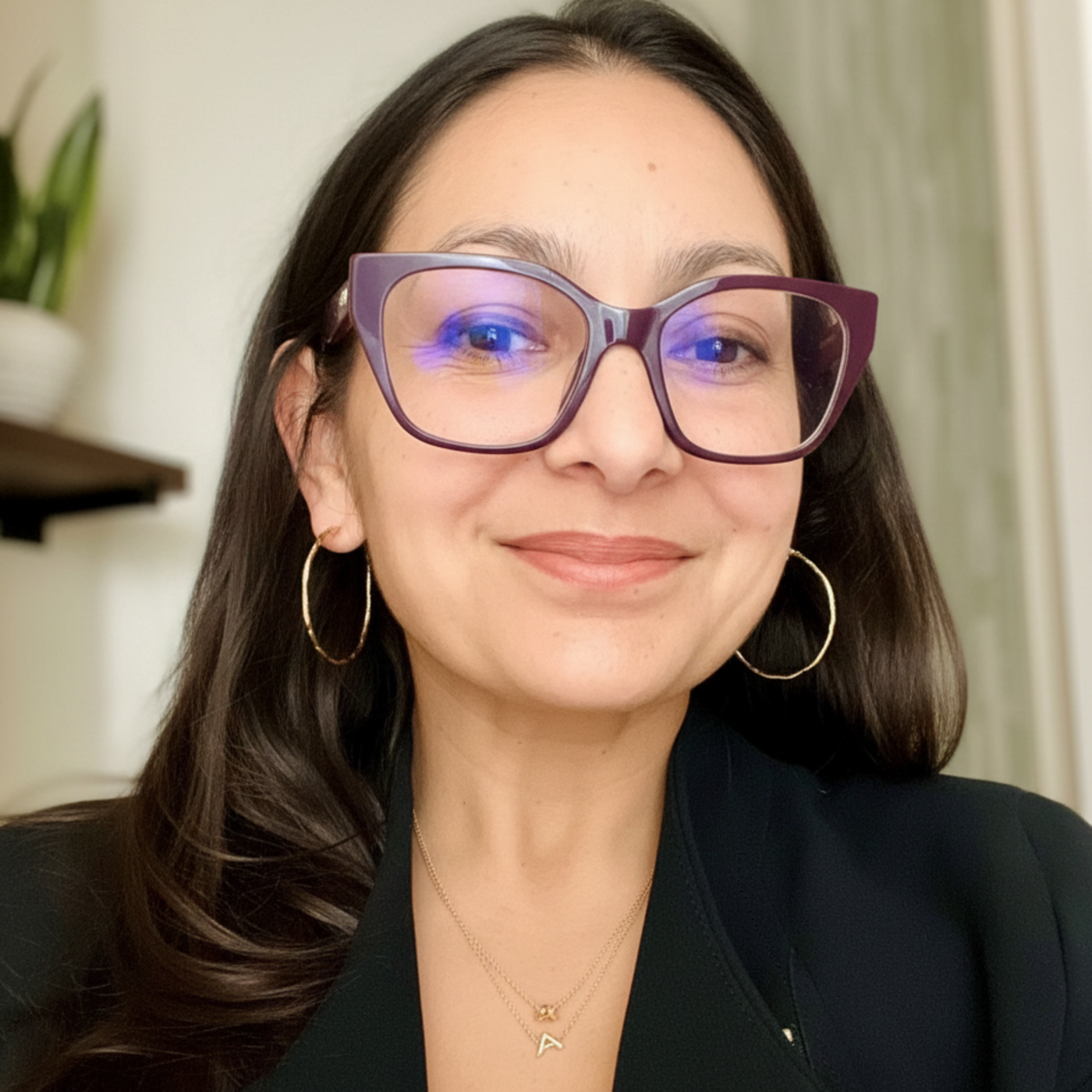







Aoifinn Devitt: This Pride series in 2025 is kindly supported by Latimer Partners LLC. Our next guest is CEO of Oasis Domestic Abuse Service, and she came to my attention when she posted a poignant post on LinkedIn about Lesbian Visibility Week and her family life with her partner. Tune in to hear from her about her upbringing, why Lesbian Visibility Week remains so deeply personal, and why she is so optimistic about the evolving state of employers. I’m Aoifinn Devitt, and welcome to this 50 Faces focus series in which we are celebrating LGBTQ+ professionals in a special series for Pride Month 2025. I’m joined today by Clare Williams, who is CEO of Oasis Domestic Abuse Service, and she has spent most of her career in the charity sector. We got to know each other over LinkedIn when I responded to her popular LinkedIn post about Lesbian Visibility Week. In which she described her life with her partner and their 6 children and the changing climate and political backdrop. Welcome, Clara. Thanks for joining me today.
Claire Williams: Thanks ever so much. I’m really excited to be here, so thank you for inviting me.
Aoifinn Devitt: Well, before we get to that LinkedIn post and the reaction you got, could you just talk us a little bit through your background? Where did you grow up and what were your early interests?
Claire Williams: Yeah, of course. So I know it’s probably a bit of a cliché for a lesbian to say this, but I grew up in a little seaside town of Whitstable which many lesbians will probably recognise from the very famous Sarah Waters novel, Tipping the Velvet. So yes, maybe I was kind of destined for a bit of drama and rebellion from the start. I grew up on a council estate at the time, and I always thought that my childhood was kind of great, really. I played lots of sports, I was absolutely obsessed with music, and I mean obsessed with music and movies. And I learned to play the guitar very badly. And spending time outside really with friends, socializing. And I was a very competitive young person, probably still am if I’m honest. And I, I just loved experiencing things. I’d give anything a go. But I guess now that I’m older and I have children of my own, all 6 of them, which you touched on. I think very differently, and my family often back then didn’t know where I was half the time. I had no mobile phone back then. I was out until stupid o’clock and only went home when I was hungry. So from a parenting perspective, I look at that and I think, God, is that okay? And actually, no, it isn’t. And I found myself in quite unsafe situations or places that just weren’t suitable for a child, and I just shouldn’t have been there, full stop. There must have been kind of poverty around me, but I didn’t always recognize it back then. But my eyes were very much open to things like people drinking a lot of alcohol and using other substances at a young age, and I was never really interested in trying any of those things. I wanted a job, I wanted a car, I had aspirations, but I would have been in a position where I could have easily used those things and I could have potentially gone down a very different path had I have done. And I suppose looking back, I used to hang around with a really large group of people. There were about 20 of us who all grew up together. But when I think back, very few of those people from that group had actually, like, turned out okay. They had positive futures, and several never even had the chance to begin one, if I’m honest. And what I didn’t appreciate until now is that even though I wasn’t taking part in that activity, people looking from the outside would have tarred me with the same brush and made those assumptions, which makes me realize that actually you can just— you can never judge a book by its cover. I was a child who kind of struggled to learn in a classroom environment. I never made a full week at school. I, I absolutely hated it. And when I left school, I was 16. I completed my GCSEs, but I didn’t get any decent grades. I got a B in art, and you know, what the hell was that going to get me? So all I wanted to do really was work, and I was never afraid of hard work. So I’m what you would kind of call a bit of a grafter. I’ve worked in factories, supermarkets, care homes. I’ve worked in a family-run sandwich bar. I do actually make a cracking BLT also. And then when I reached 23, I finally came out about my sexuality, and I, I wanted to change. I wanted more for my life. I wanted more for my son at that time. And I, I reached a bit of a crossroads when it came to my career and some of my life choices as well.
Aoifinn Devitt: That’s a wonderful story, and I thank you for sharing that. And as you were describing it, I was thinking of your current work with Oasis and how much some of your lived experience must help with with the empathy and with understanding some of the situations your clients or the stakeholders you serve. And that is a remarkable story. And then you said it’s interesting also that focus on hard work and how that was a strand that came through your life. How did then the charity sector make itself known to you? Why was that somewhere you found you wanted to be working and add value in?
Claire Williams: Well, I’ve kind of watered this down a little bit because I found my way into the charity sector by complete and utter fluke. I was out one night with friends and I ended up talking to a wonderful woman about her job and her background and what she was doing, and she was telling me about how she worked with young people in a homeless hostel and was explaining how she taught them life skills to live independently. And the one thing that really struck me about her was her absolute passion for this job, and it really kind of got me excited. It got the hairs kind of stood up on the back of my neck and I didn’t even know that jobs like this existed, really. And I asked her to keep me in mind if anything came up and became available. Not for one minute did I expect that she would remember me after a few drinks in, if I’m honest. But she did remember me. And a few weeks later, she called me up and told me about this job that was available. And I was in absolute shock that she even remembered me. So it was a real opportunity for me to sort of grab it with both hands. So I applied for the job. I’ve got to be honest, I had absolutely no experience whatsoever of the charity sector, of homelessness, or anything like that. And I was very lucky that this amazing organisation gave me a chance. And like I said, I took it. So I started in this organisation, it was a homeless organisation, as an occasional worker. They just called me up as and when they needed help, like for short staff, and if they were short staffed with sickness or holidays. So I just took every shift that was offered to me, every opportunity to just learn every aspect of the role. And, and I was a bit like a sponge, I guess. I just absorbed everything that they could teach me. I also went back to education in the evenings to retake my GCSEs. I continued to study further education to develop sort of management leadership qualifications. And slowly but surely, I worked my way through frontline roles into management and leadership positions within this organisation. And, and I will be forever grateful for the knowledge and opportunities that they gave me.
Aoifinn Devitt: So can you tell us about the work you do at Oasis?
Claire Williams: Yeah, of course. So I’m now the CEO of Oasis Domestic Abuse Service. We are a charity who is dedicated to supporting individuals and families affected by domestic abuse. We have provided refuge and support services for over 30 years, and we have a wide range of different services including safe accommodation, dedicated helpline, outreach services, high-risk services, and specialist children and young people services as well. We support individuals of all genders and backgrounds, and our focus is very much trauma-informed, person-centered support that doesn’t just respond to kind of crisis but helps people to rebuild their lives. And I think what sets us apart is our infrastructure. We’ve got dedicated teams for safeguarding, quality, training, data, and a lot more, which helps us keep standards high and respond quickly when needs change. And we also work very closely with partners like the police, health, education, and social care to make sure that people get the wraparound support that they need.
Aoifinn Devitt: And just a quick question about the use of your services. If you were to kind of plot the, I suppose, the need for the services, the incidence of abuse, Is this something that’s fairly stable, or do you see it as growing currently?
Claire Williams: It’s awful, isn’t it? Because you don’t want a charity like ours to exist in the first place, but because domestic abuse is now— people are becoming very, very aware of what DA is, of course that does increase the referrals, that increases the need. And we saw significant increases over COVID, people becoming sort of locked behind closed doors with that perpetrator in very unsafe environments and situations. And so from that point, it’s just been a kind of steady growth of new referrals because the awareness of it is just out there and it’s far greater, and so it should be. But with that awareness, obviously the need far outweighs what is available to them, which is one of our biggest issues when it comes to funding.
Aoifinn Devitt: And before we move on to talk about LGBT inclusion, which is obviously the key focus of this podcast, I’m quite interested in some of the work you do in the charity sector because I think it’s the work with marginalized communities sometimes that kind of gives us— I’ve mentioned the word empathy before— because often, you know, it is about inclusion. Would you say that there is anything about whether the homeless population or the people you work with at Oasis that most of us misunderstand or don’t appreciate by not being in the sector, that what has being in the sector kind of taught you perhaps that we don’t know?
Claire Williams: You know, I’ve worked in homeless services for 18 years, and during that time I saw just how complex homelessness actually is. Many people in this situation are dealing with sort of co-occurring conditions, mental health issues, substance misuse, and often unresolved trauma. And often that trauma goes all the way back to childhood, including abuse or witnessing domestic abuse. And that’s why a joined-up, trauma-informed approach matters so much. So, something that really struck me was the number of young people I worked with who identified as LGBT+ at that one point as well. I managed a hostel for 9 young people, and at one moment in time, 7, 7 of those young people identified as LGBT+. Now, that’s not coincidence. It says a lot about rejection, discrimination, and trauma in families and communities that push young LGBT people back into homelessness. It’s something that we have to talk about. And that realisation gave me the evidence I needed to show that more support was urgently required for LGBT young people. And so I approached an amazing Commissioner and asked for her backing to pilot a dedicated support service for young people identifying as LGBT+. And I think, you know, she just took absolute pity on me and probably just wanted to shut me up. So she said yes to giving me this opportunity to run this pilot. And within a few weeks of running it, it was such a huge success in a very short space of time. The numbers of young people accessing the service spoke for themselves. And the commissioner could see just how much that service was needed and the outcomes from that. And now, thanks to that success, the service now operates across the whole county of Kent and Medway and has supported thousands of young people over the last few years.
Aoifinn Devitt: That’s extraordinary, and it reminds me, we’ve had many guests on this podcast that have worked with other segments of the LGBT+ community, say the elder segment It’s interesting how the youth, the elders, there are ways to push in and ensure better inclusion at every level. But extraordinary work that you’ve done there. And I’d like to now move to the focus of how we got— we met each other on LinkedIn and the post you made. Can you just tell us a little bit about that post that you posted? Lesbian Visibility Week and that it comes around. I think I ever say to come around again and a little bit about your own story.
Speaker C: I started working in factories when I left school in 1996. I’d have been 16 years old. I already knew at that stage that I was gay. I knew from the age of 4 that I was definitely identified as a lesbian, but I didn’t feel comfortable coming out at that stage. It just wasn’t talked about, not in a professional sense or personally, and I wasn’t even out to my family, so coming out at work, that would have been impossible. And later on, I moved from that factory to another, which was an all-male factory. I was the only woman. All of the other women worked in the offices, and the two just didn’t mix. And, well, there I had to deal with constant— and when I say constant, I mean constant— sexual innuendos and inappropriate behavior, touching. And at that time, the guys only— they meant it in jest and jokingly, but God, you know, it was awful. It was awful. And I made a pretty strong stock, and I’ve got what I would class as a good sense of humour, but when I think back to those times, it was just too much. And also, if somebody else was in that situation, they were a bit more vulnerable, I dread to think how they would have coped. They wouldn’t have coped. They most definitely wouldn’t have, because it was such a tense and just inappropriate setting. And when you think back, I was 17. I was a kid. So You know, it just wasn’t okay. And had I come out in that kind of workplace, I mean, God, it would have just made me more of a target. So I definitely, definitely stayed quiet when I was there. And things have changed a lot since then. Now we’ve got proper policies, support systems, things like shared parental leave, we’ve got Pride networks. I mean, the list is endless, isn’t it? And not all providers of services or companies do those things well, but we are a lot further forward than what we ever have been before. We just hope that it doesn’t go back, but, you know, those kinds of things like Pride networks and parental leave, they just didn’t exist back then. And so it is a very different landscape, and that progress really does matter. We can’t lose that.
Aoifinn Devitt: Can you paint a picture for how well LGBT professionals were included at the beginning of your career? And how has this changed over the course of your career? Do you think we’ll still have work to do to create more inclusive environments, for example, and what kind of initiatives have you found work best?
Speaker C: But I guess for me, everything kind of shifted when I started working for myself in a family-run business, and all of a sudden I could just be myself. I could be open without fear. I was working with my sisters, they knew who I was, I was out to them at this time, and, and actually I could just be my true authentic self. I didn’t have to hide that part of myself, and that was a massive, huge relief for me. And so by the time I moved into the charity sector, I was already out. I was well ahead of this. And at that time, I was in a position where I could educate that setting, I could educate my colleagues, I could work with the clients around around their sexuality, and so therefore I was in a position to help shape their policies, shape their practices, making sure that they were inclusive. And I guess I kind of got them ahead of the game back then. That’s what I really love, and I really love this about the voluntary sector. There’s a real appetite to learn and improve, and that workplace, the people that you work with, they’re open. They listen, and they genuinely want to do better. And you’re not pushing against closed doors, which I imagine you could be in other companies, other areas. And that’s just, it’s not the case in all of those areas, and that’s really sad. That’s really sad, and there is more work to be done there. People need to be open to creating those environments where people can be themselves and be safe.
Aoifinn Devitt: And why is Lesbian Visibility Week particularly important?
Claire Williams: So, the Lesbian Visibility Week is quite important to me, actually, and it’s very personal. As a kid, I didn’t know a single lesbian, and yet from the age of about 4, I knew that I was a lesbian, or I knew that I was very different. And I remember thinking, God, why do all ladies have boyfriends and husbands? You know, I even looked at my own family setting and I looked at my sisters and my mum and I thought, well, why do they all have boyfriends? And husbands, you know. I don’t want a husband when I’m older. I would like a wife. But I also knew that it wasn’t something you would openly talk about because people just didn’t voice those things when I was a kid. And then at 12, I had a Saturday job, believe it or not, in a video shop. It was the best job in the world, watching videos all day and disturbing customers, especially when you’re obsessed with movies. And literally across the street lived a lesbian couple and that absolutely changed everything for me. I remember seeing them and thinking, oh wow, it’s real, it exists, I’m not the only one. And these women didn’t even know me, but their existence just gave me such hope and really changed the way that I thought. And I suppose that’s why visibility matters. I want to be someone else’s hope. Because just being your true authentic self can give someone else the courage to do the same. Recently, I was at a concert with my partner, and we were stood next to a very young lesbian couple who were there with our parents, who looked very, very cautious, barely looking at each other, no eye contact or anything like that. And a few songs in, they saw me and my partner being affectionate to one another, and then they quickly started to hold hands, and even saw that, you know, I even saw their parents kind of smile because they were pleased that that embrace had happened, that they had got that confidence. And I think that’s what it’s all about. But being visible also means about facing comments and assumptions, some of which still shocked me. I mean, I think back over the years of some of the situations that I’ve been in, I think, God, I went to the GPs when I was pregnant and My GP made a remark and said, you know, “Why are you a lesbian? Penis isn’t that bad, is it?” Or I’ve been told things like, “Well, we don’t get funding for you people,” when we were looking for advice around IVF. “No, we don’t get funding for you people.” Or I’ve been reassured by things like, “Oh, you’re just like a normal family,” as if that’s meant to be kind of comforting. I’m not the kind of person who gets easily offended, and I don’t think everyone who says these things means harm. Not all of it is all malicious, but it still needs to be challenged because if we don’t speak up, nothing changes. The progress we’ve seen has come from visibility, from Pride, from healthy challenge, and that challenge has to continue because equality isn’t a given. And we have to keep pushing forward with that. I always say this, my staff probably hate me saying it, but if we all kind of hide in the shadows, that’s where we’ll always stay. But if we stay visible, stay vocal, and stay proud, that’s how we make space for the next generation to thrive. And I see so many steps forward with that next generation already. It’s amazing. It’s just making sure that we don’t go backwards. Now?
Aoifinn Devitt: It’s funny because the last time I just specifically discussed Lesbian Visibility Week was actually 4 years ago, 2021, and I’m not sure how much has changed since then. There’s still obviously the week, there’s still a need for it. Maybe some of the pushback against other members of the LGBT community has been damaging to that visibility because it’s taken— maybe people are lying low and not presenting role models. I think one of the best ways of ensuring visibility is, A, doing what you’re doing and being on LinkedIn and doing this podcast, but also sometimes celebrities and high-profile people being more open, and that’s why we try to showcase them. But it is, I suppose, a pity that we still need a Lesbian Visibility Week when there isn’t a similar for gay men. But thank you for doing what you’re doing, and I do think that that role modeling is so critical. When it comes to— you mentioned some of these comments, and clearly we’re not where we need to be in terms of full acceptance and inclusion. How would you say in the professional world being a member of the LGBT community has affected you or hasn’t?
Claire Williams: So I guess every workplace is different and it’s shaped by different values. I don’t know, as an example, my partner works for a company with incredible benefits. They have something called communities of belonging, pride events, egg freezing. Their policies are, you know, incredible. And what they have available. Like, the list just goes on. I suppose smaller organisations, including, you know, my own charity as an example, we don’t always have the budgets for that kind of extra support to go the extra mile. So we have to think a lot more creatively instead around how we support our workforce and those accessing our services. That said, some organisations or companies They still don’t even have basic EDI policies in place. And that’s where I guess the real work begins. But inclusion, it isn’t just about policies, it’s about culture. People need to see it in action and who’s getting promoted, who’s being heard, who’s in the room. And I guess that’s when inclusion starts to become real. Personally, I can think of nothing worse than writing a policy just to tick a box. My teams are my absolute biggest asset, and that’s true of every organisation and company. So instead of treating people as, you know, a disposable diversity process, we should be striving for better practice, full stop, like just better practice. And changing culture is one of the hardest things to do, and that’s why It has to be a shared effort and a commitment. Policies and values have to be valued. They have to be lived and breathed by everyone. Workplaces need to be safe spaces where voices are captured and heard and also acted on. And we need to think about inclusion long before recruitment. You know, by the time someone joins your team and reads your values, reads your policies, is being inducted, you’ve already kind of missed a trick. People should know who you are, know what you stand for before they even apply. It’s about how you externally get that across as well and being visible.
Aoifinn Devitt: I love those ideas. That certainly culture is key. And now that we’re releasing this in June, uh, it’s Pride Month, what can allies across different workplaces do? What what are the little gestures that you think make a difference? Is it about the rainbow lanyard, the, the rainbow flag on your desk, going to a Pride parade, or just kind of a sign of allyship? Anything that you found has particularly made a difference to you or to your friends and colleagues?
Claire Williams: Well, do you know, I think it’s all of those things. I think people underestimate the power of wearing that badge, that flag. I’ll use an example. I worked with a young girl once who was housed in a homeless accommodation, and she came to my service and said that she was ultimately made homeless again because the people who ran that place were homophobic and caused her nothing but grief and bullying. And so she felt safer to be on the streets than in that accommodation, which is actually the accommodation that should keep you safe. And when she came to my project for an interview for housing, she said the first thing she picked up on was the fact that two members of the staff, including myself, was openly gay, and that as she walked through the front door, there were posters in celebration. And we asked the question about how somebody identified, and she said those tiny little things made her feel safe to the extent where she felt she could be her own authentic self. And I think that’s key, isn’t it? Nobody even realizes the difference a poster can make, but it’s all of those little gestures that make such a significant change.
Aoifinn Devitt: Couldn’t agree more. So thanks for the reminder, especially if people think, oh, I won’t bother this year, or everyone knows it always matters. So thanks for that reminder. I’d love to return to some personal reflections now. So we’ve talked a bit about your career and how you ended up in the charity sector. Were there any any particular highs or lows there so far that you can talk about?
Claire Williams: Gosh, yeah, there’s quite a few actually. I think one of the hardest parts of my early working life was dealing with sexual harassment and innuendos, that kind of stuff. I mean, when I think back to those days, I was just 17, still a kid really, working in an environment where inappropriate comments and unwanted sort of touching were brushed off as normal. And I guess I was kind of, I don’t wanna say the word lucky, but I look back and I guess I felt more lucky at that time that I was strong enough to kind of push through those times. But it makes me think about how someone more vulnerable might have coped. And, you know, we’re just working in different times and that kind of behavior should just never have been acceptable. And it still needs calling out today. And then on the other side, I guess the high points has been building a career in the charity sector from the ground up. So I left school without any GCSEs, and I’ve always been open about my sexuality, which hasn’t always been easy or straightforward, but I’ve worked at every level from from frontline roles to leadership. And I think by doing that, it’s kept me really grounded. And I know, like, the value of every role in a team. And I often say that if one cog breaks, the whole clock stops. And I’m proud. I’m proud of what I’ve achieved, not in spite of the challenges, but because of them, I guess. Every kind of tough experience has shaped how I lead, how I listen, how I support others, how I work with others. And I don’t always get it right. I mean, who does? But I do my absolute utmost to learn from everything that I do, and I reflect on all of my practices.
Aoifinn Devitt: And speaking of teams and every cog needing to work, have there been any people on your team— and not necessarily your work team, your life’s team— that have had a particular impression on new or been pivotal in your life?
Claire Williams: Yes, it’s a really difficult question because you have to try and think of these, you know, few handfuls of people that have kind of inspired me. And I suppose when I think of this question, I’ve worked with so many people, including in my personal life as well, who’ve inspired me. Each of them have their own kind of strengths, but I suppose what’s inspired me most is seeing people grow and being part of that as well, like watching someone evolve in front of you is an absolute privilege. I can use an example of one person I remember working with, was a young man that I, I worked with who had a background kind of similar to mine, I guess. He’d had a bit of a tough start in life, unsure of where he was going, what he was going to do, what he was good at. And at the time, we helped him get a job in a hotel kitchen and something kind of just clicked with him when he went to work in, in that kitchen. And from there, his life just took off. He took up every opportunity available to him through that work placement. They sent him to work in Michelin-star restaurants in Europe. He entered competition after competition after competition, and he won them all. He literally traveled the world entering these competitions. And fast forward 20 years, and he is now in a top role at a 5-star department store in London. And I just think that’s my inspiration, like kind of watching him thrive, knowing where he was at the beginning and seeing him now, that kind of reminds me why I do this work. And it, again, it keeps me grounded. And I think back to team members that I’ve worked with and I’ve seen them progress I’ve seen them develop, I’ve seen them go into leadership roles or start families, and I think just to be part of those individuals’ pathways and futures is just incredible.
Aoifinn Devitt: Well, those are some wonderful shoutouts there, I think, and a reminder of just the sheer grit that is involved in making a life and, and that, that needs respect at every time. The last question is any words of wisdom or creed or motto you might have for us, or anything you would say to your younger self, that young 16-year-old leaving school, maybe steering clear of temptation and trouble?
Claire Williams: Yes. So I suppose, like, thinking about my background as well, I sadly lost one of my best friends at a very young age. I was 9, she was 11. And I also lost other friends along that journey in teenage years as well. And I suppose those experiences and those losses they kind of shaped how I live my life today, even though I didn’t really realize it at the time. But they taught me not to kind of take anything for granted, especially things like your health and your happiness. So I try to make the most of every opportunity that whenever we don’t have our 6 children, we go traveling quite a bit and go away for weekends. And I remind myself that age happens, doesn’t it? We see the gray hairs kind of covering your head or getting the dye on your hair, kind of reminds myself that age is a privilege and not everyone gets the chance to grow older. I live with that sense of gratitude every day. So I do get days where I struggle to drag my ass out of bed. Of course I do. But I’m also grateful to be getting up at the same time. And I kind of, if I could go back to my younger self, I would tell myself that everything would be okay. Stop worrying so much. Stop holding yourself back. When I was younger, and I suppose because of my sexuality, I really struggled. Like, struggled with my identity so much. I felt feminine inside, but I didn’t really know where I fitted, you know. I, I didn’t feel comfortable enough to wear dresses because I didn’t particularly walk that femininely. And if I did wear a dress, I felt stupid. I felt too masculine. I never felt comfortable in my own skin. Now that I’m older, quite frankly, I couldn’t give two hoots what I look like now. But it’s taken me years, years to be comfortable with who I am. And I wish, I wish I realized that sooner, that just being you is actually more than enough. And I would tell anybody exactly the same. Thing as well.
Aoifinn Devitt: I think that’s one of the well-kept secrets of getting older, is that growing into your own skin, that is actually a huge plus among the many negatives that there— that’s a huge plus. And I think it’s hard to convey that. Maybe it only comes with age. Well, thank you so much, Clare. We have yet to meet in person though, although I know we will.
Claire Williams: Your—
Aoifinn Devitt: the sheer energy that comes from your profile on LinkedIn, from the whole content on this podcast, it is because you are your authentic self to every, every last bone of your body, I feel. And, and that energy is incredibly empowering to those of us who listen to you because I think it encourages us to be our own selves as well. And thank you for coming here. I do not know how you have the capacity to not only have your 6 children but also be so caring about the people you work with and carry that through their trajectory. And not only the people you work with, but your community as a whole. Because that’s what your post was about and that’s why your concern for Lesbian Visibility Week is there and why you’re, you’re doing this. So thank you so much for coming here, for your advocacy, and for sharing your insights with us.
Claire Williams: Thank you very much, and thanks for your kind words. That means a lot.
Aoifinn Devitt: I’m Aoifinn Devitt. Thank you for listening to our 50 Faces Focus Series. If you liked what you heard and would like to tune in to hear more inspiring professionals and their stories, please subscribe on Apple Podcasts or wherever you get your podcasts. This podcast is for informational purposes only and should not be construed as investment advice, and all views are personal and should not be attributed to the organizations and affiliations of the host or any guest.

Aoifinn Devitt: This podcast is brought to you with the kind support of Harbourview Equity Partners. Harbourview Equity Partners is a global investment firm focused on opportunities in the entertainment and media space. Founded by Charisse Clocks-Horace, Harbourview is a long-term investor in content with an industrial platform built to protect, optimize, and enhance the legacy of premium IP. With a vision of becoming a true stakeholder in the global value of content, Harbourview believes creators deserve a seat at the table creatively and economically. Owning their narrative, and maximizing value for all. In celebration of our partnership with Harborview Equity Partners, we have chosen a separate piece of music for each podcast in Series 1. We hope you enjoy it.
Dede: One of those lessons I learned growing up in Nigeria was no matter how bad things are, it pays to be optimistic. It pays to be motivated to see the good in people, in things, no matter how bad things are. But one of the things I try to live by right now is I want to own companies that I’m proud to tell my children, yes, this is what I held. Well, when I have children, I’m proud to tell them, yes, I invested in this type of companies. And I mean, I know that’s quite personal, but it makes me really reflect on certain industries or certain business models or certain types of management teams when we’re picking them. There’s some that we look at, and then I ask myself that question. I’m like, oh, maybe I, I wouldn’t be proud to tell my children or the next generation that, yes, we invested in this company and we gave them our capital to keep growing their businesses.
Aoifinn Devitt: I’m Aoifinn Devitt, and welcome to the 50 Faces Podcast, a podcast committed to revealing the richness and diversity of the world of investment by focusing on its people. And their stories. I’m joined today by Dede Ayasan, who’s founder and CEO of Jenga Investment Partners, a firm that invests globally across growth, turnaround, and cyclical equity opportunities. Welcome, Dede. Thanks for joining me today.
Dede: Hi, Yifan. Thanks for having me on the podcast. I’m really delighted to be here.
Aoifinn Devitt: Well, I think we may have come across each other through some mutual friends on LinkedIn, but I’d love to have you talk through your career journey to date, starting right with where you grew up and what you studied.
Dede: Yeah. So I started joining Investment Partners 3 years ago, just when I was finishing university. But before then, I grew up in Nigeria. So my initial experience with investing started when I was 10. My parents introduced me to the world of investing. And you know, back then in Nigeria, you’ll mainly come across investing through the newspapers, and it was right before the sports section. So I’ll look at the newspaper and my dad told me to pick 3 stocks I picked Nestlé Nigeria, 7up, and First Bank Nigeria, and literally 5 years after, 2 of them had doubled and tripled in value, and then one had fallen by half. So that was literally my introduction to finance, and I decided to find out why some did well and why others didn’t do well. And then I learned what— how a cash flow statement worked, why the balance sheet was the same on the left and right side. And in university, I started Jenga Investment Partners, which was an investment club, then was an investment club, now a regulated fund. But the goal then was just to build a track record, but I got really hooked on investing and I decided to take it further into something, an actual regulated fund.
Aoifinn Devitt: Well, that’s really interesting. Well, I have to unpack a little bit of that. So were your parents investors in their own careers? And I’m guessing at age 10, you weren’t discussing stocks with many of your other 10-year-old friends. It was probably pretty unusual back then.
Dede: So my parents weren’t full-time investors. I think what I learned about my dad was that anyone could invest. So he worked in the civil engineering industry, but he used to invest, and that was where he created, I guess, majority of his earnings from, from his investments in the stock market. So it taught me a principle that, you know, if you have the passion, then investing is for you. And I wasn’t discussing— I mean, I was speaking about— my friends were mainly talking about games when I was 10, but it was mainly with my parents, and that was something we bonded about, the stock market.
Aoifinn Devitt: I love that story. And then when it came to studying, where did you go to university and what subject did you study academically?
Dede: I studied at London School of Economics, so I did accounting and finance. And what happened, or how I started Jenga, was we had a project over the summer where we were meant to find out what the— well, the lease liability, which is one of these complex IFRS rules. In the library in the university, there’s like a Bloomberg terminal. They have 4 different Bloomberg terminals, but no one in the university ever uses them. And then one day I decided to just walk up and open one of them up and I played around on the Bloomberg terminal and I realized, you know, there was just so much you could learn about finance there. And it went from trying to understand what lease liabilities were to looking up the income statements of Apple and all these companies worldwide. And that was literally where the journey started from, or the serious journey started from.
Aoifinn Devitt: And let’s talk about your experience as a founder because there’s a big jump obviously from an investment club to a regulated investment fund and, I would imagine even though you’ve been investing since you were 10 and you’ve had some success stories, that it takes a bit of convincing when it comes to attracting outside capital. So can you talk us through how that journey has been?
Dede: Yeah, so initially my plan was to do 3 years in consulting and then 3 years in banking and then do 4 years in private equity and then start my own fund. That was my initial plan going into university. But along the way, I mean, the passion just kept growing and the curiosity for stocks kept growing. And at the same time, I met a lot of investors who had built successful firms coming out of university. I mean, one of them was Ken Griffin, who started at the age of 19 at Citadel. And for me, I mean, all those stories were quite inspiring, and I just tried to learn what they did and what they didn’t do so I didn’t repeat mistakes they made or do mistakes they didn’t make. And that was where it started from. And along the process, I met our current CEO and CCO along the journey. So I loved investing, but I really didn’t know anything in the operational side, and they introduced me into the operational side of launching a fund, you know, legal side, what you need to do in insurance, and we just worked together over the period. Luckily, we had a family office who wanted to support us very early on, so that gave me a bit of insurance— assurance rather. And that was where we started the journey. And then earlier this year, we applied for the FCA license, which was a very— well, was a hectic process, but it was quite rewarding because I got to really test out the business plan, and reflect on why exactly I was starting Jenga and the purpose behind Jenga. And yeah, that’s where we are today. So we’re currently a team of 3 people and looking forward to the future years growing Jenga.
Aoifinn Devitt: That’s fascinating, and I’d love to hear what your purpose is and your niche, how you approach equity investing, what you think is your edge, maybe any preferred sectors, how you construct the portfolio, etc.
Dede: Yeah, so in terms of the purpose of Jenga, so I know In the US, there’s a popular game called Jenga, and when people think about the name Jenga Investment Partners, that’s what comes to their mind first. But Jenga actually means build in Swahili, and Swahili is the most spoken traditional language in Africa. And for me, it means two things. Of course it means build. And when I started Jenga, I was really asking myself, what exactly am I trying to do? And for me, it was build the capital and the wealth of people who invest in it. And I said, why don’t I just call it build another language? And, you know, the name Jenga came from there. By At the same time, Jenga is something that’s globally known, even though it’s come from, you know, the Swahili region in Kenya, and it’s globally known. And it kind of also reflects our strategy and what our journey is all about. Because I come from Nigeria, and there aren’t that many global investors worldwide known from Nigeria. But then here we are trying to pursue a journey in investing. And for me, I have that same reflection, trying to achieve something at a global scale, even though you’re from a smaller country. But going more into the investment strategy, so at Jenga, what we do is global equities. So we manage a global equities portfolio of concentrated companies, and we look for about 15 to 25 companies. And we’re looking for two things. So one, we’re looking for pretty much good businesses that are undervalued prices. And the other thing we’re looking for are companies that are transitioning from bad to good. And when we say good, that’s really four things. So one, good business economics, so they’re profitable, growing earnings. Second, we’re We’re looking for competitive advantages, which could be switching costs, network effects. There’s so many of them. And third, we’re looking for good management teams, people that we think can grow shareholder value over the long term. And the fourth is that they’re undervalued. The edge is more of a tricky part. I think one of the things I realized in investing is that, I mean, well, especially from the great investors is that their edges weren’t just one thing, it was a bunch of many small things that added up, becomes a big thing. So For example, I think one of our edges is our ability to control our emotions, especially when you think about where the world is and the amount of bad news flowing in. And also the euphoria that happened 2 years ago in the market is our ability to control emotions and think independently. That is one of the edges from the emotional side. Zig and Reynolds are zagging. And then from the behavioral side, or from the technical side, I think it’s, well, I would say it’s our passion. For understanding the world, understanding things, businesses, why people are growing in certain industries, why things are falling, and just having that passion to answer the really big questions and focus on the ideas that are underappreciated, undervalued, and unloved by, I guess, other market participants.
Aoifinn Devitt: And do you think that— let’s— where we are today, we’re towards the end of 2022, we’ve obviously had a volatile year. What excites you most now as you look at different sectors Maybe do you think there’s an area that’s underappreciated, overlooked?
Dede: So one of the things about my journey is I started investing in Nigeria, and I know the macro backdrop is quite tough, especially in the Western world right now. It’s unusual. But when growing up in Nigeria, interest rates averaged between 12 and 20%. Inflation averaged between 15 and 20% over the last decade since I started investing. And when I initially started investing in 2010, the market was then at 54,000. Now is around 47,000. So in the last 12 years, it literally dropped 20%. By the same time, there were quite a few companies that were able to grow threefold, fourfold, quintuple over that period. And I think that’s one of the most amazing things about investing in equities, is that no matter how bad or how severe the macro backdrop is, there’s always going to be some company out there. It might take you a very long time to find, but there’s always some company out there that’s— I wouldn’t use the term benefiting from the environment, but they’re building more advantages during that period. So right now, in terms of what we’re looking at, we found quite a few exciting things. I’ll try not— I wouldn’t name any specific companies, but in Asia, for example, I think what has happened is we’ve seen a tremendous amount of income growth and consumption growth and economic output growth. And you have lots of companies that are just benefiting from that. I mean, India, for example, announced they grew 6.3%. They said it’s slow to 6.3%, and if you’re in Europe, I mean, that’s amazing to be growing at 6%. So there of interesting companies benefiting from all that growth, not just in Asia but also in the UK. And if you look at Europe, I mean, there’s a bunch of French luxury brands, for example, that have diversified well, where they generate 40% of their revenue from Asia, and they’re just tapping into that growth in income spending. So that’s one exciting place. Another exciting area for us right now is what we call, I guess, indirect opportunities. An example is we have companies in, well, Poland, for example, where right now the economic growth rate or the economic outlook in Poland isn’t great, but these companies make their revenues in foreign currency like US dollars. So for example, video gaming companies, they have most of their players and users in the US, and the macro backdrop in Poland gets priced into their share price. But when you think about the fundamentals, they’re actually generating revenue from foreign. So that’s quite inconsistent with fundamentals. And for us as a long-term investor, that’s quite exciting for us. So we look at those type of areas, um, those indirect opportunities.
Aoifinn Devitt: Very interesting. And when it comes to investors’ perception, maybe not just of your fund in terms of its size, but just in terms of some of the areas and regions you invest in, do you think investors have the right picture of the risk involved?
Dede: I think risk in finance is very complex. So I mean, you have, well, I think one of the school of thoughts is that we can boil down risk to a certain number and then I give you the number and you can judge by how risky the fund is. I think it’s very, very complex and there’s a lot of hidden risk when you look at certain things. So for example, I mean, I was talking about China earlier and if you looked at some educational companies, they didn’t look risky when you looked at like the volatility or the beta,, but then you have a new policy where they want to reduce the price of tuition in China, and the companies are told to stop making profits and the stocks drop 80%, 90%. That’s hidden risk and that’s embedded risk. And it’s very difficult. I mean, if I could understand all the risk, I would be, you know, I’ll be having triple digit returns. But I mean, that’s the thing about investing. There’s this hidden risk that we just have to keep thinking about and exploring and also communicating with our investors. So one of the things we do at Jenga is that we have a Jenga Briefings where we write monthly on articles. We’ve also written a book earlier this year, and we just try to share what we are understanding about, you know, this hidden risk and these hidden opportunities. And we try our best to explain it in a very simple way where any client, whether retail or professional or pension fund, can understand and also have a good grasp of what we’re trying to portray there. So it’s very broad, it’s very difficult. Hopefully we do a good job in identifying those hidden risks.
Aoifinn Devitt: Really interesting. And you mentioned some of the giants of the investment world, like say Ken Griffin, that inspired you to set up on your own at a relatively early stage of your career. Would you say there were any mentors or key people throughout your journey so far that have really made an impression directly?
Dede: Oh, there’s so many of them. I mean, when I started Jenga, I had made a list of like 50 different mentors and they were all like— I mean, these weren’t people that I was necessarily speaking to. I call them e-mentors, just watching their YouTube videos and see how they do things. Not just in investing, but also in business and just watching them, you know, how they do things. And that was literally how I learned how to invest and I guess run a company. In terms of people or mentors who have had a significant impact on my life right now, I mean, first my parents, they’ve taught me how to be a good person, love your surrounding, love people. And I think these are very important lessons being a founder. Learning how to inspire people and learn from your colleagues and teammates. That’s been very important for me. So they’ve had a significant impact on my life. There’s also the legends like Warren Buffett and Charlie Munger, and also one of the executives you interviewed a while back, Angela Miller-Mays. She’s been quite inspiring in terms of what she’s done in, well, the pension world industry and diversity. But I think right now, in terms of who I guess, which of these mentors are really inspiring me today, There are two of them. One is Allan Gray and another one is Lawrence Sloot. So Allan Gray, he was a South African investor who built two wonderful investment companies. One was called Allan Gray. They compounded in the early 20s percent over 40, 50 years, and I think they’re the largest private investment manager in Africa. And the other fund he built was Orbis, and they were the best single best global fund in the ’90s. I mean, his track record was amazing, but I think what really inspires me about his story was that he came from a very unconventional background as an investor. I mean, he grew up in South Africa. He traveled to the US to learn the world of finance in Fidelity. And I mean, back then, this was in the 1950s and ’60s. I can imagine just going to a different environment or a different background being so daunting, but he succeeded in it and not just succeeded, but he gave back. I mean, if you look at the writings of Gray and Alan and the lessons he instilled in his team even after he died 3 years ago. It’s just been wonderful learning about his story. And the other person who inspires me, well, she’s the number one person in terms of inspiring me right now, Laura Sloat. She grew up blind. So she was blind, I think by the age of 6, 5, 6, very early in her life. She was a woman in the 1960s and she studied history. So a very non-traditional background. Very unconventional, very different from what you expected. And she struggled to find a job. No one really took a chance on her in the ’60s. And if you think about how Wall Street was then, you can imagine how chaotic and cutthroat it was. And no one took a chance on her. And she started her fund, I think in the early ’70s, in 1973. And she had an enviable track record compounding 15% plus per year over the last, I mean, over the 30-plus period she invested for. And what I really learned from her, what I try to instill in myself today, is being able to turn weaknesses into strengths. So for example, well, perceived weaknesses. So for example, I mean, people would interview her and they’ll be like, no, she’s blind, she’s not someone that we should hire. And she always said this thing during her interviews that her blindness was never an obstacle and she just turned it into a strength. So for example, it allowed her to let go of the distractions that people see and allowed her to just focus her listening on investing. So she’ll wake up very early in the morning, 3:00 AM, and listen to several news in the morning playing at the same time. I think it was about 320 words per minute, and she’ll just focus on investing and build a great track record. And for me, I mean, that’s just been inspiring. I don’t think it gets any more inspiring than her, and it’s just something I try to instill in myself. And today, I mean, I complain about certain things, you know, when you get rejected,. And what I try to do is I try to go back to her story, and then once I read it, I just shut up and I just keep going with the battles that I’m facing. And it’s, it’s very motivating for me having those two people, learned about them in a very early stage of my career.
Aoifinn Devitt: That’s so interesting. I’ve never heard of either of them, but really inspiring stories, and thank you for sharing them here. How do you think being from Nigeria has influenced you? I think I’ve done a whole series focused on Nigerian voices. I’ve been very inspired by the energy, the resilience and just the speed at which some new businesses have been founded. And I suppose the really that, that sense of optimism. How do you think that bears on your work now in the global financial scene?
Dede: Yeah, I think Nigeria and certain emerging markets, I mean, especially areas where inflation is very high, Turkey is one of them. Well, Brazil was one of them as well. I think those nations really, they teach you very important lessons very early on. I think one of those lessons I learned growing up in Nigeria was no matter how no matter how bad things are, it pays to be optimistic. It pays to be motivated to see the good in people, in things, no matter how bad things are. And I mean, I was talking earlier about how Nigeria’s inflation was so high, but yet there were still opportunities in the public markets. And that’s really shaped my investment philosophy today. When people complain about interest rates going up from 0% to 5% and it’s like all doom and gloom, I mean, even though yes, we try to understand the facts, but at the same time we try to see the positives in things. And I mean, That was one of the things I learned about growing from Nigeria. And also I think Nigeria, even though the main language is English, it’s just so diverse culturally, lots of languages, lots of different cultures. And that’s just taught me, I think it’s taught me more about building a business and it’s taught me about diversity in general, that there’s just so much out there, so much to learn about people, so much to appreciate about different things. And it’s something I just try to remind myself about every day. Wherever I go.
Aoifinn Devitt: Really interesting. Would you say there’s any creed or motto that you live by that you let guide you? I know you’ve already touched on quite a few. Anything in particular?
Dede: Oh, my mottos change every day. But I’ll say right now, well, my current, I guess, motto right now is just reminding myself that life’s bigger than me. And I should appreciate the things around me. And it’s very important that well, especially building a company, that the journey we make is we put more things into life than we take. And I think that’s not just in entrepreneurship but just in life in general. And it reminds me every day that I should put back more than I take. So for example, in Jenga, one thing that I’ve been doing is that, well, we’ve been trying to mentor young people in investing. And even though they don’t work for Jenga, but just giving them an opportunity to like hear about what we are doing in investing— not investment advice, but just sitting and this is what we’re doing, this is how we’re looking at things, this is what we’re thinking. Many people don’t have that opportunity, and I would have loved to have the opportunity when I was growing up. And it’s just something I try to do 2 hours every week and speak to 5, 6 different people in university. It’s a motto I found to be quite rewarding, and I found it— and I would also encourage other managers to also live by it as well. But I mean, yeah, that’s, that’s the motto I’m currently living by.
Aoifinn Devitt: It’s really interesting. I like that kind of idea of office hours, you know, 2 hours a week. It’s great. My last question is around this concept you mentioned about life being bigger than you, because you starting out a business now, you have a chance to maybe set the standard in terms of what you look at when it comes to a company. And some of those factors, this bigger than us factors right now are around the environment, sustainability, whether it’s aligning with our investors’ net zero targets, or just ensuring that a portfolio is sustainable. How do you approach that with your stock picking?
Dede: I found the topic of sustainability to be very difficult to come to a conclusion in terms of what we do. So I know right now a lot of funds screen out certain companies and they try to use metrics by publishers to guide the sustainability, but I found it to be very, very complex. I mean, for example, you have EV companies that have lower ratings than companies in the oil and gas sector, and it might be due to governance. And if I put that in a portfolio, what comes out is that— let’s say I have these certain EV companies on my portfolio— it comes out that I’m running a less sustainable portfolio than someone who’s investing in oil and gas. And when you think about it from a practical view, so in terms of the transition and what the impact the EV players are having in how we do transportation. It’s bigger than just what they’re emitting or their governance. So I found it very difficult to boil it down into just numbers, and it’s something I’m still thinking about. How exactly do we do it? Because if we’re going to do it, we have to do it very well. But one of the things I try to live by right now is I want to own companies that I’m proud to tell my children, yes, this is what I held. Well, when I have children, I’m proud to tell them, yes, I invested in this type of companies. And I mean, I know that’s quite personal, but it makes me really reflect on certain industries or certain business models or certain types of management teams when we’re picking them. There’s some that we look at and then I ask myself that question. I’m like, oh, maybe I, I wouldn’t be proud to tell my children or the next generation that yes, we invested in this company and we gave them our capital to keep growing their businesses. But I think hopefully in the next few months we arrive at a, I guess, a more practical scope in terms of how we, I guess, run sustainable portfolios for clients. I mean, it’s something I think about a lot, but I found it to be very tough to do just numbers.
Aoifinn Devitt: Well, now thanks for being honest. It is a complex issue and I think we’re still figuring out how to approach it. So there’s a nice opportunity at the beginning of a fund to maybe address it from the outset, but unfortunately no more clarity there than otherwise. Well, thank you so much, Dede. I’ve really enjoyed this discussion. You, maybe you’ve been told this before, are definitely a natural storyteller. And the way you, you told us the stories of those inspiring investors has really, it piqued my interest in them. And your optimism and energy is really shining through, and I can’t wait to see what the future holds for you and for Jenga. So thanks for coming here and sharing what you’re building with us.
Dede: No, thank you so much for having me. Looking forward to also listening to the other podcasts you do. Last thing for me, I would encourage anyone who sees this to, I guess, listen to the other podcasts because there’s so many amazing people on here. And I mean, thanks for sharing, you know, the diversity in finance. It’s really glad to see.
Aoifinn Devitt: Well, when an endorsement comes from someone of your generation, that’s the best kind of endorsement. So thank you. I’m Aoifinn Devitt. Thank you for listening to the 50 Faces podcast. If you liked what you heard and would like to tune in to hear more inspiring investors and their personal journeys, please subscribe on Apple Podcasts or wherever you get your podcasts. This podcast is for informational purposes only and should not be construed as investment advice, and all views are personal and should not be attributed to the organizations and affiliations of the host or any guest.


Aoifinn Devitt: People do need to feel safe, but I, I think that part of feeling safe is also building your own resilience. Building your own resilience means actually finding strength to be able to counter what you meet. So it’s irresponsible to shelter people from absolutely everything. I think that it is important in giving freedom of speech to enable people opportunities to counter and to listen well. And in fact, I think that’s something that should be essentially taught in schools, the dignity of responsible and respectful debate.
Margaret Casely-Hayford: I’m Aoifinn Devitt, and welcome to the 50 Faces Podcast, a podcast committed to revealing the richness and diversity of the world of investing and beyond. By focusing on its people and their stories. I’m joined today by Margaret Casely-Hayford CBE, who until recently was Chancellor of Coventry University, a role she held for 7 years. She’s had an extensive career, having been a partner at Dentons in legal practice for close to 20 years, and has held roles as NED of the NHS, as a special trustee at Great Ormond Street Hospital Children’s Charity, chair at Shakespeare’s Globe, and as a board member of Co-op, to name just a few. We featured her on the podcast in February 2021, where we discussed her role as a champion for diversity in the law, and are delighted to now welcome her back to discuss her candidacy for the Chancellorship at Oxford University.
Aoifinn Devitt: It is indeed the Chancellorship, yes, and thank you very much for inviting me.
Margaret Casely-Hayford: So in our earlier podcast, we discussed your fascinating career journey and your various career moves, as well as your move into board roles. You spent 7 years in the role of Chancellor at Coventry University. Looking back at those 7 years, what were some of your proudest achievements there?
Aoifinn Devitt: I think that actually you, you started in your introduction by talking about the turns in my career, and one of the really key steps that I took.
Speaker C: Was leaving private practice where I had.
Aoifinn Devitt: Been for 20 years and going into the John Lewis Partnership as a director. That was a turn that really made me focus on the importance of good governance, seeing how the that really can create an entity that is seen as.
Speaker C: Iconic and pivotal in its role and at the helm of, of an industry. And good governance has been something that I’ve been really fortunate in being able to participate in through many of the moves in my career. And joining Coventry was really wonderful because of being able to go into an area of academia that I hadn’t been in before. And it’s a strangely sort of hands-off sort of role in that you’re sort of totemic, you’re sort of ambassadorial, but you do have to make sure that you understand the industry really well so that you can champion it at the right levels. And say, for example, speaking on behalf of the university and its sector to central government, which I did at times, and making sure that it— you represent it For example, when talking to industry and seeking opportunities for links, whether that’s to help get work placements or to strengthen the pipeline of potential opportunity for students. And one of the things that I’ve been seen as is a sort of diversity representative, and I don’t mind that because it means that people who might think to themselves, I’m not sure whether that’s for me, whether it’s women who wouldn’t otherwise have thought about getting into academia at a late stage in their career, whether it’s people of color, or whether it’s people who really just hadn’t even thought about it, but just because I look different, it’s made them think, perhaps that’s for me. I’m happy to be that diversity representative, and I’ve done a number of talks in that respect and say widening perception of opportunity just by being there is actually helpful. And then one of the things that I did do, which was helped a lot by the university, was to set up a charity called the Gallery of Living History with Andy Serkis and Jonathan Cavendish, the actor and film producer. And that was during lockdown. It was a sort of response to the death of George Floyd, the murder of George Floyd. And we were thinking about how we got people to look at each other.
Aoifinn Devitt: With greater respect and dignity.
Speaker C: And we established it really to enable young people to think about their forebears and what their forebears did. And as part of the historic context in which we find ourselves, because history is so often written from the perspective of kings and generals, and we wanted to say everybody has a role and everybody’s forebears helped to build the city, the community.
Aoifinn Devitt: The country.
Speaker C: So we established the charity, and the charity actually has allowed children and students to work together to research unsung heroes. And it’s been great to see the student proctors find themselves in giving them an opportunity to use their skills in a practical way. And then through that, they’ve actually helped widen the pipeline by stretching out to.
Aoifinn Devitt: Schools, reaching out to schools where young.
Speaker C: People who might not otherwise have come through the portals of the university have come through to use the university’s workshops, understand how they can research better and create new stories of unsung heroes. So that’s been fantastic. I’ve also done numbers of talks in schools about opportunities and so on. Again, widening access has been a really, really key aspect of who I am and what I do and what I champion. And then also just making sure that the Vice Chancellor’s messages go out to as many people as I can possibly help them to go out to. I mean, he’s a fantastically, what should.
Aoifinn Devitt: I say, farsighted individual.
Speaker C: And so it’s been great working alongside somebody like him as well. So I’ve learned the most enormous amount, and I hope I’ve been useful to Coventry in 7 happy years.
Margaret Casely-Hayford: That’s wonderful. And access comes out very strongly from your achievements there. And I do remember during our discussion in 2021, It was obviously in the middle of COVID a particularly challenging time for all institutions of education. And you talk there a little bit about your vision for what the modern university would look like, the university of the future, and how it might fuse the online opportunities as well as in-person learning opportunities, and also a lot more cross-institutional learning and exchange. Very interesting. But I think we will come to that when we speak about your vision for Oxford University. And I’d love to now hear what’s at the forefront of the mind of any leader of a third-level institution today as you see it. What are some of the issues that you think are most pressing? And then we can talk about your vision for what these would mean at Oxford University.
Aoifinn Devitt: I think it’s quite helpful that Universities UK, which is the vice-chancellor’s organisation, has literally just published— I think it came out today— a blueprint for growth which focuses really strongly on the need to stabilise the revenue for universities. It’s been something like 12 years since the fees rose, but I know that people see that an increase in fees.
Speaker C: Is something that’s of great concern because they’re quite worried about what that will.
Aoifinn Devitt: Do to student intake numbers. Having said that, a freeze of that.
Speaker C: Length of time really just makes for unsustainable economic budgeting.
Aoifinn Devitt: And so I think that their call.
Speaker C: For some form of indexation is right. I do think, however, that what that does throw into relief is a need for the public to be given evidence.
Aoifinn Devitt: And just to understand the story. You know, why do we need to.
Speaker C: Support the universities in the way we do? What do we really get out of this? ‘Cause I think that there’s, there’s been quite a wealth of information about the fact that if you learn more, you earn more. Okay, fine, that’s great for the individual.
Aoifinn Devitt: But there are social benefits, cultural benefits. You know, there’s, there’s different sort of.
Speaker C: Asset and capital growth in different ways. There are health benefits, there are social benefits, and then of course there’s the wider economic benefit and the enormous soft power benefit. From our sector, which is hugely respected globally.
Aoifinn Devitt: And we, we really do need to.
Speaker C: Have a really strong evidence base so that we can point to the numbers that really underpin all of that, so people recognize what it is they’re getting for the investment. And to me, that’s a really critically important thing. And the sector generally needs to be singing that song and to be looking at the data hard. But a chancellor of a global icon like Oxford really has the opportunity to really champion that loudly. So to me, it’s a really brilliant opportunity to just grasp that responsibility to marry the growth of the sector and the change of its model to make it more modern with giving people greater data.
Aoifinn Devitt: And really just sort of, I think, treating the public with respect and saying, this is what we do, this is who we are, this is the data to prove it.
Margaret Casely-Hayford: Let’s get back to that iconic status you mentioned before, because Oxford is obviously quite an unusual university with its college and hall and the identity and the symbolism that goes with an institution of such grandeur and stature. Can you speak a little bit about how you would weave that into your role? And, and you are an alum yourself of Oxford, I understand?
Aoifinn Devitt: Yes, that’s right. I’m a Somervillian, so a proud graduate, and in fact an honorary fellow of Somerville. I have a huge love for the college and the university, and it did so much to give me confidence and to make me the person I am. So I’d be really happy to celebrate and advocate and champion the University. I mean, I think that there are a number of aspects to the question that you’ve just raised. One is that, first of all, the colleges and halls have their own individual identities, but they are part of this unified whole, which is the University. And it’s really important that the Chancellor listens to, understands, accepts, and recognizes those various elements because they’re critical to the legacy and the way the institution’s structured. But it’s also important that that iconic role doesn’t mire the university in its progress as a modern institution. And so in respecting the status and its excellent legacy, one’s also got to be prepared to push forward in terms of pushing boundaries, testing norms, and enabling innovation and research as an organization. And I think that’s one of the things that Oxford has done brilliantly over the years. And it’s, in fact, it’s no accident that government often leans on Oxford. And it was really just brilliantly symbolic that during COVID the key challenges to the virus itself were founded at Oxford University. And that comes from researchers that push boundaries the whole time. So actually, championing and promoting that is critical to the future. But one needs to make sure that we’re doing this in a global context because of course, first of all, there’s the partnering aspect with— because you can’t do this on your own. There’s a really important role to make sure that you’re nurturing partnerships with industry, nurturing partnerships with other countries and other institutions, other academic institutions. There’s also the fact that one needs to make sure that there’s a stream of sensible funding coming in. And all of that means that you’ve got to make people understand the relevance of the organisation, the relevance of the institution in a modern context. So that means really sort of listening to the scientists, the thinkers, the philosophers, to make sure that one really can articulate its relevance, because everything moves really quickly these days, and the really key thing is to be agile in your messaging, agile in your operation. And so I think that the chancellor needs really to make sure that they’re under the skin of everything. To not just understand, but to be able to understand it so well that they can articulate all of that and make sure they’re in the right place at the right time to get the messages over appropriately.
Margaret Casely-Hayford: I love that. I’m definitely getting the themes of transparency, communication, proactive communication coming from that, as well as that balance act that needs to be struck between a heritage and an iconic status and a reputation. And this gets to the research agenda, and I think a topic that’s often on many lips when it comes to the academic institutions of today is around academic freedom. So given that academic freedom is essential to allow this research to flourish, what is your position on that?
Aoifinn Devitt: Well, obviously a university is a place of learning and learning comes from listening. It comes from accepting challenge. It comes from being able to accommodate, assimilate other points and perspectives. And to deal with those in a rational fashion. So allowing free speech, allowing academic freedom clearly motivates and promotes that. And so to me, that’s really important. I think it’s also important for what I, I mentioned before, which is pushing boundaries and testing norms. It’s actually all too easy to accept a body of thinking and to operate within that. And one of the things I learned from being a law graduate, a jurisprudence graduate from Oxford, was that there are two types of There lawyers. Are the lawyers who apply the law, and there’s nothing wrong with that. You, you know, you do you, that’s great. And then there are the lawyers that challenge things and say it can’t stand still, this is not the way it was meant to be, or this might be the way that it is currently, but that progress suggests, or our morality has moved on, And it suggests that we should test this and go in a different direction. And one of the really abiding memories for me was sitting at the feet of Lady Hazel Fox, who was actually the stepdaughter of Lord Denning. And Denning was one of the greatest challengers of norms, testing the norms. And I just think that that sort of academic freedom, that sort of liberation is really critical for the progress of society. And sometimes it can be uncomfortable, you have to be prepared to stand your ground. Last week I spoke to a wonderful young man who was chaplain of one of the City of London churches, St. Catherine’s Cree, and he said that people in certain roles— he and I were talking about the chaplaincy in the city and, you know, how difficult it must be given how increasingly secular the city is becoming— and he said that there are times when you just have to stand or something like a tent pole and allow the canvas to fall in such a way that others can come within it. But your, the, the importance of your role is to stand for something. And I, I just thought that was a really lovely analogy. So if you stand for something, you allow others to come in, you allow them a safe place in which they can operate. Because you stand for something, they can actually question, they can actually test, but they can see what the parameters are, they can see what the certainties are, and in fact they can even test you, and you need to be able to respond in a helpful fashion to enable them to mature, to move forward. That’s what a university environment should be. It should be like the tent on the campus that people can come into.
Margaret Casely-Hayford: So the other freedom, and I know you’ve already touched on this, is around freedom of speech, and this comes as much from the student body as well as from the academic quarters. And equally, there is the concern around safety on campus and feeling safe and hate speech, etc. And we really had a few years of having much of this play out in a public arena. So how would you thread that needle?
Aoifinn Devitt: Yeah, it’s a really tough one, isn’t it? Because people do need to feel safe, but I think that part of feeling safe is also Building your own resilience. Building your own resilience means actually finding strength to be able to counter what you meet. So it’s irresponsible to shelter people from absolutely everything. I think that it is important in giving freedom of speech to enable people opportunities to counter and to listen well. And in fact, I think that’s something that should be essentially taught in schools the dignity of responsible and respectful debate. But I don’t think that that should go to the points of putting people in danger. And we’re very fortunate in this country.
Speaker C: We’Ve got a great legal structure in that respect.
Aoifinn Devitt: You’ve got the Equality Act of 2010, which essentially safeguards people to quite a wide extent. We’ve got the laws that prevent people from being put in danger of their lives. And, and I think that provided one ensures legal compliance, there’s an enormous amount of room to maneuver and to enable what I would say is the growth of resilience in listening, learning, and respectful debate. And as you know, it’s often been said, I might not agree with what you say, but I will go to the death to protect your right to say it. What I don’t have is the right to put somebody else’s life in danger. In order that you should say it.
Margaret Casely-Hayford: And just to tie this then, we’ve already spoken about diversity as a need that is in place in order to make institutions and society more sustainable. And clearly this resilience is is a, a real backbone of sustainability too. Can we just tie this together in, in just hearing maybe a few words on how sustainable you want the institution to be and what you would do around the resilience, not just to speech and speech that was not palatable perhaps, but also around environmental change?
Aoifinn Devitt: That’s such a good question because you were talking about sustainability. One of the really important things is to widen access so that you are not going to miss the next Einstein because they can’t get to university because they can’t survive because financially it’s too difficult for them. I mean, it’s really interesting to note that in, I think it was about 2022, there was a report that said that 1 in 4 of the young people at age of 18 in the Northeast can expect to go into higher education, whereas it’s around 50% in the Southeast. And if Einstein, and in fact, interestingly, Einstein’s wife was thought to be the actual writer of a lot of his papers, but of course, because of the way that women were treated at the time, she was sidelined. And so that says a lot. So if young Tina Einstein is sitting in the Northeast of England, she has a much lesser chance of going into higher education than she would if she was sitting in the Southeast. Well, that is completely ludicrous, and it’s, it’s bad not just for her but for the economic growth of the country as well as the prospects of excellence within the education establishment. So I really strongly advocate widening access, and in order to do that, it does mean that we need to think about how we create a more stable revenue stream for universities and the maintenance grants, whether it be through bursaries, grants, loans, accessibility for the students. So yeah, that sustainability question is a really, really big one. And as I say, it’s great that the Blueprint for Growth has been published asking all of these questions and really exhorting the sector to look at itself in a transformative way. And I mentioned the farsightedness of the Vice Chancellor of Coventry. These are points that he’s been making for quite some time. So I was actually really pleased to see them so deeply enshrined in the blueprint.
Margaret Casely-Hayford: Well, we have a lot to talk about clearly, and this may only end up being part 1 of this set of podcasts, but I’d love you to just, in order to wrap up, it’d be great if you could capture for us a creed or motto that you live by or any words of wisdom that capture the essence of your personality and your commitment to academic life?
Aoifinn Devitt: I think I probably said this when we spoke last time, that I’ve had a motto that I’ve lived by for some time: I can, I will, just watch me. And I think it’s something for many women and also ethnic minorities to think about, because we, we tend to be marginalized because of who we are. We therefore have to prove ourselves. And there’s— you walk into the room and you can feel the doubt.
Speaker C: You walk into the room and you.
Aoifinn Devitt: Can see people thinking, have you come to make the tea. And I do think it’s really important that we bear in mind the fact that we’ve got that slight burden to bear. I mean, it’s slightly, it’s gradually going. People have greater trust in our ability, but I’m happy to break ceilings to demonstrate what I can do and hopefully to allow others to let the light shine on others. And I was just thinking about the fact that it’s almost a millennium since Oxford was founded as a learning institution. And it’s never yet had a female chancellor. So that’s a, what is it, a 950-year glass ceiling, which I think apart from sort of the religious institutions is probably the world’s oldest glass ceiling. And it would be really fantastic to break through that and just go, “I can, I will, just watch me.”.
Margaret Casely-Hayford: And indeed, I will take away from this your lifelong commitment to taking a stand. To being a first, to having a principal position on almost every topic, and to seeing that through with commitment and grit. And thank you so much for coming here, Margaret, and having this conversation with us.
Aoifinn Devitt: Oh, thank you for asking me. It’s been a great pleasure. Thank you very much indeed.
Margaret Casely-Hayford: I’m Aoifinn Devitt. Thank you for listening to the 50 Faces Podcast. If you liked what you heard and would like to tune in to hear more inspiring investors and their personal journeys, Please subscribe on Apple Podcasts or wherever you get your podcasts. This podcast is for information only and should not be construed as investment or legal advice. All views are personal and should not be attributed to the organizations of the host or any guest.

Aoifinn Devitt: Our next guest sits at the intersection of innovation and change at my alma mater, Trinity College Dublin. Hear from her about the innovative microcredentials designation that they have introduced, what the impact is, and what this means for the university learning of the future. I’m Aoifinn Devitt, and welcome to the 50 Faces Podcast, a podcast committed to revealing the richness and diversity of the professional world by focusing on its people and their stories. I’m joined today by Professor Orla Sheehills, who’s the Vice Provost and Chief Academic Officer at Trinity College Dublin, as well as holding the position of Professor in Molecular Diagnostics. Prior to her appointment as Vice Provost in 2021, Orla served as the Director of Medical Ethics in the School of Medicine, was the founding director of the Trinity Translational Medicine Institute, and was Dean of the Faculty of Health Sciences from 2019 to 2021. Most recently, Orla was elected as a member of the Scientific Council of the International Agency for Research on Cancer for 2024 to 2027. This is a cancer research agency of the World Health Organization that supports cancer prevention research. Welcome, Orla. Thanks for joining me today.
Orla: Thanks so much, Aoifinn, and it’s lovely to be here.
Aoifinn Devitt: Well, I’d love if you could talk a little bit about your background, your progress to this role ultimately, but, you know, a little bit about your path.
Orla: Okay. So when I left school, I suppose I had a bit of a dilemma. I loved science at school, I was also really interested in law, and so I wasn’t really sure which path to go. So I went the scientific way. I studied biomedical science, and from there was very lucky in the ’80s to get a job, an actual job, in Trinity College. So I worked initially in the Sir Patrick Dunne Research Laboratory, which is based up in St. James’s Hospital. So it’s unusual that it’s an academic lab but based within a clinical setting. And that gave me the foundation to then go on, do my PhD. I subsequently got an academic post, start to build up my own research group, and began teaching. And meanwhile, in the back of my mind, I always still had this niggle, what about law? So I took a figary and went back and did a master’s in medical law and ethics. And that was actually, I suppose, in one way unusual, but in another way really helpful because it allowed me to bring those two disciplines together. And so I developed more teaching modules in medicine and for some of our research science courses involving ethics in the context of biomedicine. And then from then I became the director of the Translational Research Institute. Again, it’s based up in St. James’s. It’s Trinity’s newest research institute. After that, I was elected to become the faculty dean. And then 3 years ago, I was asked to become the Vice Provost and Chief Academic Officer.
Aoifinn Devitt: Well, fantastic. And we’re going to speak a lot about the education aspect of your focus right now and some of the changes you’re putting in place in Trinity, which I’m very excited about. But just a few questions on that background, because we do also have a medicine series and we dive into some themes in medicine. What exactly is translational medicine?
Orla: So translational medicine is that area of research that looks at questions that are patient-centered. So everything starts with the patient.. And they are questions that will ultimately assist a patient through their disease course. So whether that’s in identifying their disease earlier, in identifying markers that will triage those patients for more personalized therapies, or identify them for drugs that will more efficiently treat the disease that they have. And I was particularly focused on, on cancer research.
Aoifinn Devitt: And moving to your recently just started role there and the research for cancer at the IARC, what exactly is, would you say, the agenda there for the next 3 years? What excites you about some of the advances in cancer research?
Orla: So within the IARC itself, I mean, it’s a global organization in education and research and just developing knowledge in the context of global health generally, particularly then focusing on cancer, looking at things like the environment, the effect of the pollutants we breathe in, the foods that we ingest, how some of those can exacerbate cancers, looking at differences throughout the globe, different exposures, and how different types of cancers occur in different areas. And then also looking at the area that excites me particularly, which is in this precision or personalized medicine, using molecular diagnostics to understand how cancers progress and to try and think a couple of steps ahead of the changes that happen in a person’s tumour, so we can predict which drugs may be used at particular points in a disease path. Historically, we used to treat cancer with very toxic drugs, and you got a drug and that was the drug. And if it worked, good, and if it stopped working, that was unfortunate. Now we’ve a more sophisticated appreciation of how cancer evolves, and so we watch and we monitor the progress of a cancer through a patient’s disease course., and we can alter and tweak the drug depending on the genetic route or the genetic driver that’s pushing that disease in a particular way.
Aoifinn Devitt: And given the dramatic advances that we’ve seen in this area, and it has been quite recent, and I know that your current role also focuses within Trinity College on— there’s a funding aspect and the fundraising aspect to all of that. Just on the cancer side for now, what would you say is sort the of state of fundraising around cancer research relative to its history?
Orla: So I suppose it depends where you are globally. So in Ireland, we are seriously challenged to keep up and to keep relevant with our research because of the paucity of national funding available. We do quite well through Europe, but by the same time, when you look to the East and the amounts of money that are invested into biomedical research, we lag far, far behind. And even on the European landscape, the research budget has been cut dramatically. I suppose in recognition of some of the geopolitical events that have happened. But it’s very unfortunate that one of the first things to be cut always seems to be research.
Aoifinn Devitt: And that kind of brings me now to looking at third-level institutions and their role. From your position, your vantage point as Vice-Provost, what would you say is at the forefront of your mind as you look at the, the role of an educational institution like TCD and how it’s evolving?
Orla: So I think we are a very old university. So 1592, we’ve been around for a long time. And what struck me when I took up this role and, you know, the Provost first said to me, you know, what do you want to do? I had this sort of an existential moment where I looked and I thought, we haven’t really changed the way we teach throughout all of that time. We look at students in a very binary fashion. So they are either undergraduate students or they are postgraduate students. Or perhaps they are full-time students or they’re part-time students, but there’s very little flexibility in between. And I don’t think we’ve really evolved or matured in our way of delivering education to respond to the needs of society currently. And so that was the first thing I thought I’d like to change and have a look at.
Aoifinn Devitt: And how much of a role do you think COVID played in that? Be, I suppose, the swift, almost overnight acceptance of the online form of delivery. And I suppose the reach that that provided, but equally some of the limitations.
Orla: So I think it was a huge benefit, but there were challenges, as you say. So prior to that, online would always have been seen as the, the poor relation to in-person education. As you say, we were forced to pivot almost overnight to online delivery. Now, while that demonstrated and it accelerated the pace at which we could deliver online teaching, I think there is a big difference between an emergency online delivery of education and true sort of considered pedagogy in the way we deliver. So what it allowed us to do was pivot quickly and develop the technologies so that we could deliver online material. What we’ve been doing since is refining that so that the online experience is just as meaningful and in some ways perhaps more meaningful than in person. Now, there are benefits obviously still to both, but there is a place for good online teaching, and that’s where we’re getting to now.
Aoifinn Devitt: And I know in the professional workplace there’s a lot of focus on creating these collisions and these opportunities for people to collide together, I suppose, and their ideas to generate creativity and just generally build a better body of work. And I know in the interview with the Provost Linda Doyle, we talked a little bit about some of the cross-disciplinary initiatives in Trinity around Trinity East, these hubs of learning being created. What kind of a role will they play actually bringing people together physically in order to really look at cross-sectional as well as synergies?
Orla: Yeah, I think there’s huge benefit from that coexistence of different disciplines. I know myself, I said at the beginning, I started on a scientific route. I you then, know, incorporated some arts, humanities, social science elements and merged the two. And I think the world is richer for having a tight-knit intersection between varied disciplines. Even within the research institute I mentioned, we have wide-ranging modules, things like music and medicine. So it’s very important, I believe, to, you know, incorporate the arts into what would be traditionally scientific subjects and vice versa, because there’s so much you can learn from one another and push one another on. I think from looking at problems with a different lens or from a different perspective, we can often see more clearly through to a solution.
Aoifinn Devitt: And then on the topic of continuing education, because I think this is another factor we’ve spoken about, how quickly some fields are developing, technology, medicine itself, and the need for this lifelong learning commitment.
Orla: Yes.
Aoifinn Devitt: And in particular, I wanted to speak with you about the microcredentials initiative at Trinity. I think this is quite innovative and love to hear how that started, what the goal is and how it’s going, I suppose.
Orla: Yeah, so we’ve been doing quite a bit on microcredentials, on all forms of lifelong learning, really. Microcredentials are short accredited pockets of education that allow the learner to dip in or dip out of a particular topic. They offer lots of opportunities. So it could be for somebody who wants to see if their interest in a particular topic might be fulfilled. Equally, we are working with industry and enterprise partners to deliver educational modules to upskill staff within the workplace, and the government has provided funding as well for people to upskill and change the direction of their professional careers. So they have quite a wide remit, and there is a broad variety. In Trinity, we’re focusing in the initial stages. We got funding from the government to establish a suite of micro-credential courses, and we’re looking at 4 pillars really. We’re looking at environment and sustainability. We have microcreds on well-being and the care community, ICT, data science and engineering, and then people, leadership and culture. So 4 basic pillars, and we have suites of courses within each of those, and all of them have been developed in conjunction with enterprise, looking at the skills deficit here in Ireland and seeing how we might address some of those needs, working in partnership within industry and enterprise.
Aoifinn Devitt: And what’s the target audience? I think you mentioned some upskilling within existing roles, and I think the other perhaps binary way that we used to look at students was mature or not mature, whereas of course there is a spectrum across of age across which people would want to learn. So what’s your target audience?
Orla: So my target audience is everybody that we don’t currently educate. So that’s a little bit ambitious, but I suppose there are pockets of students that we are aiming for. I think the large group would be people either in a professional capacity, working in industry, in enterprise, or in the healthcare setting who need to or want to upscale in particular areas. So those pockets that will assist them in that further down the line, we want to have people who will look at microcredentials, collect them, and ultimately gather them and assemble them into a major award. At the moment, they are small, 5 or 10 ECTS modules. So ultimately, I— the ambition would be to be able to knit them together, as it were, into a substantive degree. And that might be from a single institution, multiple institutions in the same country, or multiple institutions across countries. And that would be the ultimate goal.
Aoifinn Devitt: And what response have you had so far? And where are you in this goal? I suppose in terms of, are we only at the beginning of your ambition?
Orla: At the beginning. So we’ve done a pilot, we’ve had about 6,500 learners. I think we’ve almost 3,000 applications this year. So we’re on a steep upward trajectory. We brought out our initial— our first offering was about 67 microcredentials. We’re expanding that all of the time and we’re part of an evolving movement within Ireland. There are all of the other institutions are developing their own suites of microcreds also. So there is a widening sort of universe of microcredentials available within Ireland. We have, as I say, targeted those specific 4 areas in the short term. We’re expanding that all of the time, but we’re building closely on our links with enterprise, trying to circle back to make sure that what we’re developing is relevant And that especially if we’re expecting a company to sponsor their staff to go on a course, it needs to be something that’s relevant for that particular company. So that part of the work is ongoing and evolving. But I’m also very keen that we would look at and try and, you know, through our access pathways, encourage students to come in. There are some scholarships available. There are other routes of entry into microcredentials. Traditionally in Trinity, we have a long history of our Trinity Access Programme where we try and help students who wouldn’t typically come to Trinity to come here and experience the student life that we have on offer and the education that we can give. But we don’t— and I don’t think anybody really in Ireland has looked beyond that. Those people who missed the opportunity when they left school and maybe for other reasons have gone out into their life, maybe now they have caring responsibilities, maybe they have work responsibilities, and it’s to try and encourage them in and entice them into third level education so that they can then explore and expand and develop themselves.
Aoifinn Devitt: And I suppose two questions really. One is how much has the advent of AI— and I know that the Provost is probably one of the most forward-thinking academic leaders I know in terms of her embrace of AI and her vision as to how it can be used— but obviously fast-forwarding that into the workplace and the kind of skills that will be needed to complement that, how much of that has influenced your development? And then I suppose a broader question around universities and careers in general. I think, you know, when in my day back in the ’90s, there wouldn’t have been a massive career university integration. It was the idea that there was a career office and then you moved on. Is that changing?
Orla: Yes. I mean, we actually have a growing careers office, which is a wonderful interface, and I see it just as that. It’s quite a bidirectional fluid interface. That allows engagement with enterprise partners, also allows them to voice back to academics what they need, because there’s no point in us, 400-year-old university, delivering the same things we’ve always done. We need to be relevant to society. We need to provide and create students who are alive to society’s needs and who can respond to them and deal with the problems that we, we currently face. And so it’s really important for me that we have that input back from enterprise and industry. Increasingly, we have adjunct staff who will come from industry sponsors or partners who will come and educate and teach on courses. And that brings a huge relevance, I think, to the material that’s being taught. And it’s really important for the industry and enterprise partners to feel that they can input and co-design. But it’s equally important for the students to know that what they’re learning is relevant, does have a career trajectory, and there is a career pathway that they can follow and they can see where they might lead or eventually end up.
Aoifinn Devitt: And I suppose when you look at subject matter that will perhaps be in focus going forward, and we’re getting close to the end of the conversation here, just in terms of gaps maybe that you think are really apparent in the educational arena, whether it be subject-wise and this flexibility, how do you think this will evolve? Say if you were to look back in 5 years’ time, where do you think you’ll be with this offering?
Orla: With microcredentials? Yes. So I think, yeah, I think they will evolve dramatically. But I really would hope within 5 years’ time is that we have sufficient agility and flexibility within our own infrastructure and systems so that we can efficiently stack microcredentials for students. That’s our limiting factor at the moment. Our computer systems are quite archaic. They haven’t been invested in in many years, and they need to be updated so that we can have that agility. At the moment, to give you an example, it takes some unfortunate person in our academic registry office the same length of time to upload a microcredential as it does an entire master’s program. So it’s a completely manual process, and something like that shouldn’t be happening in this day and age. And I would hope to God in 5 years’ time that that isn’t the case, that these things happen seamlessly. I would also hope that we can incorporate AI not just in our teaching, but also in our processes within the university so that we can streamline things that currently take so much time, manual time, manual labor, to free up those people to use their creative skills in much better and more productive ways.
Aoifinn Devitt: And my last question is a bit of a surprise question. I put it in, put on script, but it’s really this been the material that we’ve talked about that’s generated it. And it’s really around the marriage of the old and the new when it comes to theory and learning, because clearly medical ethics is probably as old a topic as medicine itself, but there will be modern-day influences in how we interpret that. And a book I’ve been reading, The Almanac of Naval Ravikant, speaks a lot about the older the idea, the more relevant the book. So essentially, if we’re talking about interpersonal relations or family, the 2,000-year-old book is, is just, is probably as relevant because it stood the test of time. How in a university do you get that blend of teaching the old, the old maxims that never change and have actually stood the test of time, with the demand for the new?
Orla: Okay, and I actually think, and I completely agree with you, that those old questions are the same questions. I mean, history keeps repeating itself. We keep walking ourselves into the same problems that we’ve hooked ourselves into in the past, and, and the answers don’t change. So I think the way of doing that is to demonstrate how a question which is as old as the ages itself is relevant, and you can superimpose a historical question into a current dilemma and work out, and you, you can then use history to see how has this been addressed in the past, where did it go wrong, where did we make progress, and how might we use that learning in order to inform what we’re going to do with today’s problems and crises.
Aoifinn Devitt: And I think translating the old, I suppose, the older arts Yes. Into modern-day application and leadership, you know, refers back to philosophy.
Orla: It absolutely does. For the med students, I used to do a particular lecture. I’m just thinking of it now. It’s society’s evolving attitudes to the body. And we went right back, you know, 2,000 years and cataloged exactly how things changed, how our thinking changes. The reason it’s relevant is because it speaks to the core of maybe stem cell research. But the same questions that are there that are relevant for stem cell research, you can follow them all the way back and look back at Michelangelo stealing bodies, dissecting cadavers in a completely illegal way, but without which we wouldn’t understand anatomy. So you can use utilitarian arguments for doing particular things, and you can see where things have gone too far. And I think students actually find that fascinating to see ‘Oh my God, this is so relevant to stem cell research.’ But God, that same question has been rehearsed over centuries.
Aoifinn Devitt: Hence why the rich repository of universities are so relevant.
Orla: Yeah, and that’s why we need comprehensive.
Aoifinn Devitt: Universities, and they need to be allowed to thrive. Well, Orla, thank you so much. I hope you will package that medical ethics content into a microcredential someday that we can access remotely and take away, because it seems absolutely fascinating. And thank you to you for the leadership you’re providing. It’s an astonishing example of just how well universities are evolving behind the scenes, and I couldn’t be more excited, as I said in my interview with Provost Linda Doyle, to be an alumna of this university and to see what, what’s going into place. So thank you for the innovation and clear joy in learning that you’re bringing to the role.
Orla: Thank you, Aoifinn, and thank you for being a wonderful alumna.
Aoifinn Devitt: I’m Aoifinn Davitt. Thank you for listening to the 50 Faces podcast. You can subscribe on Apple Podcasts or wherever you get your podcasts. This podcast podcast This is for information only and should not be construed as investment or legal advice. All views are personal and should not be attributed to the organizations of the host or any guest.

Aoifinn Devitt: Our next guest has pivoted from working in private practice to going in-house and then back again, where she is now a partner at Evershed Sutherland. Hear from her about her evolving practice from privacy into everything AI, how it is so important to understand the technology, and some of the words of wisdom she has gathered along the way. I’m Aoifinn Devitt, and welcome to this 50 Faces focus series. Which showcases the richness and diversity of inspiring people in the law. I’m joined today by Rachel Reed, who’s a partner and head of US Artificial Intelligence at Evershed Sutherland. She’s based in the Atlanta area. She started her career in law at the firm, then spent 18 years in a series of in-house roles before returning to the firm as a partner in May 2023. She’s a board director of Hop on a Cure, a nonprofit dedicated to finding a cure for ALS. Welcome, Rachel. Thanks for joining me today.
Rachel: Thank you for having me. It’s great to be here.
Aoifinn Devitt: Well, you’ve certainly had an interesting background, but can you, before we get to joining Evershed Sutherland initially, can we talk about your background before that, such as where you were born, what you studied, and what your path to law was?
Rachel: Absolutely. So I was born in Gainesville, Florida, which makes me a diehard Florida Gator fan. Hope that doesn’t alienate the listeners right off the bat. I ended up staying home for college and attending the University of Florida for undergrad. I had a couple of majors. First, I was a journalism major and switched out of that when I realized I couldn’t spell without spellcheck, and then ended up doing poli sci, getting quite interested in the law, finished up at Florida and went to Harvard Law School, which was a dream come true. Beautiful campus, great professors, learned a ton there, but I also learned that I do not like cold weather, having come from Florida. So after finishing up at Harvard, my choices, I was looking at either coming back to South Florida or to the Atlanta area, really just an area that had a big corporate law practice that was warm and relatively close to home. My family is still all in Gainesville, Florida. So I interned at a couple of firms and applied and ended up at Sutherland, Asbill Brennan, which was one of the firms that had been founded in Atlanta and had kind of a nice Southern feel, but also a very exciting corporate practice, which is what attracted me to that firm.
Aoifinn Devitt: And how did you make your way to this particular field of law, or did that come after your time in in-house roles?
Rachel: It really evolved throughout law school. So one thing I realized I did not like was sort of the debating, the public arguing, the mock court type exercises that we did in law school. I also, you know, as a first year, you have to take a standard set of courses, and I just found myself drawn towards the more transactional ones. So civil procedure and sort of being held to these, candidly, sometimes archaic rules of the court and artificial deadlines and things of that nature just didn’t really interest me as much. And so this is going to sound weird, but things like antitrust and intellectual property law, and I took as a second-year mergers and acquisitions class, it was really just what interested me, what got me excited. And then as I went through law school, I definitely picked pictured myself more as a commercial or transactional lawyer, not getting dressed and going to court every day. And since this is sort of a diversity-based podcast, I will say this was back in, you know, I graduated law school in 2001, and this was back in the day where women had to wear pantyhose and had to wear skirts, especially in courts in the South. And so a lot of that just really didn’t suit my personality very well. I wanted to dress how I wanted to dress and speak how I wanted to speak. And it was just a little bit more permissive. There were still rules back then for women, but it was a little— gave me a little bit more freedom to be myself, to be in a transactional practice.
Aoifinn Devitt: It’s interesting when corporate transactional practice is the relatively more liberal place to dress and behave, so that’s saying something. And then the transition you made from being in private practice to going in-house is a transition that many lawyers make. Can you talk us through what drove that in your case?
Rachel: Yes, and this was again, I mean, sitting where we are now in 2024 and looking back, it doesn’t feel like it was that long ago, but it really was. And it was a decision that a lot of mid-level women associates made at the time they were either getting married or thinking about having children, and it was really just the demands both of the job but of being in the office, which is also very interesting how that has evolved not just over time but post-COVID. But the demands were such that you really couldn’t even envision yourself being able to do that while at the same time raising a family or building a family. So I actually got a cold call from a headhunter about an open position. I was not looking for jobs. It sounded interesting, so I decided to explore it and go for the interview, and it seemed like a great opportunity. I had just gotten engaged, so I was at that phase. I was going to get married, and you could make a good living in-house, presumably with a much better work-life balance. I can tell you I learned a lot about that over the 17, 18 years, and it’s not always a great work-life balance in-house either, but at the time it felt like the right decision. I’ve made a few career moves, not career moves, but job changes over time, and I’ve always just sort of trusted my gut. And so that, that one was telling me it was the right job and I should take it, so I did. It worked out great. It also led me to my you next, know, role after that, and then eventually back to the firm.
Aoifinn Devitt: So pretty interesting. Anything that you didn’t anticipate in terms of the cultural change, maybe a change of pace? Having one client instead of many, not having access maybe to a huge layer of senior legal talent, which you would have in a law firm and maybe you don’t have in an in-house. And what were some of the things you missed maybe and observed maybe that were less expected for you?
Rachel: Yes, well, the support is definitely the hardest part of the transition, I think, from law firm to in-house. And not legal support, right? Secretarial support, IT support. You sort of get pampered in a law firm because you’re the profit center. Right? And once you go in-house, suddenly you’re a cost, an expense, and everything that comes with what you do is an expense to the company who is focused, right, on its profit centers, which are in the business. So that’s definitely an adjustment. What I liked a lot was having more responsibility and more autonomy, as well as a broader breadth of responsibilities. I think especially as a younger associate in a law firm. We do, and I think this is true a lot in the transactional practices as opposed to litigation, we sort of put people by level into pretty narrow predefined roles. So if you’re on an M&A deal, you’re in charge of due diligence or disclosure schedules, right? We don’t give them sort of the breadth of experiences and types of work that you get when you’re part of a small in-house team and you only have 8 people, right, to support a multi-billion dollar company, and you have to take on additional roles. So my first in-house job was with a healthcare IT company. I was hired primarily to support a particular sales organization in a region of the country. So we sold healthcare software and technology products, but before long there’d be another need, right? Like, oh, the business is building a new outsourcing business and they need counsel. So you would take on those other things. And then there are just sort of the side projects, you know, legal has to be involved, but it doesn’t fit neatly in anyone’s space. So there are a lot of opportunities to learn different things, to do different things, and to take on more responsibility. And candidly, as a young associate, that’s not always within your control.
Aoifinn Devitt: What drove the journey back then into private practice after 18 years? That perhaps is less typical of a move.
Rachel: Yes. Although as I go through this journey, I am finding more and more people who are what we call boomerangs, have left the law firm and then came back. So to the earlier, I sort of alluded to in-house is not always a great work-life balance. I had progressed with the company I was at over the course of almost 15 years. I had taken on a huge scope of responsibility. I felt like I had sort of done everything I was capable of accomplishing at that company. And I will say there’s a little bit of a sense of burnout because other people change, right? So one of my roles, for example, was supporting the IT organization. And if there’s a change in one of the IT leadership roles, you sort of feel like you’re going back and doing the same thing again to build those relationships and partnerships. The other thing that I always caution, I don’t know if caution is the right word, but advise lawyers who are thinking of going in-house is that inevitably at most companies, the more senior you become, the more your day-to-day shifts from doing quote unquote real legal work to administration, management, managing up as much as managing down, right? Managing outside counsel, budgets and things of that nature. So I was missing on some level doing more of the pure legal work, but it’s also, you know, that’s what keeps me stimulated is the learning and growing in new things. And when you feel like you’ve sort of hit the ceiling in a role, for someone like me, that means it’s time to move on and find the next opportunity.
Aoifinn Devitt: And speaking about the meat of the legal role, which clearly the areas you’ve been in could not probably be more top of mind, privacy and AI, and privacy was primarily some of the, in the in-house work that you did. Can you talk us through, let’s start with privacy. I’d love to talk about some of the issues and aspects that you think as an expert in this field, we’ll be hearing more about as laypeople perhaps in years to come. What are the hot button items and some of what’s on your mind?
Rachel: So thank you. That’s a great question. And I get accused sometimes of bringing every question back to AI. But I do feel like we are at sort of this pivotal point in this technology evolution, and AI is going to impact everything we do. But taking a step back, right, the world we live in has been shifting more and more over the years to an online, digital, data-driven world. And I think partially COVID accelerated that. But also it’s the rise of social media. It’s the fact that teenagers now, right, that’s how they interact. And that’s been the case for years. And that’s now who’s entering the workforce. So, so many of our interactions socially as a consumer and as a professional are now happening in the digital world. And that creates data, right? So everything now is data-driven. And I imagine a lot of companies are having regular discussions like, how do we become a data-driven company? We’re going to lose a competitive edge, right, if we can’t be a data-driven company. So the drive to collect data, to use it in different ways, and just the proliferation of data in cyberspace, right, that’s happened over the past few years is going to emphasize privacy, I think, above everything else. We’ve seen that that’s how the laws and regulations are evolving. So if you look even just in the US, but certainly in Europe and other places as well, what has happened over the last few years is not just that we’ve had additional states, for example, adopt privacy laws. There have been amendments and states have taken steps to, for example, broaden what they consider personal information, right? So if you go back to the early 2000s when I started practicing, personal information was like your Social Security number. That was basically all anybody cared about protecting. And now we have Internet activity, IP address, geolocation data, sort of all these ways we’re interacting with digital technology that are tracking our devices, right? Not just what we would think of as information associated with our person. So we’re broadening those definitions. We broaden significantly, starting with the California Consumer Privacy Act, the rights of individuals to exert some sort of control over their personal data. And then now we’re layering on top of that artificial intelligence technology, specifically generative AI, which is going to process just these vast quantities and volumes of data unlike anything we’ve seen before. And the privacy implications of that are quite significant. So I think not only are we already seeing this proliferation of laws specific to AI technology, folks are going to find that existing privacy laws are also going to be implicated by that technology. And I think if regulators see a gap or a disconnect between existing privacy legal landscape and AI technology, I think we will see them move very quickly to close those gaps with amendments or additional laws and regulations around privacy and protection of personal data.
Aoifinn Devitt: And how do you see it from a corporate standpoint in terms of a policy around privacy? Clearly there’s that trade-off as a corporation between the amount of data you can use and commercialize versus observing privacy norms. Privacy policy can become virtue signaling of sorts from corporations. And equally from the consumer side, don’t consumers maybe underweight it sometimes, their own privacy, until it really matters because they’re keen to get a free app or something of that nature? How do those kind of human issues factor into the advice you give?
Rachel: I think it’s for most corporations, it’s all about trust, and that can be managed in a number of different ways. And I think it depends a lot on the industry and the type of company. But for privacy laws and ethics generally, I say, always say kind of the good thing is that they’re very principles-based. So you don’t have to understand all, you know, 50 states’ privacy regimes if you follow a set of pretty basic principles that include notice, transparency, consent, accountability. So people want to know what personal information you’re collecting as a business, who you’re sharing it with, what you’re doing with it, how you’re processing it. I think that for all companies, right, if you want your customers, your consumers, even if you’re business to business and you’re doing data to preserve that trust, you have to be candid, transparent, and truthful about your privacy practices. And then I think consent is the other big one. And a lot of times, yes, the consent might be buried in terms and conditions or teeny tiny script when you’re agreeing to download an app or things of that nature. And there my advice is sort of take the reasonable consumer standard and the nature of your business and make sensible risk-based decisions. So if you are a financial services company and you want to kind of share data with retailers for marketing, like that is not something I’m going to expect when I go open a new savings account, right? That then my data is suddenly going to be used for marketing. If I’m downloading a gaming app, right, then I’m going to say, yeah, probably whatever I enter into this app is going to get sold to someone or shared with someone, right? Because that’s the nature of that world and that industry. So I think understanding what reasonable consumers anticipate and then meeting those expectations. So it’s not to say that the financial services company can’t sell my data,. But I would probably make that in a big bold disclosure or something that requires an affirmative click or a checkbox, right? When the person is agreeing to those terms, not buried further down in the terms because it’s not consistent with expectations. So if you think about, you know, what does the consumer expect and what do I need to do to sort of preserve their trust in me as a responsible business? I think that will get you a long way towards privacy compliance.
Aoifinn Devitt: That certainly seems like a very fundamental way of determining what regulation should be in place or what approach should be taken. When it comes to AI, we’re probably all dealing with such a novelty and the deluge of information and expectations and a sense of not knowing the direction of travel really of different areas. How do we make sense of that? And what’s really focusing your mind from a legal standpoint right now when you speak with companies and your clients?
Rachel: So number one, and where I always start, is understanding the technology itself. And a lot of lawyers in particular look at me like I’m a bit crazy when I say that, but I started as a baby lawyer doing technology contracts and trying to understand life insurance systems and things of that nature. But if you don’t understand what the technology is, how it’s developed, how it’s trained, and how it’s implemented, it will be virtually impossible to advise from a legal perspective or even from a business or a risk perspective on how to appropriately manage that technology. And it’s not intuitive. So every— I’ve been doing a lot of speaking on AI for companies, for clients, for lawyers across the board. And the slide I always spend a lot of time on is actually a diagram of the tech stack, right? So how, when you implement generative AI solution, what it actually looks like, and there are 5 layers. Layers, you know, including your infrastructure layer, which is basically either the cloud environment or the data center. There’s layers of software, there’s where the actual large language model sits. And then there are layers on top of that. And that has been eye-opening for a lot of the folks I’ve spoken with. But it helps explain where you can control what a generative AI model does and where you can’t, and helps you understand what questions you should be asking the vendor if it’s a vendor solution or your own IT if it’s an internally developed solution. And it also helps again, as lawyers, a lot of time our job is to apply law to facts. And I think these are critical facts, right? So you need to collect the relevant facts about the model. How was it trained? What data does it use as inputs, right? What guardrails have been put to restrict or contain the outputs? Things like abuse monitoring, or you can sometimes customize systems so they’re less likely to put defamatory language or offensive language, right, as outputs, things of that nature. But again, if you don’t understand the technology and the building blocks that went into it, it’s going to be very difficult both to really understand why generative AI comes with the inherent risks it does come with, things like bias, right, things like hallucinations, it’s because of the way those models were built and trained. So it’s to help you understand that. And then as, and I like to assess AI in terms of use cases, right? So the technology has such broad functionality and applicability, you could apply it to almost anything. So when a business is trying to make responsible and ethical decisions, I say you need to look at it as a specific use case. And first you need to understand the technology And then you need to understand who’s going to use the technology and how. And then you have what you need to do a proper legal assessment, right? Looking at the current laws and applying it to that particular use case.
Aoifinn Devitt: And with both of these areas, privacy and AI, what I think of when I think of these is, are we running to standstill to a degree because it is advancing so quickly? Can the legal side keep up? And it seems a little bit like the cybersecurity dilemma that, you know, we are furiously trying to keep up with the hackers who are ahead of us in that respect. How would you say the legal capabilities around these fast-moving areas are developing?
Rachel: So the law will always lag behind the technology. That’s something we’ve been seeing for decades. The EU is acting much faster than the US, as we’ve seen, and they’re trying to keep up. And that will likely sort of set the benchmark. But what we have done in the United States with these sort of broad federal regulatory regimes is cast a wide net. So, for example, the FTC Act generally prohibits unfair and deceptive trade practices in interstate commerce. And that law has been used historically in the absence of federal privacy legislation to enforce privacy violations along the lines of my privacy notices X, but I’m doing Y with the personal data I collect. That has already been applied to cases of what the FTC has deemed to be misuse of AI technology. So back to those principles, the same ones often apply to AI: notice, transparency, consent. If you’re interacting with an AI system, if it’s making a decision that could impact an individual, certain rights, inherent rights are inferred in those instances. And so we see the federal agencies using existing laws. If they find anything that they think is unfair or deceptive to consumers generally, they will act on it. We’ve seen similar enforcement by other agencies such as the Fair Housing Administration. If you use an AI algorithm to distribute rental housing ads to web browsers, right, and that algorithm is triggered by assigning a certain zip code based on the IP address, and that zip code determines whether the rental you know, ad is displayed. In the United States, zip code is a proxy for race, so that violates the Fair Housing Act. So what I would encourage folks is two things. We are not going to be able to stem, I don’t believe, the proliferation of AI systems and everything we do. I think that horse is out of the barn and it’s not coming back, and it’s going to rapidly proliferate because in the tech world right? It’s a race to not be left behind. So every SaaS vendor, right, every infrastructure as a service vendor, every real big tech vendor is enhancing their products and services with AI right now. And they’re just going to push it out to their customers, right? And customers are not really going to have a choice. The choice is going to be use the old technology or use what the vendor is now offering. And the idea is to use it responsibly, as best we can in the absence of prescriptive laws and regulations, right? So we’re going to have to use sort of responsibility and ethics as a guide. We have things out there like the NIST, National Institute of Standards and Technology, Standards and Technology has an AI risk management framework that is also principles-based that companies should be applying. So I think it’s finding that medium, making sure you have governance in place and that folks are thinking about the implications of the AI you’re using and deploying, remembering that we do have an existing set of laws and regulations that can be applied, and then really staying attuned and staying nimble for the developments that will inevitably come at some point.
Aoifinn Devitt: And you touched on this. It’s clear that AI is going mainstream. It’s being integrated into everything. Do you think this as a practice area will stand alone going forward? Will it be folded into, maybe sit alongside intellectual property or privacy or where if somebody, a lawyer entering the profession now, wants to specialize in this area, where will this practice area sit?
Rachel: So what we have decided as a firm at Evershed Sutherland is that it’s going to sit in the data privacy, cybersecurity, and technology function. I think it goes hand in hand with data privacy, and I think the two are inseparable. The same way though, I think data privacy goes hand in hand with cybersecurity, and I know some companies separate those functions and treat them differently. What I believe is going to happen and why I think clients and law firms will be best served by combining those functions is that eventually, at least in the US, the legal and regulatory landscape is going to become so complex and there’s going to be so much overlap between the privacy laws, the security laws, and the AI laws and regulations that you will inevitably have to become well-versed in all of those bodies of law to be effective in your role as a lawyer. And so they’ll naturally become combined and become part of the same function. I think the part that’s going to be hard for some sort of pure privacy lawyers to get up to speed is that you really do have to understand technology. So there’s sort of an intellectual property rights component of that. There’s a, do I know generally how hardware and software is run in a business? Those are things that can be learned, right? They’re not inherent. You don’t have to go back to law school to learn these things. But I think having an open mind and really starting to understand the tech world, how technology is built, and then how it’s licensed regularly to customers, and how does a software as a service differ from an on-premise platform, just those types of things folks will have to get up to speed need. But as far as sort of a legal practice area, I think with that underlying foundation in the tech, privacy, cyber, and AI fit very nicely together. And if you’re not combining them, you’ll need to have, you know, make a friend in the other practice group and have close partnerships with others who work in those areas.
Aoifinn Devitt: Clearly a highly dynamic and fast-growing area. I’d love to change gears now a little bit just to what you said was tantalizing in terms of the work-life balance. And how that can ebb and flow regardless of being in private practice or in-house. And this podcast, as you noted, has a particular focus on minority voices, less heard voices, and around diversity. I’d love to hear from you, I suppose, how you rate the legal profession today. How do you think it’s doing today, maybe compared to when you started your career, and any impressions on what it can do better?
Rachel: That is a very deep question. It’s near and dear to my heart. And I want to answer honestly, but also be kind of respectful of the organizations that have given me you opportunities, know, over my career. There have definitely been improvements, but not nearly enough in my opinion. And I think that’s true for both in-house counsel as well as law firm counsel. So one of the organizations I was fortunate to be sort of nominated to participate in when I was in-house with something called the 30% Club. And they endeavor, right, their mission is to get at least 30% women at senior management and board-level positions. And so when I first went to the first meeting and you get matched up with a mentor, my first question was, why 30% when women are 50%+ of the population, right? And so if that tells you anything, right, it’s like, Yes, people care more now. They’re doing more, but it’s, it’s still not enough. In the law firm, I mean, again, some of the old-fashioned ways have gone by the side, but I still hear stories about certain judges in the Deep South, right, that female lawyers are like, if I showed up in pants, I would be kicked out of the courtroom. I think that is ridiculous, right, in this day and age. The other thing that I’m still seeing as a challenge is is the pressure on hours and time for younger and mid-level associates. And I see it in ways that appear to affect the women more so than the men. And I will say I have a stay-at-home husband. That was a decision we made right after I finished my maternity leave. And I— we have one child. She’s now 13. She’s amazing. But he is the parent that drives her to school, that picks her up, right? That takes her to bass lessons in the afternoon. And when we get the call that she’s not feeling well at school, goes to pick her up, right? There are just a lot of responsibilities of parenting. And so sometimes I even think, am I the right person to be telling people how to find this work-life balance when I have a full-time adult basically helping manage my family and other people don’t? What I am trying to do back at the firm is be a resource, a sounding board for all of the female associates. I want them to see someone who hopefully has made it work, but also am willing to share with them that it’s really hard sometimes, right? And this is a demanding job and there are times when you just have to make decisions and sort of hope for the best. And I think as a young woman in this field, I think we feel, especially feel the pressure to not say no to more work, to not admit that it’s gotten to be too much or I need a break or I need someone else to help with this because I think we worry it’ll be seen as weakness or lack of commitment or things of that nature. So I am trying to help with coaching to say like, no, that’s just life, right? Everybody needs a break sometimes. There is absolutely absolutely no reason you can’t be both a successful law firm lawyer and a parent and a spouse. And, you know, whether you’re a pet parent or whatever you are, it’s okay to have interests and commitments outside of the office. And I try my best to both demonstrate that with what I do, as well as both talk the talk and walk the walk, and hope that I can help at least our firm retain female talent. And make it just a really safe and comfortable place for them to work and grow.
Aoifinn Devitt: That is wonderful. And sometimes I think it’s about life hacks as well, sharing life hacks that maybe have made it easy for you because clearly you have a massive amount to stay abreast of in terms of technology, privacy changes, AI. And those are things that, you know, take time and the job is hard. So I think combining that with a family, a foot cannot be taken off the pedal much in this profession. And I suppose it’s a way of how to keep it on while not compromising other sides. So I do think sharing practical things can often matter quite a bit. And just a final point on that, have you seen any particular things like affinity groups, women’s circles, special kinds of leave, maybe emergency childcare, or any particular hacks at a professional level that you found particularly impactful?
Rachel: What I found most helpful is just building a support network. And for me, that’s both with, among my clients. So I have an Atlanta Women Attorneys group where we meet really just to socialize, to vent, to form and deepen friendships. There’s really not a pure business aspect to it, but I find that the more you make the time to connect with similarly situated, right, high-powered, hardworking moms in other positions and just being able, like you said, to share tips, best practices. I think at our last event, we were exchanging Amazon shopping carts because someone had found the perfect under-desk treadmill that you could walk on. So things of that nature, really just building a network and a community. And then I think it’s just not being afraid to ask for help. There are a lot of amazing women out there who want to champion other women, myself included, and I’ve been the beneficiary of many of them along my career. So really just understanding that you are not alone in what you’re doing and reaching out if you need help, but looking for these opportunities to sort of form these networks and groups because you can all rely on each other and you’ll all be the better for it.
Aoifinn Devitt: That’s a good segue actually to the question on reflections around mentors and key people, given you have clearly a set of peers there. Was there anyone in particular that mentored you? And sometimes the answer to this is no. But I’d love to know, through your career, was anybody particularly impactful?
Rachel: I have had several along the way, and interestingly, the two that come to mind are both men. So I do want to say it doesn’t take, you know, you don’t need a working mom as a mentor if that’s what you are. I think you can pick up really great advice from others. But one was when I first started at the firm, and it was a partner who who took me under his wing and really taught me the basics of software and technology law, which started me down this path. And it’s really, I think, when someone just makes a commitment of their time to your learning and betterment, from someone like me, it really makes a big impact. And so I think look for that, look for cues. If someone’s willing to take your meeting request and sit down with you for an hour and explain something to you, like, that’s a good person to kind of stay close to and think about as a mentor. And the other was in one of my in-house roles, one of the general counsels. I think learned a lot from him in the non-legal aspects of in-house work in particular, but even a law firm, right? We’re a business as well. We have accountability to our other partners, to the COO, and, you know, so it’s still the aspects of business and how much of it is really relationship-focused. So sort of about building trust, maintaining trust, figuring out the best way to work and collaborate with either your peers or whoever’s higher up in the organization. So I think it was two different things. You know, the first mentor was more substantively, and then the second was more of the soft skills. But I think both of it, it’s taking the time I think everyone is so busy. If someone’s taking the time, it shows that they care and they’re willing to invest in you, and people really appreciate that, myself included.
Aoifinn Devitt: I think it’s interesting, people often say, how will I know who my mentors should be? I think they make themselves known because of this behavior. Often it is a natural thing. And staying on the personal reflections, when you look back at your career so far, private practice, in-house, and then back to private practice, were there any particular highs or lows that you can recall and maybe any lessons learned from the low points?
Rachel: There are definitely points, and it’s usually early on in each move when you second-guess yourself, right? And it’s like, oh my God, did I just make a terrible mistake in switching to this job or that? And I think I’ve had them. So I 1-2-3 every time I switched. And so my advice is be patient with yourself. And I remember some of the best career advice I ever got was from a woman who hired me for one of my in-house roles. And she said— and I was pregnant with my first child, first and only— and she said, don’t make any career decisions until at least a year after you come back from maternity leave. And that was huge, right? Because things obviously seem very overwhelming. So I made the same commitment with my job changes, right? And said, OK, I’m panicking a little bit, but I’m not going to make any decisions. I’m going to give it a year. And inevitably it worked out. And so I think, again, trusting your gut is really good. It was hard to leave a role after almost 15 years, but everything was telling me that now, you know, that it was the time. And then same with coming back to the firm. That was not necessarily my first or only option, but you after, know, thinking through the choices, discussing it with my family, and my gut kept saying like, I think I do want to give this a try, I think this work. So being trustful of that, and yes, it was super hard. I mean, the first 6 months, I think, I don’t— I think I blocked it out. It was a bit traumatic, but now I’m getting in a groove and I am really enjoying what I’m doing. So I think there are no wrong choices if you trust your gut. Don’t ever feel like you’re stuck in a role or a position. If you feel that way, reach out, ask for help, find a mentor, especially I think for lawyers and for women lawyers. There’s so many opportunities out there. And just keep an open mind for them.
Aoifinn Devitt: Well, thank you for normalizing that feeling, that knot in the stomach in the first few months, ’cause I think many, many people will identify with that. And just a couple of closing questions. So can you talk about any, the cause in particular that’s close to your heart and the work you do with Hopin’ a Cure and ALS?
Rachel: Absolutely. So Hopin’ a Cure was founded actually by a friend and neighbor of mine, John Hopkins, who was a founding member of the Zac Brown Band. He was diagnosed with ALS unexpectedly a few years ago. And really part of this is the sense of the neighborhood I live in. We’re all very close and dedicated to each other. But the more we learned about it, ALS is one of the least researched and most prominent diseases out there globally. And it’s one of those that we firmly believe can be cured if we can get the right money and dedication to research and researching cures. So a bunch of us have banded together to do this. We’ve raised a lot of money and made grants to researchers, experts in this area. And it hits home, I think, seeing someone you know and you’re close to going through the progression of this illness. And I know people have similar experiences, you know, almost everyone has a close friend or a family member who’s dealing with some sort of illness. And I think just giving giving back is what is most important. It doesn’t matter to what, but finding something you care about and finding a way to support it. It doesn’t have to be financially, but by volunteering or again, for the attorneys out there, joining a nonprofit board, I think is a great way to give back.
Aoifinn Devitt: And you’ve already littered this conversation with a lot of great words of wisdom, particularly on the career front. My last question is whether you have any creed or motto that you live by or any words of wisdom that you can leave us with?
Rachel: Yeah, so this might sound a little bit ordinary, but it’s really be authentic, be true to yourself. And I realize that’s easier said than done. And I also realize it’s easier the older you get. I think both because you sort of have more leverage, you’re more established, more experienced, but also you’re just more confident being yourself and doing what you want to do. But I think it’s really never too early to start. At least being as true to yourself as you can. Yeah, I do have to dress professionally sometimes, even though I’d rather be you wearing, know, yoga pants and flip-flops. Little things like that. But bring as much of your true authentic self to work as you can every single day, and don’t be afraid of that. It’s exhausting otherwise, is what I found. And we want, right, we want to live these sort of fulfilling, whole lives. And for me, that’s the best way to do it. So if I’m starting to feel like either I can’t be myself or I’m not doing it, to me that means something needs to change and I need to do some reflection.
Aoifinn Devitt: That’s a wonderful conclusion. Certainly there is little room for exhaustion caused by inauthenticity. Plenty of other things legitimately giving us exhaustion in the lives we lead. So I think your authenticity has shone through this podcast. Rachel, thank you so much for coming here. You have made some pivots in your career that are not easy look effortless and graceful. Remarkable. And similarly, the ease with which you seem to have mounted these learning curves that are seismic in terms of the changes in the profession is quite remarkable. So thank you so much for sharing your journey.
Rachel: Thank you very much. It was my pleasure.
Aoifinn Devitt: I’m Aoifinn Devitt. Thank you for listening to our 50 Faces Focus Series. If you liked what you heard and would like to tune in to hear more inspiring lawyers and their stories, please subscribe on Apple Podcasts or wherever you get your podcasts. This podcast The podcast is for information only and should not be construed as investment or legal advice. All views are personal and should not be attributed to the organizations of the host or any guest.
Aoifinn Devitt: Brought to you with the kind support of DLA Piper Ireland.
Maud Sarliev: And in French, it’s: Impose ta chance, sers ton bonheur, et va ton vers risque. À te regarder, ils s’habitueront. So basically means stick to your guts, believe in yourself. It won’t be easy, but you’ll get there, and people will look at you and follow your path if they find it inspiring.
Aoifinn Devitt: I’m Aoifinn Devitt, and welcome to this 50 Faces Focus series which showcases the richness and diversity of inspiring people in the law. I’m joined today by Maud Sarliev, who is an expert in international criminal law, international humanitarian law, human rights, and a leading authority in the development of creative legal thinking to address the environmental and climate crisis. Her professional commitments and casework have taken her to conflict and post-conflict environments in Southeast Asia, the Middle East, Central and Eastern Africa, Latin America, the Balkans, and Eastern Europe. She is currently judge assessor with the French National Court of Asylum, a founder of Control Z focused on climate and environmental justice, in addition to numerous other roles. Maud grew up near the Massif Central in France and moved abroad to the Côte d’Ivoire as a young child. This experience of living abroad and being enmeshed in different cultures inspired her to choose law and commercial law in particular in order to enable her to have an international legal career. Welcome, Maud. Thanks for joining me today.
Maud Sarliev: Thank you. It’s a pleasure to be here.
Aoifinn Devitt: Let’s start by talking about your career journey and what first interested you in going into law and international law in particular.
Maud Sarliev: Initially, I read international and EU law because I wanted to learn and, and live abroad again, and I saw business law as the best way to achieve that, which I was wrong about, basically. I went from being a first-class honours student to being a failed commercial lawyer. Which was very hard to accept at the time, but probably the best thing that’s happened to me. So after that, I decided to start from scratch as an intern with the Khmer Rouge Tribunal in Cambodia, and the rest is history.
Aoifinn Devitt: It’s interesting, my next question is usually around surprising turns, but I guess that was the surprising turn there, finding your passion in a different area. I’d love to now talk about some of those areas, because international war crimes, human rights evaluations, huge issues, highly complex and systemic. And sometimes I would say it seems to the outsider that progress in making change is slow and can sometimes be protracted. How do you cope with maybe the lack of measurable success and lack of feedback in dealing with some of these big issues?
Maud Sarliev: When it comes to how to cope with it, I try to focus on the objective that the values that I stand for and the general interest rather than my own, which sounds very corny and perhaps self-indulgent, but it’s far, far from easy.
Aoifinn Devitt: I remember when we spoke earlier, you used the story by the Amerindian philosopher and environmentalist Pierre Rabhi to illustrate this point. So if you don’t mind, I’d like to just read this story now in full so that our listeners have a full appreciation of its beauty. The Hummingbird’s Tale by Pierre Rabhi. One day, a long time ago, and in a faraway place, or so the legend goes, there was a huge forest fire that was raging in the countryside. All the animals were terrified, running around in circles, screaming, crying, and helplessly watching the impending disaster. But there, in the middle of the flames and above the cowering animals, was a tiny hummingbird, busy flying from a small pond to the fire, each time fetching a few drops with its beak to throw on the flames. And then again, and then again. After a while, an old grouchy armadillo, annoyed by this ridiculous, useless agitation on the part of the hummingbird, cried out, “Tiny bird, don’t be a fool! It is not with those minuscule drops of water, one after the other, that you are going to put out the fire and save us all!” To which the hummingbird replied, “Could be, but I’m going to do my bit.” So a really beautiful story there that captures the idea of everyone doing their part. And you’re a leading authority in the development of creative legal thinking to address the environmental and climate crisis. Can you give us an example as to how this works exactly, this creativity?
Maud Sarliev: One good example is something that I remember from when I was reading family law and we were going back into history and the professor was telling us, yeah, and up until ’94 in France, adultery was a crime. And you’re like, what? I’m sorry. It took a long time to accept something that was already accepted in society and had been accepted in society for years. Maybe not as much as accepted as we would’ve wished for. So that’s what I see with the climate and environmental crisis is that the law is lingering behind, but there is so much will and determination from the scientific community, from parts of the legal community that I think the next step is to get the lawyers and the scientists together and have them take the bridges between their respective jargon and bubbles down and make each other understand where they’re coming from and where they want to go, and then bring that to policymakers so that the law is changed and adapted to the challenges of our time.
Aoifinn Devitt: No, it’s really interesting. I suppose around human rights and your right to, say, a clean environment And that seems an area that definitely lends itself to hybrid, or at least hybrid thinking. And then also there’s an increased awareness as well of ecocide, especially in the current situation in Ukraine, and a lot more media attention to that.
Maud Sarliev: We all depend on clean, like breathable air and clean water and edible food. And without a sustainable, healthy environment, there’s no access to that. And similarly with ecocide, ecocide is even more blurry in my view, because It all comes down to the fact that the environment is, as a notion, as a concept itself, is very dynamic and very fluid, so hard to define. But what’s incredibly interesting and also incredibly depressing when it comes to Ukraine and the conflict that’s been raging since even before February 2022, because it started in 2014 with the invasion of Donbas and Crimea and the annexation of Crimea, but it’s really like where everything seems to be shifting. And also there’s an alignment and presented alignment between the political will of a government and its president on the one hand, with a 10-point peace plan of President Zelensky that lists ecocide and clean water and nuclear and energy safety as each of the 10 points on the one hand. And on the other hand, a real strong and solid determination of the Prosecutor General’s Office to hold accountable those most responsible with the environmental impact of the conflict. And here, because the law is not there, they are pushing Instead of reinventing the wheel, the idea is to push for the interpretation of the existing provisions and see how far they can go and explore the limits of these provisions. And as you, I think you said, just to be clear, in Ukraine they have a provision in the Ukrainian Criminal Code that defines ecocide. And it’s going to be very interesting to see how the Ukrainian judiciary is going to approach that and explore indeed the limits of that particular provision. Similarly, they have another provision that allows for the transposition to some extent of international humanitarian law into the Ukrainian internal legal order. So what does that mean? Which provisions that already exist are going to be applied? To which extent? How can we demonstrate the existence of their elements? For example, you have a particular additional Protocol I to the Geneva Conventions, which is quite interesting because it defines in its Articles 35 and 55 as a war crime, like any attack that’s caused long-term widespread and severe damages to the environment. So how is that going to be interpreted? Then at the ICC level, before the International Criminal Court, if the prosecution’s office considers that there are reasonable grounds to believe that crimes under the jurisdiction of the ICC defined by the Rome Statute and impacting the environment have been committed.
Aoifinn Devitt: It’s interesting that you are, for the most part, trying to find the answers within existing law, existing legal frameworks, and not reinventing the wheel. Is that because that would just take too long?
Maud Sarliev: Unless you want to do it the French way and have a revolution in 1789 and end in 1873, trying to recreate everything has, in my view, never been the easiest and fastest and most constructive and effective approach. And when it comes to environment and climate, Most of the time, the legal frameworks are there, or the beginning of an interesting legal framework is there. So test it, see how it works, how it doesn’t work. And if it doesn’t, then you have a practical case, a study that you can use and work out from. I think everyone’s efforts is important in, in that particular field. And again, that goes back to building bridges, building bridges between the practitioners, between academics, between the scientists and the policymakers, to have everyone’s perspective on board and then take it there and see which solutions are the most acceptable for everyone. And that’s why the right to healthy environment, concepts like the right to healthy environment or ecocide, all the campaigners behind it, behind these two concepts and others, are so important. Similarly, in the Aboriginal culture or the Māori culture, brings along people whose interests are usually completely sidelined, such as the interests of indigenous people and communities who have a completely different approach to environment. They see it from a philosophical standpoint that’s not comparable to the way we look at it in, in the West. They give them rights and considers nature as an entity that should be protected for itself.
Aoifinn Devitt: I love that systems thinking approach and drawing inspiration from how other societies view the environment and I suppose the role it plays in their lives. So I think that that’s really interesting. When it comes to recognition of some of these crimes against the environment, do you think that society, despite the fact that they get a lot of media attention when they happen,, but then it blows over perhaps. Do you think that society is taking them sufficiently seriously?
Maud Sarliev: A lot of people do not necessarily realize that the environmental impact of a conflict is not about birds, bees, butterflies, or hummingbirds, but it’s about the future of, of mankind. Because when you have farm fields turned into minefields, when, when you have water contaminated by industrial pollution or oil spills, when you have the air turning and bore because of chemical plants exploding or any sort of industrial accident. It’s not only one person, one geographical location that’s impacted, it’s that person and their family and friends, and it’s for the generations to come and beyond. And one example that I usually use, which may come across as a bit shocking to people, is to me, when someone is a victim of rape, men or women, it’s not only them that’s being impacted, and it’s not only now, it’s also in the generations to come and beyond. If you look at the impact and damages caused by the Kakhovka Dam catastrophe disaster that happened a few days ago, a few weeks ago, Or if you look at the impact of what has happened in Nagasaki and Hiroshima with the nuclear weapons being used, isn’t it comparable? So it’s not only, again, birds, bees, butterflies, and hummingbirds dropping water to, um, raging fire. It’s really about us as humanity. We are shooting ourselves in the foot unless we adapt. Our legal framework and our policies to the stakes.
Aoifinn Devitt: Well, some very profound ideas, I think, to ponder there. So thank you for raising those and I think making them real for us because I think it has to be done. I’d like to just move from there to some reflections on your career so far. First question is around diversity. This is a podcast series that focuses on diversity quite a lot. We look at the evolution of diversity and inclusion throughout professions. From your experience in law, how has your experience of diversity been? Have you seen— is it improving throughout your career so far?
Maud Sarliev: Well, I’ve been really lucky. So in Cambodia, there was a lot of diversity because it was a hybrid tribunal with Cambodian colleagues, and within the national side of the tribunal, we had a lot of Westerners. It was more North represented South. And then in Kosovo, again, working with Kosovars and then the international sides, you wouldn’t have a lot of diversity in terms of color, to say the least. And in the Special Tribunal for Lebanon, again, you know, the Lebanese, there was a lot of Lebanese and Middle Eastern representation, which is completely normal. But on the international side, I saw a little bit of evolution towards important, but not as much as one would wish. And now what strikes me, now that I work a lot with my international colleagues in Ukraine and other conflict zones, is that I don’t see many women, I’ve got to say. So the not so positive developments that I notice, or have noticed lately, and that’s specific to my experience as a sure it’s going to change and evolve. And that being said, so from I started where I was convinced that women representation was no longer an issue and we’d already won that battle, I’ve noticed that you have fantastic networks such as the Atlas Network, which is a network of women in human rights, international criminal law, with a Facebook group and I think 6,000-7,000 members now, with little groups in different cities on all the continents, which is developing, and where we provide support to younger women— and women, sorry. And so that’s a really interesting and positive development. And another network that I find incredible in that same sort of vein, not only for women but for students around the world is the network that’s being built around the PiCTA competition, which is a competition on international humanitarian law and international public law. It’s taking place at least once a year in a different city of the world where there have been conflicts, and that summons and convenes teams of 3 students from all over the continents. You know, you have loads of African teams represented, loads of South American teams, loads of Asian teams, and that’s incredibly positive in terms of diversity. I was actually speaking in a lecture where I was invited by former Pictaist, as we call ourselves, last week to talk about environment, climate, and international criminal law and international humanitarian law and how bridges can be built in that respect. And I think it’s incredibly important to have the voices of our African young researchers, lawyers, and practitioners heard when it comes to these debates.
Aoifinn Devitt: Absolutely. Well, we’ll put links to all of those organizations in the show notes, so look forward to that. But just wanted to quickly now move to you advising young law student who wants to enter your field. As I, I said to a friend of ours, Angus, who also works in the same field, it does seem for some like the dream job. What advice would you give in terms of entering the field of international law? Any steps you recommend?
Maud Sarliev: If you think that’s your call, then just try and persist and be determined. I have many, many examples around me of people like Kip Hale is another one, and Angus and others who have been extremely persistent in their approach to the international world. And you have many ways to get in. You can go The UN or international tribunals, NGOs are not the only answers. You can work your way in through reaching out to your connections and, or just emailing someone that you find interesting, asking if that person you’re very impressed by doesn’t respond to your message. Well, you know, it’s not the end of the world. And you do that once and twice and three times, and, and you have a meeting and you share a coffee Or you have a phone call and, and you get advice from that particular person, and that’s one further on your career path. I’ve done that with many people I didn’t know and had never met before who had no problem to email me out of the blue, and I’m always very happy if I have the time, which is getting rarer and rarer. I’m always very happy to help out as much as I can with time I have.
Aoifinn Devitt: Well, you’ve mentioned two great people there. I brought up Angus Kelly, and of course Kip Hale appeared on the first series of this podcast. So thank you for that shout out. And my last question is really around wisdom. So when you look at, of course, your career, the people you’ve worked with, any wisdom that you have gathered that maybe you live by now that you can share?
Maud Sarliev: I think there’s a quote, another French poet, it’s a bit cliché, but It’s something that I read when I was about 19 or 20, and I didn’t understand it, and I sort of it made my motto without realizing. And I’ll say it in English, it’s: impose your chance, hold tight to your happiness, and go towards your risk. Looking your way, they will follow, or looking at you, they’ll get used to it. And in French, it’s: impose ta chance, serre ton bonheur, et va vers ton risque. À te regarder, ils s’habitueront. So basically means stick to your guts, believe in yourself. It won’t be easy, but you’ll get there and people will look at you and follow your path if they find it inspiring. So that’s sort of been like, it’s, it’s easy of course to come up with that. You’re not a young student and have realized that you’ve got nothing to prove, but things that you have to prove to yourself. So there’s that. And also the other thing is that don’t let anybody, including and perhaps most importantly yourself, tell you that you’re not worth it or too ambitious. That’s another thing that I’ve learned along the way.
Aoifinn Devitt: Well, those are beautiful words to leave us with, and I’m so glad you said them in French because I was going to ask that anyway, because that really made my evening. And thank you, Maud. Your creativity that really laces through all of your work is such a gift to the profession. And I think forcing us to think differently about established areas is what pushes us out of our comfort zone and into creating the solutions that we need in the future. So thank you so much for coming here and sharing your insights with us.
Maud Sarliev: Thank you. Thank you for inviting me.
Aoifinn Devitt: I’m Aoifinn Devitt. Thank you for listening to the 50 Faces of Focus podcast. If you liked what you heard and would like to tune in to hear from more inspiring lawyers and their stories, please follow us on Apple Podcasts or wherever you get your podcasts. This podcast is are information only and should not be construed as investment or legal advice. All views are personal and should not be attributed to the organizations of the host or any guest.
Aoifinn Devitt: But with the professionalization of sport, with the increasing TV rights and payments, with private equity coming into sport, you see that, for example, in Formula 1, in soccer, and more recently in rugby, that drove change and an increasing demand for sports law expertise. So today, sports law is a genuine career choice for students coming out of university. They have the brilliant opportunity to study it at undergrad level and to do masters in it. There are now sports law departments within bigger law firms, and you even have boutique sports law firms, as well as in-house opportunities with sports federations, marketing companies, and agencies. So the landscape has really changed quite dramatically.
Susan Ahern: I’m Aoifinn Devitt, and welcome to this 50 Faces focus series, which showcases the richness and diversity of inspiring people in the law. I’m joined today by Susan Ahern, who is a barrister, international arbitrator, and accredited mediator with a specialisation in sports law and regulation. She is past chair of the Sports Law Bar Association of Ireland and formerly was general counsel for World Rugby Rugby World Cup Limited. Susan is the first independent judicial chair of World Wheelchair Rugby Independent Vice Chair of the Irish Horse Racing Regulatory Board Appeals Panel, and an arbitrator of the Court of Arbitration for Sport. She has over 25 years’ experience as an INED, including on the board of RTE, UCI 2023 Cycling World Championships, and multiple national sports federations and the Olympic Federation of Ireland. Welcome, Susan. Thanks for joining me today.
Aoifinn Devitt: Thank you.
Susan Ahern: Well, let’s start by talking about your background. Of course, having overlapped at Trinity, I know a little bit of this. But it’d be great if you could just fill us in on where you were born and what your path to law was.
Aoifinn Devitt: Well, I was born in County Tipperary in a large town called Clonmel, and I was taught by nuns and lay teachers in the Presentation Convent for 14 years. That actually was a quite a nice combination, and I really did get a good education in that school. And was given the freedom to try things out. So for example, myself and my pal Sarah set up the school cafe, which didn’t exist previously, and I think was a legacy that was left when we went on to university. And it was a school where there was plenty of sport, you know, an all-girls school but plenty of sport. And so really, I actually wanted to be a PE teacher. That’s what I thought I was going to be from a career perspective, and that really did persist until quite late in the day. But in my final year in school, we did debating through a, you know, an inter-schools competition, and to be honest with you, that really opened my eyes to the wider vista, and that included law. So for me, I hadn’t thought about law previously. There were no lawyers in my family, but I began to make that mental adjustment and eventually aimed for law. And of course, you and I, Aoifinn, we did cross over in Trinity College in Dublin, where I was for 4 years, and then I went on and did a year again, a master’s in law in Queen’s University in Belfast. So that’s really, I suppose, the background to how I started in the path to law.
Susan Ahern: So would you say there were any surprising turns along your trajectory so far?
Aoifinn Devitt: Yes, I would. There have certainly been a couple. I think the first surprising turn was that having, having done those 5 years of law study, I then went and became a banker. And so I became a graduate recruit into corporate banking, into an Irish bank where I had an absolutely fantastic training. And I also managed to meet my husband there. And then after that, I veered into capital markets with a small Belgian bank. And began to do a lot actually of the legal documentation there. And then I moved on in my next role to the National Treasury Management Agency, which was the entity that managed the national debt and pension reserve fund for Ireland. But by that time, I was actually working as a legal counsel because I had completed my barrister training in King’s Inns at night, actually, by that stage. So I had finally, after about 5 years, figured out that I did like the legal side of the house and that I did like the legal side of banking, and that’s where I went to. And that persisted, obviously, for 5 or 6 years. And then surprising turn number 2 was that I applied for a job as legal counsel to the then International Rugby Board, which is now World Rugby, and I was hired. That started my pathway as a sports lawyer, and at the time, both the general counsel, who actually had only been in the job 6 months himself when he hired me, he and I were the only 2 full-time sports lawyers in Ireland at that stage.
Susan Ahern: And that is interesting, actually. Not many lawyers made that move into banking, so well done on even knowing that was a career path, because I don’t think I would have known coming out of Trinity. And then just taking up that sports theme, so you played sports from an early age, you continued it through Trinity. I knew you for your volleyball fame there, and clearly now in your profession. First of all, what role would you say sport has played in your life? How do you think it has changed you as a person? And is it the ultimate confluence of those interests now that take that into law?
Aoifinn Devitt: Yeah, I think even you’ve put your finger on it there. If I look back at any one thing that is attributable to the career I’ve had to date, it stems back to volleyball really. But before volleyball, I was an athlete. I started an athletics club at the age of 7. I did shot put. I was quite a good shot putter at the age of 12, but then I stopped growing and soon became quite bad at that and dabbled in hurdles and then really became quite embedded in volleyball, which was introduced in my school when a new teacher came there. And through that process, the school became quite good, our teams were quite good, and I was eventually selected to be a member of the Irish junior volleyball team. And so thereafter followed 11 years playing both junior and senior national team. I played in a club as well as, you know, playing a little bit in Trinity, but mostly I played with a club And through that, I traveled a lot, I coached abroad, I was coached by coaches from abroad, and that was a really a wonderful time and a wonderful learning experience and creating a, I suppose, a family and a network in that environment. And that really led later on, and not very much later on, to getting a tap on the shoulder from the President of Volleyball Ireland because he knew I was studying to be a barrister, and they had a constitutional review that they were doing, and I got the tap on the shoulder to say ‘You’re a lawyer, can you help us out?’ And so really, that was the first step on my sports administration career. And not long after, at the age of 26, I found myself actually running a national sports federation. That was Volleyball Ireland. And I did that as a volunteer and in tandem with my working life for 4 years. So I suppose everything— there was a kind of a step-by-step process through volleyball that led me ultimately into that World Rugby role, because I’m firmly of the view that if I hadn’t had that mix of the athlete experience, the sports administration, as well as the law, that’s not a role that I would have achieved. So yes, I think volleyball really is the singular element that has tied my career to date.
Susan Ahern: And a lot of people credit time in sport, especially as youths, for really forming their personality, maybe their sense of teamwork, discipline, rigor. Not easy sometimes to go out to those early morning trainings. What would you say— would you say for you it made you approach your professional life differently, having been trained to such a high level?
Aoifinn Devitt: Most definitely. I think the most important thing for me was the teamwork element. I really did thrive in that environment. I liked being part of a group of people who had a singular and collective objective, and everybody played their own part and role in doing that. And so when I ultimately did become the head of legal in World Rugby, I approached the management of my team in the same way, kind of like a team captain, that we’re in this together. There’s a collective purpose, there’s mutual support and engagement, because nobody teaches lawyers how to be managers or how to run legal teams. So you have to come up with your own way of doing it. And for me, the easiest analogy and the way that was absolutely deeply embedded in me was running the department like a team.
Susan Ahern: After your time as general counsel at World Rugby, Rugby World Cup Limited, you then decided to go back to the bar. Can you talk us through that decision?
Aoifinn Devitt: Certainly I can. I spent a wonderful 15 years in World Rugby. I had a great innings there and I really grew up and matured as a lawyer. But I also did an enormous amount of travel, and my children were teenagers by that stage, and I really did want to be around them a lot more. And I was also cognizant that we were now entering into a 5th Rugby World Cup cycle, so that was going to be my 5th 4-year cycle, as it were, and I didn’t want to hit repeat. And I was also very cognizant of my age and that I was at about the right age in my early 40s where I could do something different and yet harness the 20 years experience that I had. Because I had trained as a barrister, the bar was always niggling at me in the background, and so I just took the leap with a view to not solely being a barrister but rather having a portfolio approach, because I wanted to combine my love of counsel work in disciplinary tribunals, which was a a big part of the work that I did. But also I had a growing desire to sit on the other side of the table as a decision maker in tribunals and in arbitrations. And then finally, I really wanted to leverage my corporate governance experience and my INET experience as a board director. So that portfolio approach was something that I thought would, I suppose, be the next stage in my career and give me career longevity.
Susan Ahern: Well, we’re going to come and speak about that portfolio approach a little bit later, but first I’d like to dig into the world of sports law because it does sound like for many law students perhaps, or practitioners out there, this could be the ultimate dream job, the fusion of the work and play. Can you speak a little bit about the area of sports law, like how it evolved maybe over the time you were there and what scope you would have had as a general counsel in a role like at World Rugby?
Aoifinn Devitt: Certainly, and I do appreciate what a great and attractive what a great job that was. I’d like to be able to say that I deliberately went down that pathway, but of course it was by dint of just making a series of decisions. I would start by saying that sports lawyers are specialist generalists. You need to know a little bit about a lot and a lot about certain key areas. And back in the early ’90s, when I joined World Rugby, the scope really did encompass both the commercial practice and also the regulatory practice. And so just delving into the commercial side, really you’re looking there at hosting and participation arrangements for all of our tournaments, sponsorship and licensing agreements, and broadcasting. And that’s dealing with whether it’s agencies or direct sales, and ultimately World Rugby set up its own production vehicle for Rugby World Cups. And if I was to give you an example of— I was thinking about this— one of my favorite contracts of the many, many hundreds that I did was actually the arrangement to put a replica of the rugby ball under the Eiffel Tower for the 2007 Rugby World Cup. So there were lovely features like that along the way. But then moving to the other side of the work, then on the regulatory side of the house, that really was dealing with off-field matters. So not necessarily the sport the sports rules themselves, but really everything that went around to support those. And you’re looking at writing those rules, those regulations, interpreting them, educating the membership, and also implementing them before independent tribunals. So that was an area which really, I suppose, if I had a preference, it was probably in that space. I really enjoyed getting my teeth into crafting those regulations. And then a lot of the time was spent in enforcing them. And we did all of that in-house. So our little team, which did expand over the years, but it was one of the features, I think, of that team that we did it ourselves. And we only really went to external counsel in very discrete areas or where we had an official law firm for a Rugby World Cup. So that gave a great sense of ownership, which I certainly took with me throughout my career. That’s the early phase. Those are the two sides of the function, I suppose, of a sports lawyer. But with the professionalization of sport, with the increasing TV rights and payments, with private equity coming into sport, you see that, for example, in Formula One, in soccer, and more recently in rugby, that drove change and an increasing demand for sports law expertise. So today, sports law is a genuine career choice for students coming out of university. They have the brilliant opportunity to study it at undergrad level and to do masters in it. There are now sports law departments within bigger law firms, and you even have boutique sports law firms, as well as in-house opportunities with sports federations, marketing companies and agencies. So the landscape has really changed quite dramatically, but the only downside I would say is that now it’s very difficult to be the generalist traversing both the commercial and regulatory side of sports law in the way that I had that opportunity, because it’s so broad and deep now that students and law graduates and so on tend to now have to choose either the commercial path or the regulatory path, unless of course they start in a small sporting organization.
Susan Ahern: So interesting just how that has become such— and I was just thinking of celebrities buying into Premiership football franchises, that the Ted Lasso effect is alive and well. Really interesting. So besides that, the regulation side and the commercialization side, any other issues that are at the fore or coming to the fore now for sports organizations?
Aoifinn Devitt: Yeah, there are a few that spring to mind, and I think the one that is at the foremost of my mind particularly is safeguarding issues around child protection and also athlete protection. They’re very much in the news, and they are very much at the forefront of the work that sports bodies are doing. I think we’ve certainly seen issues in a number of countries, not least in the United Kingdom, Canada, where these issues are very much alive, and certainly that’s an area where sport needs to focus a significant amount of attention. We’re also seeing an increase in athlete activism. So previously, team sports are reasonably well represented, they’ve got collective bargaining and so on, but for the individual athlete, it is far more difficult. And so now they are starting to work together, really, both within sport and increasingly in external organizations. So you have bodies like Global Athlete who are starting to represent the voice of the individual athlete. And the other area where I think we’re starting to see a recognition that is in the area of diversity and diversity in decision-making, because traditionally sports federations have been predominantly managed by men, and the boards have been reasonably homogeneous. So you are now starting to see diversity coming through, both on a gender and on a minority basis. And I think, just to give you one example, the Irish government has mandated that 40% of the boards of Irish sports governing bodies must be female by 2024. So I think that’s a very solid requirement and a recognition that diversity is essential. And of course, that has come after many years of the organic growth not, not working. So I think those are probably the top 3 issues that I think are on the minds of sports federations at the moment.
Susan Ahern: And recently, a leisure centre near us has a new esports whole division department, as well as we’re hiring for an esports manager. And we’ve heard a little bit about the world of NFTs kind of encroaching on sports area. Is that something that you think is going to start exploding in terms of the esports franchising and digital?
Aoifinn Devitt: Definitely. It already has. I mean, I think if you were looking back and having a conversation 7 or 8 years ago, you might say, well, oh, where is this going to go? But most sports now, certainly the professional sports, will have an esports complement to what they do. You’re seeing it at the Olympic level where you have esports. You’re seeing it coming into, for example, in cycling, the cycling world championships. They now have esports available. It’s a reflection of the generation that are there today. They want to have that optionality. And I think sports who are able to work it into their existing frameworks, that’s great. But also that it sits alone as well. And I have to say, I haven’t had any involvement in where there are professional esports teams, but I am fascinated by them.
Susan Ahern: Yes, I’m watching from afar. I won’t be signing up for that leisure center, I think, anytime soon, but just very interesting to see how much that’s taken share, I suppose. I’d love to ask about some of the arbitration and mediation work that you do. Is this something that grew out of your sports law work? And What skills do you think are needed in the arbitration and mediation area?
Aoifinn Devitt: Well, I can say that definitely the arbitration piece is a direct next step, in my view, out of the work that I did in World Rugby in terms of being effectively a prosecutor in the role of disciplinary officer for that organization and enforcing regulations before independent tribunals over many years and across many different subject areas. So I came to know and understand that both that disciplinary and arbitral process, it effectively was ingrained in me. And so when I left, part of my idea was to become an arbitrator, to become specifically to start with being a sports arbitrator. And I was very lucky that within a year or so of moving out into my independent practice that I was appointed as an arbitrator of the Court of Arbitration for Sport, which is effectively the Supreme Court of Sport, as it were. I suppose in terms of— I’ve learned a lot in these years. I think that developing a new area of practice into arbitration, into mediation requires quite a degree of patience and a commitment to the long haul because arbitration in particular is built upon networks and reputation and building on your credibility. And so for both arbitration and mediation, you really do need to have a solid foundation of knowledge. You need to have the credentials from the requisite recognized bodies. You do have to engage in speaking on the speaking circuit. You have to network, and you ultimately have to get a lucky break. But of course, having done all that foundation work, you can see how you you would build that lucky break yourself. And so really what that has shown me is, in terms of my skills, I’ve had to really work on communication, on efficiencies, on building rapport with the appointing institutions and with my colleagues at the Bar, which are both sources of work essentially. And I think if I look at mediation, and I’ve actually just come from a mediation conference this afternoon, One of the key things there, and a differential from arbitration or from tribunal work, is the mediator is not making a decision, and their job is to actively listen. And so I’ve had to learn how to switch my mindset from that sort of confrontational environment to one where it is a consensus-building environment. And that really is— that’s a challenge, and it’s a great challenge. I really relish that particular environment.
Susan Ahern: It sounds so interesting just taking into account, I suppose, the listing aspect and also the complexity. And I suppose the reduction of issues to multi-issue as opposed to single issue where there can often be that conflict. I only learned that for the first time in business school around negotiations. So I think maybe that is actually ultimately more intellectually stimulating as well when we start to look at things as complex, nuanced, and multi-issue.
Aoifinn Devitt: Exactly. And sometimes the dispute that you come into the room to deal with isn’t actually the real dispute. And I think spending a day or however long it takes in trying to peel away the layers and get to the essence of the issues. There’s always a turning point in a mediation where you can see a pathway to, I won’t say solution, but a pathway to compromise. That’s always a lovely moment in in a, a mediation from the mediator’s perspective, at least.
Susan Ahern: Interesting. So we’ve gone from the question behind the question to the dispute behind the dispute. It certainly sounds like we’re into multi-layered analysis there, but, but I can see the intellectual challenge and perhaps the satisfaction. And governance is like that. So you now have a lot of experience in different governance roles, directorships, as well as many board roles, INED roles. What would you say you bring to those roles? And what do you think makes a good director or chair in your view?
Aoifinn Devitt: Well, as an INED, I mean, the first thing I bring is independence. If you don’t bring that, then you’re not much of an INED. So I would say independence is key. But personally, I also bring pragmatism and decisiveness. I very much like— in the INED world, I like the practicality of dealing with business issues, whatever the business happens to be, and trying to look and see where the business is going strategically and that the right people are there to deliver on those strategic objectives. I suppose the sum of my various— because of the sum of my various experiences, I’m frequently selected to be on the audit and risk committees of these bodies or the broadcasting committees or inputting into crisis management policies. So you bring a general independence, but then also the specific skills that are coming from having that banking and legal background are generally, I suppose, plucked out by the Chair to be used in a functionally appropriate way. In terms of what goes into being a good director, really, you absolutely have to know what your duties are and you have to fulfill them, and exercising that independence of judgment. So that’s at the very high level. I think from my practical experience, I think it’s really important that independent directors contribute across all areas, not just their own areas of expertise, and that they’re clear on where conflicts of interest arise, because sometimes having the insight to understand that as well is important. And simple things as well, Aoifinn, like just being prepared for meetings, reading your papers, being supportive of the executive, but not being shy about asking the hard questions. And I am increasingly looking at things like culture of the organization and ESG, so that environmental, social, and governance responsibilities, and where they sit within organizations and how they’re being reported against. So I think that that space is evolving and evolving quite quickly. And you asked me as well about what goes into being a good chair, and I have really had the benefit of sitting on boards with good chairs, and I think The key thing for me is that they are the communication link between the CEO and the board, and of course also between the board and the CEO. And if that individual is balanced and is able to bring all of the board members into the various discussions so that they all contribute in a balanced way, that’s hugely important. And obviously that they’re able to chair a meeting within an agenda and stick to timeframes, these are actually quite important aspects of that role.
Susan Ahern: The reason I ask that question is it’s so rare that you actually get the manual or you get the course in what it takes. It really does come, as you mentioned, a bit about the personalities and knowing them, but also watching a good chair in action is so important. It’s the ultimate apprenticeship role, I think, and the same for a director. I’d love to go back to that diversity point you brought up earlier. You mentioned how we’re kind of getting it right in terms of maybe arranging some of the review panels, et cetera, now. But sport is not known to be a particularly, I suppose, equitable area when it comes to the amount of airtime, money male and female athletes get. We don’t see as much perhaps in sports being— in the US now it is, but in every country there may not be the same amount invested in female sport. But then to take that also to your profession and your experience around diversity, How has your experience of diversity been, I suppose, both from a professional standpoint and in watching the industry in which you work?
Aoifinn Devitt: Well, if I look at the legal side of things first, I think the legal profession has gone through considerable change in the past decade in particular, even though I still believe it has further to go. And even though there are more women now, certainly in Ireland and the UK, who are entering the legal profession, after about the first 5 years, you start to see a divergence in terms of how women are doing and their numbers being maintained. So I’ve been pleased to see the focus of the law societies in Ireland, the UK, and also the Bar of Ireland on initiatives like Women in Law Pledge or gender equality and inclusion charters, or more recently for my own professional body, the equitable briefing policy that they have introduced in order to try and ensure that women in the law are getting the same opportunities. And that’s not just to get work, but also to get the high-earning work, the commercial work, and so on. So that’s been an interesting thing for me to see and be involved with. And similar activities are happening in the arbitration world as well. You do have bodies like Arbitral Women who launched an equitable representation and arbitration pledge. And you see the institutional bodies like the ICC and the LCIA really trying to promote women and appointing them as arbitrators. So all of those things have really happened pretty much in the last decade or so. So that takes me back, I suppose, to when I started, which was well beyond that. And when I started, really, it was a bit of a base zero in all environments. There were no female heads of departments or directors. And this is not just within the legal environments, also in banking. There really were no role models at that C-suite level. And that began to change as I entered the C-suite, as it were. So for me, in many ways— and I was thinking about it lately— in many ways, I just took the environment I was in and worked with it. And it’s really more in retrospect that I understand and see how that was not necessarily a straightforward pathway. And so I’m really pleased to see that society in general is really working on trying to have more women involved in decision-making. And I’m very supportive of initiatives like the 30% Club for women on boards. I think that the trend is really going in the right direction. I think the conversations that are being had in business, in law, in arbitration are the right ones and they’re entirely appropriate. But I still think it’s very slow, and I think there still remains the danger that female talent will be lost because, quite frankly, I think there are easier jobs in this world to do than law. And so therefore, it was really incumbent on law firms and law societies and bar councils to keep working towards equity for their female members.
Susan Ahern: And then just the backdrop in sport itself. I know this wasn’t a scripted question, but how do you think we’re making strides there?
Aoifinn Devitt: Well, I think in sport there’s been an exponential change. If you start maybe at the top of the pyramid with the International Olympic Committee, there is now equal representation of men and women at the Olympic Games. That was a policy they pursued over a long period of time that has now been achieved. And so that then has— because they are at the pinnacle, that has a way of filtering down. And so you are seeing across sports, you are seeing those efforts to try and create that equitable balance.. Now, I haven’t done an analysis across sports of recent times, but you really are starting to— if I take rugby as an example, previously you had a Women’s Rugby World Cup and you had the Rugby World Cup, female Rugby World Cup, and then the Rugby World Cup was the men. A number of years ago, they changed that nomenclature and they are all Rugby World Cups, and the differentiating feature is now the year. And so that was an effort to try and say, well, actually they’re all Rugby World Cups. They just happen to be men or they happen to be women. And you’re also seeing female representation being deliberately increased in sports like that where you have that 40% representation. But if I look back maybe to more locally in Ireland, there was an extremely successful program that was run by a number of organizations called ‘If She Can See It, She Can Be It,’ and it has won numerous awards because what it did is it showcased girls and women playing sport. It showcased those women that can be role models for younger girls so that they could see women playing sport and they could actually think, you know what, that’s something I would like to do, and if she can do it, I can do it. And that has been enormously successful and has resulted in the transformation, certainly in television in Ireland, on the amount of female sports that is now being shown on television. Has it a ways to go? Of course it does. But having started from effectively ground zero, there has been massive change. And I think that is going to continue because we are never going to go back. Once women are given an opportunity and once girls are given an opportunity to get into a space and make it their own, they’re not going to give that up easily. So I’m really hopeful for the future.
Susan Ahern: Well, really great to hear that, I have to say. So thank you for the insights from the inside, I suppose. And you’re an athlete, you’re used to winning and losing. If you look back at your career, just on the moving to the reflection section here, would you say there are any highs or lows or any particular setbacks that you learned lessons from?
Aoifinn Devitt: Yes, and I think it’s always hard to be honest with yourself and talk about your setbacks, but I think it’s fair to say that everybody has them. And the one that I think is probably the most recent for me was at the time when I transitioned from being a general counsel and head of a legal department doing really stimulating legal work with a great team, which was mostly female, I have to say, and I moved to try and establish myself as a barrister and build my arbitration career. That was not an easy transition, and when I had a bad day in court or worse, no solicitor instructions, I wondered if I had made the right decision. But I am resilient, and I do— you won’t be surprised to hear— have that competitive streak. And so I just had to set myself the challenge of doing something every day that incrementally moved me forward. At least in my own mind. And so I went on lots of boards and bar committees and did lots of CPD and generally got stuck in. And actually, that incremental work is paying dividends now. So looking, I suppose, at the highs, if I think about my past career in rugby, I would have to say that running the legal and disciplinary teams at two Rugby World Cups one in New Zealand in 2011 and then in England in 2015. They are 7-week marathons in the midst of the media eye, which are wildly exhausting, full of ups and downs and issues and very little sleep, but they were exhilarating. So that was a real high for me in my past career in-house. But now today, I would say that my greatest high was being appointed as an arbitrator to the Court of Arbitration for Sport, actually at the Tokyo Olympic Games. It was a high point, but it was also a privilege because those games, due to COVID, obviously had no spectators. So it was just the athletes, it was just their coaches and entourage. And the referees and officials, of which we were one, who were permitted entry. So that really was a special time. Wow.
Susan Ahern: As you’re describing disciplinary committees, and I’m thinking of all the disciplinary infractions in sport and the amount of tabloid headlines that even one will get, I think we’ll have to dedicate a whole podcast series to ethics and sports. But we’ll leave that for another day. Another thing I want to just get back to is when I speak with people who’ve had a lot of sports in their background, coaching and coaches come up time and time again. And I’ve heard about people seeking to have bosses who are like coaches because of that deep personal interest a coach has in your success. And I’d love to ask if there have been people in your life, whether they’re coaches or otherwise, that have had a pivotal role for you.
Aoifinn Devitt: Yes, clearly coaches do. When you’re on the field of play, you follow their pathway and you, you pretty much have to because if you don’t, you’re not going to make the team. But then you have the choices to be a member of that team or not. But in my working life, I would say I haven’t had a specific mentor or coach in my career path, but there have been a couple of people who I would call out as maybe changing the trajectory of my life. And I did mention before the president of Volleyball Ireland, a man called Aidan Curran, who, who was the man who tapped me on the shoulder way back when I was but a young lawyer, and started my sports administration career. So I look back on that, I suppose it’s more of a turning point than anything else. But the other individual that had a big influence on me was the Judicial Panel Chair of World Rugby, a man named Tim Gressom, who I did work with very closely for 15 years. And he was a former Crown Prosecutor in his home country and also a rugby referee, and for me, he was a great sounding board. Board, and I really did learn everything about rugby discipline from him, as well as getting insights from a criminal law perspective that I might not otherwise have had, and they have served me well in my tribunal and arbitration careers. And I think it would be remiss of me if I didn’t mention my husband, who has been a huge supporter in my career and in life, and we’ve been equal partners in that journey. And I think my career would not have been possible without his support.
Susan Ahern: Well, that’s lovely to say, and I’m sure he’s got some prime seats at some prime sporting events as well as part of the journey.
Aoifinn Devitt: So I guess there’s always a trade-off.
Susan Ahern: Indeed, always a trade-off. Well, my last question is around any creed or motto that you live by or any words of advice that you have maybe found to be important for you and your trajectory, or that you would have given your younger self perhaps. So a bunch of questions thrown in there, but really just getting around words of wisdom.
Aoifinn Devitt: I’m not great with words of wisdom, and I was thinking about this, and actually what I came back to was I had an uncle who lived in the, in the United States, and who on a visit home when I was about 12 or 13, he brought me a poster of an athlete jumping a hurdle. Obviously I was a hurdler at that time, and that poster had a quote, and it was ‘Dream your dream, awake in action.’ And that poster resided on the inside of my wardrobe until I left home to go to college. And so when I meet a hurdle in my career, I think of that and it spurs me on. And I also think about it when I actually achieve something. So I think about it both positively, in a positive frame of mind, and also in a negative frame of mind. And I suppose I would say that I, I do see the world as a place of opportunity, and I do see life as a journey. It’s made up of many, many parts, and I consider that I have been really fortunate to have had 3 phases to my career so far, and I don’t believe I’m done yet.
Susan Ahern: Just thinking of those words of wisdom, sports really is the ultimate petri dish of life, so it’s no surprise that we get so many inspiring quotes from sports and from some of the players. So thank you so much, Susan. You’ve always been a wonderful teammate. I think we were on a moot court team at one point, as well as a team player. And I think you’re doing this now for the industry as a whole, being a wonderful team player, pushing forward the equity that we spoke about before, and being a wonderful role model for the generations coming behind. So thank you so much for coming here and sharing your insights with us.
Aoifinn Devitt: Thank you, Aoifinn. It’s been my pleasure.
Susan Ahern: I’m Aoifinn Devitt. Thank you for listening to the 50 Faces Focus Series. If you liked what you heard and would like to tune in to hear from more inspiring lawyers and their stories, please subscribe on Apple Podcasts or wherever you get your podcasts. This podcast is for informational purposes only and should not be construed as investment advice, and all views are personal and should not be attributed to the organizations and affiliations of the host or any guest.
Aoifinn Devitt: This podcast is brought to you with the kind support of Plutus Capital, a female-run investment management firm based in Evanston, Illinois, which works with clients on a wide variety of mandates such as custom diversity solutions, manager due diligence, diversified hedge fund to fund allocations, and advisory services. I’m Aoifinn Devitt and welcome to this collaboration between 50 Faces Podcast and GAIN, where we are meeting 3 interns from their recent 8-week summer internship program, which was held across various financial institutions in the city. GAIN is a community of investors with charitable status set up to change the lack of gender diversity in investment management from the ground up. Its mission is to increase the number of female applicants for entry-level roles into the industry. They do this by informing young women with online resources, bringing helpful information on careers and investment to their fingertips, inspiring young women with a strong network of female role models who speak in high schools and universities around the UK and feature on their online channels, delivering compelling and high-impact messages on the many benefits of investing as a career, and also by providing opportunities for young women to get into the investment industry, such as via this internship program. I’ve gathered 3 interns here to discuss their impressions of the internship, their impressions of the industry, and their plans for the future. I’m delighted to be joined here by Ellen Welford, Heyu Lo, and Ava Boras. Welcome, thanks for joining me today. So let’s start with Ellen. Can you talk to me a little bit about where you’re studying now and where you did your internship?
The GAIN Summer Internship 2021: Yeah, so I’m currently studying at Oxford and I’m just about to go into my third year studying economics and management. I’ve also just completed an 8-week internship at a small family investment office based in London.
Aoifinn Devitt: Great, thank you. And how about you, Han Yu?
The GAIN Summer Internship 2021: Thank you, Aoifinn.
Speaker C: So I’ve just finished my second year doing chemical engineering at University of Cambridge. I’m entering my third year next academic year. So I’m currently interning at Metropolis Capital and MMM. It’s my week 5 now.
Aoifinn Devitt: And Eva, how about you?
Speaker D: Hi, I’m Eva and I just finished my second year in Biomedical Engineering at Imperial College London and will be going into third year. And I completed— two weeks ago I finished a 7-week internship at Capstone Advisors.
Aoifinn Devitt: So Ellen, you studied perhaps the most traditional path for preparation for a career in finance. How did you find that Economics and Management that you were learning at Oxford How did you find the skills there translated into something you might have needed?
The GAIN Summer Internship 2021: Yeah, so definitely economics is quite a traditional route into finance and the investment industry, and quite a lot of my peers have also gone on to do internships in banking and you consultancy, know, quite the traditional route. One of the things about my degree course is like the mix between the economics and the management side of things. So the economics is quite problem solving and we do quite a lot of mathematical work, whereas the management management side of the degree course is a lot more essay-based, and we do a lot more reading and a lot more referencing. And one of the things that surprised me about my work in the internship is how writing-heavy it was. So quite a lot of the tasks that analysts have to do is prepare for meetings and send everybody out a brief in advance of a meeting, and then also write up the meeting notes afterwards. And then throughout my internship, I also did 2 projects which were kind of accumulated in a report-style structure. And so my first project was on SPACs, and that was about a 30-page-long report. And I guess I didn’t really anticipate that I’d be needing my writing and essay writing skills that much, but I think that’s definitely something that really helped going into the internship.
Aoifinn Devitt: That’s fascinating. And I’d love to know then how our 2 scientists found that, whether they had a similar element of writing included. So Han Yu, chemical engineering. To the world of finance. How did you find that transition?
Speaker C: Well, it fits pretty well because I think from my internship I’ve realized that, as contrast to Alan’s work, I have less writing. It’s probably because my tasks and responsibilities are different, but what I do a lot is reading, reading, digesting, guessing the key takeaways from a lot of readings, and then present it. So I think this is what I’ve learned from chemical engineering, especially from writing reports, because when writing like lab reports, we have to do some extra researching as well and then present it into the report. So this is one of the skills that I’ve learned from chemical engineering that’s very useful in my internship. But the scientific knowledge-wise for chemical engineering, I do find more comfortable when looking into the chemical industry or maybe just like sciences industry. So chemical companies, pharmaceutical companies, that’s where I have the chance to use my scientific knowledge into my work now.
Aoifinn Devitt: Absolutely. And Eva, did you have a similar impression, biomedical engineering to investing? How did you find that transition and what skills did you bring to bear?
Speaker D: So as my peer just said, bioengineering in general is very lab-based and a very important skill to have is knowing how to write reports. That reflect all the experiments that you’ve done before. And I feel like that’s what is more overlapping with investment and asset management, which involves, at least in the group that I worked in during my internship, which was risk arbitrage, there was a lot of heavy research to be done into looking into different companies and their financial past and comparing and whether in the future some finance would be feasible or not. And I feel like not because it was biomedical, but just the engineering part of it was the most useful in terms of preparing for the internship, as well as being able to work under time pressure and having certain deadlines to complete projects, or if a report was expected from me from my supervisor, to know how to manage my time. So I feel like my degree also helped me develop that skill.
Aoifinn Devitt: It’s really interesting. So clearly a diverse set of skills needed, and even if you’d come maybe with a certain set of skills well developed through your degree, there seemed to have been the opportunity to learn new skills there in those positions. I’m curious, so in terms of what you knew about the asset management industry before entering, I’ll start with Ellen. Would you say that you knew a lot about the world of investing? Had the asset management industry done a good job of advertising itself to you, making you aware of it?
The GAIN Summer Internship 2021: Yeah, so I think I was in a relatively fortuitously lucky position in that my next-door neighbor works in the asset management industry, and that has been my only connection to the industry from a relatively young age. You know, I had no family members or no one in my school went into the industry, and so as I from, say, a super young age, I would be quizzing him on what he was doing in his work and what he enjoyed about his work. And one of the great things about him was that he was always so eager to explain things to me and was always really patient with all of my questions and also just made it sound like such a dynamic, interesting industry to work in. So that was kind of my first exposure to the industry. And then after that, I decided that I was going to study economics at my A-levels, and then with a view to if I really enjoyed that, then studying it at university. So it was a good job that I enjoyed it in the A-level stage and then continued pursuing the asset management side of things from then on. I did do a work experience with my neighbour when I was about 17, so I shadowed him in his asset management firm. And then I’ve done a couple of spring weeks as well, which is again quite a traditional economics and management undergraduate route. You know, you go from your degree to your spring week to your internship, then fingers crossed to the grad role. So I had a few bits and pieces of insight into the asset management industry kind of sprinkled in. Through my life, but I definitely think the internship has kind of surprised me with how much I’ve still got to learn about it, because all of these other insights gave a great overview. Yeah, I don’t think I ever realized how deep it went.
Aoifinn Devitt: Fantastic. And Han, you and Eva, how about you from a science perspective? Did you find that the asset management industry was knocking on those doors in the traditional kind of milk round, or did you have to seek it out yourselves?
Speaker C: I was exposed to finance sector, not just asset management, relatively late, so I’ve only realized this sector when I was in uni because I didn’t have any relatives or friends or family that’s in this industry. So I realized it, I joined society, and I’ve just realized there are so many more branches in finance sector. And yeah, and then digging around, researching around, and realized that asset management is probably the sector that I’m most, most interested in out of all this financial sector. And yeah, so what I thought about asset management before entering the internship is managing people’s assets, right? And there are like so many different ways to manage the assets. And then after I’ve joined, I’ve just realized there are so many branches from asset management yet, you know, like public fund and private equity fund and stuff like that, hedge funds. So, right, so I’m probably just understanding one part of it. But yes, definitely, I have still a lot more to learn.
Aoifinn Devitt: Fascinating. Eva, what was your experience?
Speaker D: So on the contrary to Ellen, I had no exposure to asset management or the finance industry as a whole. Me personally, I completed the business GCSE back when I was like 16. But then I decided to look into it when I came to university, and I realized how important the finance world is. At the core of the economics of how the world works, it all comes down to money. And so I felt like it would be very important, as well as very interesting, to look into this whole world that I hadn’t been exposed to before. So to answer your question, no, I hadn’t been exposed to it before.
Aoifinn Devitt: And had any of you been investing personally in stocks or had an interest in investing before embarking on this internship?
Speaker C: I did have a little interest in investing before joining, but since, like I’ve mentioned, I didn’t have a lot of exposure to this sector, so I wasn’t very comfortable of taking risks. So I’ve decided to learn a bit more before I do any decisions.
Aoifinn Devitt: How about business clubs or economic clubs or investing clubs at university? And some even go right back to high school. Did any of you join any of those kind of affinity groups?
The GAIN Summer Internship 2021: So I know that Oxford has a fair amount of investing clubs, but I think quite a lot of them are a lot more focused on the sell side, so quite a lot of people focus on like M&A and investment banking, and that was not the side of things that I wanted to go into. So I joined one of the societies called Oxford Women in Business, and that really appealed more to my interests, which were really in kind of the business fundamental side of investing. And that society is also really interesting because it introduced me to the world of not only investment but then also consultancy and law, because yeah, the society covered all of those different grounds. And then I say, after being able to view all of those different options, I decided that the investment management side was the most interesting to me. And then also another point to that is that I joined GAIN as an ambassador whilst doing my degree at Oxford, so I assume we might come on to talking about GAIN in a little while, but that was also an amazing introduction to the asset management industry.
Aoifinn Devitt: And just getting back to the idea of you can’t be what you can’t see, how important was it to you to see senior women succeeding in these roles? And on an ongoing basis, if you could put yourself forward 5 years and you’re a junior to mid-level, how important do you think it will be to see women in leadership roles?
Speaker C: You wouldn’t want a job that has no future or promotion, good job prospect. You don’t want yourself to working harder than anyone else and reach a glass ceiling. That’s very demotivating, I think. So looking if there’s like more opportunities or normalizing females in the senior roles and firms, that’s very encouraging. I’ll be very happy as long as it’s fair and square, as in they don’t discriminate women as someone who are not decisive. Things like that.
Aoifinn Devitt: Any other thoughts on that point around female role models perhaps being important?
The GAIN Summer Internship 2021: It’s quite difficult, I think, because I’ve really not had exposure to many female role models. Most of the women that I’ve spoken to in investment management are under 30, and I think that that’s a big issue in itself, and that a lot of women who go into the industry drop out of the industry when they decide that they want to start a family. And I think my firm at the moment are really strongly trying to encourage shared paternity and maternity leave. So that— I know that one of our head directors at the moment who’s a male has just taken 2 months of paternity leave, and I think that’s like a really important step to equalizing the playing field a little bit and making sure that women aren’t taking a disproportionate amount of time out of the job and out of the industry. But yeah, I think most of the women that I’ve spoken to are under 30, which makes it difficult because obviously they are great role models in themselves and have been able to provide so so much insight into the role and what the whole industry consists of. But when you go a bit higher than that, I’ve, yeah, struggled to find a vast amount of people that I can reach out to and discuss with. And so hopefully that will change going into the future, but I think at the moment we kind of need to create our own role models in a sense.
Aoifinn Devitt: Ava, do you have any thoughts on that point?
Speaker D: I feel like a big part of why there is not that many female role models in very senior positions is the fact that at some point in your career, you’re faced with a decision of whether you want to continue working or have a family or have a child. And that’s a very important aspect that should be taken into account. I know during my internship, I didn’t meet any portfolio managers that were women. But I did meet the head of legal and compliance. The whole compliance part of the firm that I was working in was mainly women. I did really feel very motivated, even though it was compliance instead of asset management or like a portfolio manager. I did feel very encouraged to keep working when I saw the woman that was the head of compliance. So I feel like it’s definitely very, very important to try and get a lot more women in charge, which there are women working in the industry, but not necessarily, as mentioned before, in a very high position. So I feel like for me, and I would say for like every girl that’s in primary school right now, if they had like a talk by a very important female CEO, they would certainly be inspired or maybe have it in the back of their minds., as you said, as an option of what they want to aspire to be. So definitely I think having more role models or people to look up to, it’s very important.
Aoifinn Devitt: Did any of you have specific mentors during your internship or in your university careers office perhaps? And how did you find that useful if so?
The GAIN Summer Internship 2021: Yeah, I have had a couple of amazing mentors actually. And again, I know I keep bringing it up, but it’s through the GAIN program. So when I first became an ambassador 2 years ago, they provided me with a mentor, an amazing woman a woman named Natasha who actually did become like a more senior position. So, you know, she is like my one reference point. And she worked on like the ESG side of investment. And that was something that I was really interested in at the time. So that’s environmental, social, and governance. And it was amazing to talk to her and get her insight into the industry. And then just before starting the internship program, GAIN also provided us with another mentor. And so again, I had an amazing, amazing woman named Hannah, and she was in her late 20s and had risen up the ranks like really, really quickly. So it was amazing for her age and provided me with so much insight into what it was like in kind of the early days starting out into the industry, because that wasn’t too long ago for her now. And yeah, those are my two like really great reference points that was also someone outside of the firm that I was interning with, so I was able to ask them all the stupid questions that you’d maybe not want to approach someone in your actual internship firm to ask, you know, like, what does business casual really mean? And like, can I wear this? And how do I approach and talk to someone this senior? You know, all of those sorts of questions that you wouldn’t want to ask someone who has, I guess, a decision on your final hiring job decision. Yeah, I think that the mentors were really important and amazing to have a sounding board to bounce ideas off and then also ask advice throughout the internship on certain projects or things that you’re working on. So I definitely recommend everybody to get a mentor, and then hopefully if/when I get into the industry, I’d love to be in that role and provide mentorship and guidance to other young women hoping to break into the industry as well.
Aoifinn Devitt: Thanks, Ellen, for giving us some insights into what GAIN does, because obviously that’s a huge part of this podcast is to, I think, to highlight this internship program and some of the supports that are in place throughout the year. Some fantastic events, some panels, career advice, and just really of sort showing the path into the world of investing. And the wonderful thing I think is that GAIN is just one piece of the global initiative on these fronts. Han Yu or Eva, do you have any thoughts on mentorship and its importance?
Speaker C: Yes, and it’s from GAIN. They’ve done a very fantastic job. So I wasn’t a GAIN ambassador, so I’ve— but they assigned me a mentor for my summer internship. I believe they do for all the interns that’s involved in this summer internship program. So she was the point of reference because again, I wasn’t very familiar with this whole sector before the internship. This might be a stereotype, but I’ve always find more comfortable, you know, to ask questions and approach someone who is a girl, who is a female, than counterparts. So she did give me a lot of advice in terms of maybe preparation into the industry and confidence in working in the industry. So she’s actually the one that’s talked to me about diversity in this industry that I mentioned just now. And yeah, what Alan said, you wouldn’t want to ask some of those questions that’s from your internship firm. So I do ask her a lot of specific questions as well, even during my internships, and how to first talk to people. Should I ring them up? Because it was a virtual remote working style. So stuff like how do I first approach the people, how do I organize a coffee chat with people, things like that. She has been very helpful.
Aoifinn Devitt: Great. Thanks for bringing this up, Ellen. And I think that’s where ESG is coming in with finance, in that it is definitely smoothing some of the rough edges of finance. Instilling across the board a commitment to change, to positive change, and as well as also integrating achieving a return with fulfilling a mission, doing good, and ensuring that that return is sustainable. Just, I would be curious if anyone had found that the ESG element was of particular interest, and maybe whether that might be an angle through which more women are attracted to the industry.
The GAIN Summer Internship 2021: I definitely think it is an angle that is attracting not only more women into the industry, I guess, but just more people of our generation. I think our generation is a lot more sustainability focused, you know, we all want to do our bit to help the environment. And I definitely think, I completely agree with what you said about it softening the edges of finance, and I think that, yeah, that softening of the edges will attract a lot more women. And one of the things about the firm that I’ve been interning with as well, and one of the things that I absolutely love about it, is that it’s a family office and it manages these assets, but the returns on the assets are donated to various charities. And the family whose assets we own are some of the biggest philanthropists in the UK. And it just has that feel-good factor, you know, that the money and the returns that we’re making are not just padding out someone’s back pocket, but are really funding really genuinely good causes and really doing good. And I think that that is definitely an angle that has attracted me into the industry. And the ESG side of things is something that I’ve been really interested in in the past, and I’m hoping to explore further going into the future. But I definitely think investing to do good is an amazing movement and one that I hope will continue into the future.
Aoifinn Devitt: So, Han, what are your impressions on the ESG question?
Speaker C: Yeah, so I was trying to say, because as chemical engineers, you know, engineers have a very different role to the society as compared to the finance sector. So entering to the university, I’ve always thought that I hope to be able to use my expertise to contribute to the society, and engineering can easily play that part. But then I’ve been thinking about how finance sector can actually help. So that’s something that’s very motivating and also completes my career goal in terms of contributing myself, using my expertise to contribute to the society. So ESG is something that’s not just for the girls, but for our generation.
Aoifinn Devitt: Well, that’s just so impressive. Well, as we’re getting close to the end of our time, I’d love to just go around the group now and have— I’ve got 2 questions because I’ll never ask just one. And the first one is around, was there any kind of key takeaway from your internship, either something that surprised you or maybe a mistake you made and a lesson learned, kind of a little bit of wisdom that you picked up? And then if you could also let me know whether you’re intending to stay in the industry and what your future hopes are. Ava.
Speaker D: So for me personally, because of the environment that we’re in because of COVID I didn’t really get to go into the office, like have in-person experience during the internship. I was only able to go into the office for the last 2 weeks. So I did go 3 times in person. So what I would say surprised me the most is how important it is to go in person into your office environment wherever you’re working. Because being an intern, like, this is what my boss told me. He told me being an intern is hard and being a remote intern is even harder. So for me, I found it quite difficult at first to really know how to balance my time as I was working from home. And I didn’t really know how often I should approach my portfolio manager or how often I should reach out or do my own thing. So for me, what surprised me is how important it is to go into the office, basically, and also talking to other teams. Because even though I was in the risk arbitrage, which was investing money when there’s a merger or acquisition, when I went into the office, I did speak, as I mentioned before, to the legal and compliance team, and some other convertible bonds and some other teams. And it was so helpful to just get to know different people, as well as when I spoke to the receptionist and the human resources team. And also another thing I wanted to mention, which I would say this is advice or something I would have wanted to know before starting my internship, which is don’t be afraid to reach out when you are lost or when you don’t know what’s going on. Because as an intern, there’s nothing expected from you in the sense that you are like a baby to them, to the industry, to the firm. So reaching out when you feel like you’re not understanding exactly what you have to do or how you should portray your work, then I feel like for me it’s the most important because the last 2 weeks of my internship I had the amazing opportunity of— I reached out to this other manager in the firm and I got a whole new insight on the industry, which was so useful to me. So that’s what I would say was what I learned the most and what surprised me the most.
Aoifinn Devitt: And will you stay in the industry, Ava? Is that your plan?
Speaker D: I’m definitely very interested in learning more about the industry. My manager recommended me a book which was specialized in risk arbitrage, and I’m reading that at the moment. And I’m definitely looking into, like, for instance, Engain, to go into some of the events during the year to try to maybe learn about other areas in the finance world. But I’m definitely very interested in it. So I would love to learn more about it. Yeah.
Aoifinn Devitt: Fantastic. Who’d like to go next? Han, can you?
Speaker C: Yeah, um, so I do agree with Eva’s advice, and you know what, I should have known before I joined I should heed her advice because talking about how you should ask people when you are stuck, because again, I was doing half remote, and actually my first 2 weeks was actually a remote working style because I had to do my quarantine at home when I just came, so I think first 2 weeks having it— doing it remotely is not the best plan because like what all the challenges that Eva mentioned, you just don’t know how much research you should do yourself until you should ring someone up to ask a question, or you should like just write a list of questions and ask it at the end of the day. But in terms of what surprised me the most, although it’s not about people but about the work, because I’m doing this investment analyzing, meaning finding stocks to invest in. And I’ve just realized that there are just so many industries in the world that we can invest in. So maybe some industry that you never thought of it, but it’s— it could be some industry that’s a good investment, might not be thrilling. So for example, doll manufacturer, it’s not the most thrilling industry ever, but it could be a good investment. Some of the companies might gain a lot of money from it. So yes, that’s one of the eye-opening things that I’ve learned from the internship.
Aoifinn Devitt: And do you think you will stay in the industry? Would you like to do that after graduation?
Speaker C: I’m very open to it, and I love the job I’ve done so far because I’ve been learning all these different industries every day. One day I’m looking at insurance company, the other day I’m looking at banks, the other day I’m looking at doll manufacturer. So it’s a very steep learning curve, and I find it very challenging but interesting at the same time. So I’d love to learn more about the industry, about the sectors. So maybe another internship next year, learn more about the sectors before going in as a graduate job.
Aoifinn Devitt: Fantastic. And Ellen, anything that you take away now and your plans?
The GAIN Summer Internship 2021: Yeah, I mean, just bouncing off the other two as well, I’ve been really lucky in that I’ve been able to go into my office for most of my internship. So I’ve been working Monday through Thursday in the office and just Fridays from home. And yeah, my kind of heart goes out to both of you guys because I found it so amazing to be in the office, and I think I’d have really struggled doing an internship virtually. And some of the really tiny questions that you have, like, I can just nip over to someone’s desk and say, oh, you know, how do I find this piece of information, rather than send them an email, which feels far too important for such a small question. So I’ve really, really loved that aspect of it. And again, I think that one of the things that surprised me is how much I’ve learned in 8 weeks. But then as a side effect of that, they always say that the more that you know, the more you realize you still don’t know. So I’m just here realizing that there’s this whole world out there that I still don’t fully understand, and there’s still so much more to learn. And I guess that’s one of the interesting things as well. Like, some of the directors that I speak to say that they still learn things every single day, and even having been in the industry for 15, 20 years, you know, they’re still learning, still expanding their horizons, and still loving the diversity of the job. And yeah, to that end, I’m still really interested in going into the industry after graduation. I hope to go into the industry, and I think that it’s, yeah, really appealed to kind of my curious side as well as my innate need to do something different all the time. I don’t like focusing on just one thing for too long, so I love that you’re in a meeting and then you’re researching one thing and then you’re looking into another thing and then you’ve got a whole different sector altogether. And yeah, so much diversity and so much that really is applicable to the world around you, and I find that all just so interesting. So yeah, hopefully in a year’s time I’ll be moving to London for a grad job, but that’s a fingers crossed at the moment.
Aoifinn Devitt: Well, I think the key takeaway for me as a senior person here is not only how important in-office working is and just being present for the younger generation and for incoming talent. And I hope that those not only in the senior level but in the mid-ranks take this to heart, how important it is for you that we are in the office training you and being visible for you. So I think that’s been a real eye-opener for me to hear that. So thank you. Well, I think what we’ve learned here is a lot about breadth, breadth in the industry itself, perhaps that doesn’t do a good enough job at revealing just how rich it is in terms of opportunity, and also breadth in terms of the skills that you need to function well in there in terms of writing skills, analytical skills, looking for evidence, analyzing it, critiquing it, and obviously dealing with people. A big part of that skill, you mentioned that the skill to ask questions, the skills to network. Clearly a wide range of skills needed, but that should open up many doors. Second, I’m learning also about the importance of mentorship and role models, as well as just pure visibility of women and diverse faces in the roles you might want to go into. So thank you for sharing that. And I think also thinking about the advent of more and more ESG-based investing and ESG initiatives across finance, hopefully that will do something to humanize the world of finance for the whole next generation So very much looking forward to that. Each of you has been an inspiration, and I will say that as a somewhat senior person in the industry, I am absolutely delighted to see such talent, such enthusiasm, and such generosity for you coming here and sharing your insights with us. So thank you very much to Ellen, Han Yu, and Eva, and to GAIN for collaborating on this podcast series. And we will have in the show notes all references to the internship programs and the wonderful activities that GAIN puts on. And thank you for sharing your insights here with us.
The GAIN Summer Internship 2021: Amazing. Thank you.
Speaker C: For Thanks your time.
Speaker D: Thank you for having us.
Aoifinn Devitt: I’m Aoifinn and David, and thank you for listening to this 50 Faces breakout room brought to you with the kind support of Plutius Capital.
Aoifinn Devitt: There’s a popular narrative that women are less confident than men, but is this borne out in the data? Find out from our panel of experts from areas of coaching and executive search why lack of self-confidence can be an issue for far more people than we might think, and how the stories we tell ourselves, visualization, and building a personal board of directors can be keys to confident personal growth. I’m Aoifinn Devitt, and welcome to this 50 Faces Breakout Rooms podcast. This podcast is a joint initiative between 50 Faces Productions and Girls Are Investors, or GAIN. GAIN is a community of investors with charitable status set up to change the lack of gender diversity in investment management from the ground up. In the UK, women represent just 8% of decision makers in investment management. At entry level, it’s not much better. It’s understood that only 20% of applicants to the industry are women. I work in the investment industry and we frequently come up against the concept that women have a deficit in confidence when compared to men. Recently, I presented to a group of university students who are members of a women in asset management club, and it seemed to me in a somewhat troubling way that the popular narrative that women are less confident than men had become accepted as a truth and had even become internalized by young women at a young age. I set out to gather a group of professionals who have firsthand experience with these kinds of issues in the workplace: 2 executive coaches and 1 executive search expert. We are gathered here today in this breakout room to discuss the issue of confidence more generally, whether there is a deficit, and what we can do about it. I’m delighted to introduce our panel today. Kate Grussing works in executive search at Sapphire Partners. Katherine Hesselin is an executive coach and management consultant. She’s managing partner of Change Associates based in Dublin, and I’ve been lucky enough to have been working with Katherine myself. Brian Hillary was introduced to me by Katherine and is also based in Dublin. He’s a partner and head of coaching at EisnerAmptner, a specialist accountancy firm. Let’s kick off with the fundamental question: what does it mean to be confident? How would you define that, Kate?
A: Thank you so much for the opportunity to be here today. I think it’s such an important topic. The question is a fascinating one. I’d say to be confident means to know that you’re likely to succeed at something. Could be that you’re confident in preparation for a job interview. It could be you’re confident in the context of a promotion. But, you know, there— it also could be you’re maybe making a big public speech or presentation. I think for most people, confidence ebbs and flows. It’s not static.
Aoifinn Devitt: Thanks for that, Kate. Catherine, how about for you? How do you define confidence?
Speaker C: Well, again, thank you for having me on. And like Kate said, it is interesting. It does ebb and flow. I think for everybody, even in the hours of the day, it can ebb and flow. I define it as self-confidence is about how you feel about yourself and then your ability to take action about it. I do think that self-confidence and self-worth are different, but I’m not sure that most people make that themselves. Differentiation Themselves. And I think when you ask them the question, they kind of roll everything into one: self-worth, self-esteem, self-confidence. And I don’t really think the definitions matter. If they feel it, it is it, whatever that it might be for them.
Aoifinn Devitt: Thanks, Brian. How about you?
Speaker D: Yeah, similarly, I think Catherine mentioned self-worth there as well. I think self-confidence and self-worth are very closely linked. What I think is self-confidence, the way to think about it is it’s trusting maybe believing in our own abilities, our ability to execute a task. So if we have a healthy sense of self-confidence, it might be we’re more willing to take on a new challenge or an opportunity. We mightn’t be afraid to express our opinion or to be wrong, or we might be more inclined to ask others for help when it’s needed. I think self-worth is something that’s a little bit deeper, and I think it’s about how we feel about ourselves and the value we place in ourselves.. And I think if we have a healthy sense of self-worth, we might feel more centered, balanced, safe, and secure. And I think maybe if we have a lower sense of self-worth, it might be manifest as not— we’re we just feel we’re just not good enough for this job or this interview, or maybe we’re not worthy of a relationship. And I think if we have a lower sense of self-worth, it might manifest itself as issues with self-confidence in other parts of our lives.
Aoifinn Devitt: So Brian, just getting back to that point about self-worth, I’m just going to ask you this first. Is it possible then to have a sense of self-worth but not be confident? Or do you think that they always go together?
Speaker D: I think none of us will be confident in everything. We can’t be good at everything. And I think even acknowledging that is a step forward. I think if we have a low sense of self-worth and maybe connected to a low sense of self-esteem, I do think that then that can manifest itself across different parts of our lives, almost to a point where we might withdraw from opportunities, that we can be kind of closed in ourselves.
Aoifinn Devitt: And I’m just going to stay with you and then we’ll go back around the popular narrative that women are less confident than men. Is that something that you’ve seen in your practice? And do you think that it’s justified to to say, say that, that it’s general as a general rule?
Speaker D: So another really interesting question. I think everyone will struggle with issues of self-confidence throughout our lives. So almost everyone anyway. And I think in my own experience, it’s something that I’ve had to work on. And in my experience as a coach, it’s something that I often work on, or it’s an area of focus with both male and female clients. And maybe to get a little bit more of an objective view, I did speak to a number of my colleagues and clients before today. And what came out of those discussions was that it isn’t the case that women are less confident than men.
Aoifinn Devitt: Absolutely fascinating, because right from the beginning here, we’re starting to debunk that popular narrative, which is great. How about you, Catherine? What have you seen in your practice? Does the narrative bear out?
Speaker C: Well, it’s funny. So when you put the question to me, I kind of had to think about it. The metadata doesn’t support the narrative. So what’s out there in terms of Harvard studies, etc., doesn’t support the narrative that there is a difference between gender on confidence. And I have found the same thing like Brian in my practice. Both male and female present with having lack of confidence in certain things. So I haven’t found it to be gender specific. And everybody feels it at certain points in time. I would have felt, had a sense of, oh my God, the confidence level to even come on. Am I the right person to come on this podcast? I think we all feel it at certain points in time.
Aoifinn Devitt: Very interesting. That’s certainly what I’m learning on imposter syndrome. It is by no means confined to women and/or confined to status or age throughout an organization. It can happen at any point. Kate, how about from your perspective, and especially as you’re in the executive search arena, So you see perhaps that we have this classic other narrative that is, for example, that women tend to ensure that they are fully qualified for all the points of a job description, whereas a man may be happier with only meeting a few of those criteria. Maybe what are you seeing from your perspective in search?
A: No, well, there is lots of research that shows that men will apply for a role if they have approximately 60% of the qualifications, and women will only apply for a role if they have 100% of the qualifications. There have been many studies looking at that. I do see it in my search work. And when I pick up the phone to a candidate, I’ll typically know something about them. They will have been recommended. I will have looked them up on LinkedIn perhaps. And a man and a woman with identical profiles, the woman is less likely to say, “Oh, absolutely. What took you so long to find me?” She’ll say, “Well, I’m not ready. It may not be the right time.” Whereas her male peer is much more likely. And, you know, won’t— he the male peer is less likely to say, oh, well, I don’t have these two aspects of the candidate description. I think some of that, from my perspective, is healthy in women, where women candidates can perhaps be less arrogant or can be less overconfident. But it can be a double-edged sword in terms of if my female candidates are self-doubting, that can come across in their interviews. So, part of my and my colleagues’ and fellow recruiters’ job is to make sure that our female candidates blow their own trumpet and understand why they are as qualified as their male peers.
Aoifinn Devitt: Let’s get into a little bit more detail there. So, just say you have this highly qualified woman who you’ve approached, perhaps. You think she’d be excellent for the role, but she’s hesitant and she has self-doubt in certain aspects. How do you encourage her to address that situation?
A: Well, I will typically go through quite forensically the items in the role description and ask her questions against each of them. I will hopefully have her CV or enough background in front of me so that I can try and unpick her answers. Now, you know what? My job as a search consultant is to find great candidates. It’s not to boost her confidence. But I know through my decades of work in this field that I am more likely to have to nudge or prod or encourage female candidates over male candidates. I will typically ask a candidate for, can you give me an example of some time when you have done this? And so, ask for quite practical things. And then a woman is quite likely to say, oh yeah, well, I did do that. Or, oh, I have another example. So, it’s getting them to go back through their CV or their education where you help them find the evidence so that it’s not a matter of their bravura or what they think. It’s let’s look at what have you done that would help you be qualified in this domain.
Aoifinn Devitt: Really interesting. I think not only a database of that, but also really focusing on case studies and granular examples, which obviously everybody is always going to be more readily able to identify with an actual case study than a theoretical ability. That’s very interesting. Just going back to the coaching side now, because Kate, obviously you said that your role is not to bolster someone’s confidence. On the coaching side, it may not be your role, but it may be how some clients see your role. Katherine, how does that manifest itself when a client might come to you with a confidence issue? How often do other issues that maybe people seek coaching about come down to confidence?
Speaker C: Before I answer that question, I might just go back to Kate’s point. The data is really clear on, men tend to overbelieve in their competence levels, which has fed out for Kate in her experience in the search world. And women tend to underplay it. And unless you kind of do that granular, go after the granular, give me the data or give me some examples, there’s loads there, but they just don’t put them on the table. To go back then to your question around on the coaching front, how do issues relate to confidence? Oftentimes clients don’t come with the confidence. They don’t come and say, I have a lack of confidence issue. They might come with something else. But quickly, it kind of comes out, well, I want to go for a new role, or I want to try something different, or I want to speak up more. And ultimately, when we kind of— when you peel back the layers from it, they ultimately say, you know what? It is about lack of— I’m not confident enough to speak up or to put myself forward or to go for it. So they don’t often call it out. But then eventually, as we feed things through, it comes out that, yeah, it is about lack of confidence. And then we talk about that and how that manifests itself for them. And there’s physical manifestations of that lack of confidence. You know, they’ll say, I have sweaty palms, my heart is racing. There’s a whole load of manifestations. So we talk about it and we kind of figure out, okay, well, let’s talk about what it is today, what you’d like it to be, etc. And we go from there. And it’s all bespoke. So it’s all related to the— there’s no kind of grand plan. Everybody’s definition of confidence is different. So you go with their definition because the coaching belief that I have is they have all the answers. My job is just to help pull those out of there.
Aoifinn Devitt: I think it might be interesting just before moving to Brian about maybe looking at how— because some of the perception is that not everybody suffers from these issues. How many people say who come for coaching do you think have issues about confidence? Maybe not in every domain, but in certain domains. I suppose I’m trying to get at how pervasive is lack of confidence as a problem?
Speaker C: I think nearly every client that I have, male or female, at some point we touch on the topic of lack of confidence. I don’t think I’ve ever had a client where it doesn’t arise.
Aoifinn Devitt: Now, Brian, how about you? I would imagine it’s a similar observation.
Speaker D: Yeah, and actually just I’d echo what Catherine was saying there, that I think it would be an exception where it didn’t relate in some shape or form to self-confidence. And I think coaching is something that is kind of a tool mechanism that can just be a great way to help someone with their self-confidence. And while some people, as Catherine said, some people I work with may explicitly state, I’d like to work on my self-confidence, very often they have a goal or an area of focus that if that’s achieved or worked towards, it actually has a positive impact on their self-confidence. So whether it’s explicit or not, it’s almost always a theme. And I think in terms of how self-confidence or issues with self-confidence can manifest itself. I think sometimes issues around self-confidence stem from deep-seated beliefs that we hold about ourselves and the stories that we tell ourselves on repeat. And if the stories that we’re telling ourselves is that I’m just not good enough, I’m not worthy, I’m winging it, I’m going to be found out, I think those beliefs about ourselves can impact the decisions that we make. So then we don’t go for a job interview or a promotion. We don’t express our view or opinion in a meeting, or maybe we don’t say no enough. So we always say yes, and we work really long hours at the expense of other parts of our lives. And something else I was thinking about, I think sometimes if there’s a recurring theme of self-confidence or issues with self-confidence, is it so sometimes that we can take ourselves out of the race before the starter gun even goes.
Aoifinn Devitt: I know that when we had our talk at the beginning, we’re going to go around and ask about, well, how do we, I suppose, break away from this? What are the kind of action plans that we can put in place to instill confidence? And I think you mentioned the stories we tell ourselves. How much of this is kind of a growth mindset versus a fixed mindset problem? That they say, well, I’m just not confident. Or is there, I think, an increased recognition that people can develop confidence and build it, that is not something that’s fixed? About their personality? I’ll maybe start with Brian and we can go around.
Speaker D: Yeah, so I would think it’s not fixed, but it can take time to shift our sense of self-confidence and self-worth. And maybe just on action plans, kind of in my experience, what works well is to have a plan that’s focused and very achievable too. So take for example, if I was working with a client and self-confidence which manifests maybe with a fear of public speaking, we might have 3 steps to it. And the first step might be just understanding and demystifying the underlying fear or anxiety. So what is You it? Know, talking about what is fear, talking about the sympathetic nervous system being activated, adrenaline flowing through our system. Where does it manifest? As Catherine said, is it shallow breathing? Is it racing thoughts, sweaty palms? And then maybe talking about why we experience it. So is it a fear of judgment, a fear of failure, fear of rejection? And I think talking about it in this way helps to in some ways demystify it. And it helps the client to realize that they’re actually okay. And in some ways, it loses its grip. So the first step is just understanding, you know, demystifying the fear, anxiety. The second step would be developing an awareness or helping the client to develop an awareness of how unique and special they are. So their own values, their strengths, their capabilities. And some of the exercises there are around developing and clarifying core values. I think when we know our core values, it helps us to make better decisions in our lives based on what we value most. I would encourage clients to actually write them down and keep them visible. Something else when I’m working with clients, sometimes with their permission, I speak to some of their colleagues. Sometimes I notice some of the feedback is very positive, but a client can be very slow to— they can downplay or minimize that feedback. Again, I encourage them to take bits of that feedback and actually write it down and make it visible. Someone might be a great communicator, a valued colleague, And I think these exercises help the client develop their sense of self-worth. And the third step would be taking specific tangible action to be, say, in this example, to become more comfortable with public speaking. So it’s to pick an event that they’d actually speak at, reframe the event as not a dreaded challenge, but an exciting opportunity. And some of the things we might look at is internal dialogue. So as opposed to saying, this is scary, this could be terrible, this could be a disaster, to reframing that, that this could be exciting, fun, an opportunity to learn and grow. And we try to focus on the process as opposed to the outcome and to enjoy the process as much as possible. So they’re just some of the things we might work on. But I think approaching, say, a public speaking event in this way, the client can approach it with a sense of excitement and enthusiasm as opposed to fear and worry.
Aoifinn Devitt: Really interesting. And I love that reframing concept. I’ve heard people should even reframe the sense of butterflies in your stomach or anxiety as not perhaps worry there’s something about a negative outcome, but actually that’s a sign of how important an event is to you, is that that’s how your body is reacting. So it’s a sign that you’re taking it seriously, it’s important, not necessarily something that should lead you down a spiral of lack of confidence and poor performance. Catherine, over to you. And when you speak about maybe action plans, I’d love you to touch on a point you made earlier, which is around the answers being inside yourself, because some people might attribute lack of confidence to others, maybe how they’ve been treated in the past, but maybe even their family background What action plans do you think of and where does the answer lie? Always within or sometimes externally?
Speaker C: I believe that the answers always lie within you. I mean, obviously how you frame things come from your family of origin, your experiences. All of those things do have an impact on what you think about yourself. But then I would use techniques like Brian talks about, like reframing it. So that’s how it was that time. It doesn’t have to be like that. What possibilities are out there for the next time? And that was, you know, that was the feedback that you got from Boss A. Do you think that the 4 other people in the room had the same feedback to give you, for instance? In terms of plans, action plans, I’m very much again of that belief that you decide, you are the person who calls out, like, do you want to work on confidence? And then if you do, then we kind of talk about it. So I often use metaphors. So I say to somebody, when you’re having a bad confidence moment, what would you call it? And I try and get them to put something on it. And often I’ve got, well, I feel like a mouse, and it could be a cornered mouse. So we talk about, okay, so how does that feel? What are you doing as a cornered mouse? All of those things. And really getting into how they feel. I feel terrified. I feel like I’m looking from A to B. I might be so frozen in the moment I can do nothing. And then I say, well, do you want to stay in that place? Because it is important to validate that is a place that they feel. And most people will say, no, I don’t want to stay there. And I physically get them to move. Right, where do you want to go? Well, I want to go to a place where I’m totally confident. Okay, well, let’s move to that place. And what’s the metaphor you put on it now? And what I’ve often heard is, I feel like a lion, the pride of a lioness. And they put the character on it, I don’t. And then, what does that feel like? Well, I’m very proud. You can see it in their body language, their whole shoulders go back, their voice might go up. What are you doing? How are you feeling? All of those things. And then we talk about, okay, so if you want to move from the mouse to the lion, what are 2 things that you can do between now and the next time you meet to facilitate that movement? So they have— there’s their action plan set, and then we reinforce, like Brian had talked about. We talk about, okay, what did you try? What worked? How did it feel? Will you try— and really kind of emphasize and acknowledge the fact that they’ve done something with us, and that acknowledgement will reinforce, hopefully, them going to do it again. It’s a process. This will take time. I mean, if they suffer from lack of confidence, it didn’t just happen overnight. So it can’t be rectified overnight.
Aoifinn Devitt: Very interesting. And I’d say as a client of Catherine’s, she does actually make you move. So you be prepared to start moving around the room. It’s always been very helpful in terms of mindset. And just before I come to Kate in terms of the effect she’s seen of that kind of coaching on some of the clients she works with, let’s get back to Brian to ask you about The point about confidence coming from within or being influenced by external forces and what can we do about that?
Speaker D: I think ultimately it does come from within. And I think that’s where, you know, it comes back to the deep-seated beliefs that we hold about ourselves if we struggle with self-confidence and it’s connected to that sense of self-worth. And I think it’s creating a shift in those kind of deep-seated beliefs. And as Catherine said, I just think that’s something that actually takes time to shift those beliefs. Catherine made an interesting point there. It’s, say, I took, for example, a public speaking event, but it’s only when you do the— you repeat the event that you go again and you build up momentum as well. I think that’s where self-confidence is generated. I think certainly you can find support via a coach or maybe a mentor to help you develop self-confidence and just talking to people about it. But ultimately, I do think it’s probably something that ultimately the shift has to come from within.
Aoifinn Devitt: Very interesting. I think the other point, getting back to Katherine’s point about a mouse and how does it make you feel, I think that’s the difference between feeling that the situation doesn’t feel right, perhaps, or an introvert who genuinely doesn’t like perhaps big events that involve a lot of public speaking. I think it’s possible to be very comfortable in your own skin and not like that, but equally, the lack of confidence is a negative effect that we don’t like that situation and want to move. I’m just going to go back to Kate on the executive search front. So you’ve worked with clients, and I certainly— do you see clients who’ve benefited from this kind of coaching? And how do you ensure that women can really have the most, I suppose, productive career trajectory that they deserve?
A: I think it’s really important that women do own their own achievements, and having a coach or a mentor is a fabulous way to have an external perspective because sometimes we can have these little demons or parrots on our shoulder. And we do need an external catalyst reminding us of our strengths or what I like to call our superpowers. And as Brian said earlier, no one’s good at everything. And you certainly, know, not all at the same time. I think women are so talented. There are more fabulous women than ever in the pipeline coming out of universities at all levels of companies. And certainly, as we’re recruiting for roles, we see more women than ever. Who get recommended to us, who we think really merit being on longlists and shortlists. In addition to coaching, I think it’s important that you think about who are advocates you can enlist, who are your champions. It could be a group of girlfriends, it could be former colleagues, it could be a sister or a sister-in-law, but it is important that you have those people in your corner who you can turn to when maybe you’re trying to negotiate a pay rise or thinking about a stretch assignment or considering a change in role and having that group of your own directors. And obviously, it can be men and women. It’s whoever really understands what makes you tick and what you’re good at.
Aoifinn Devitt: It’s an interesting point. And also, I think sometimes there may be a bit of a misnomer in the term executive coaching because there’s a sense that it’s only reserved for executives and that if you know, kind I’m, of making my way up the ladder, I don’t I can’t ask for any. I know, Brian, that you’ve worked with people right across their career at every level. It seems to me that coaching is something that should really be available and certainly accessed at almost every stage. Would you say that?
Speaker D: Yeah, I totally agree. And I think just on that, while maybe a company or an organization has a finite amount of resources, one of the things we did in the last number of years was we kind of set up a coaching function within our business. And as part of that, our management team have access to coach, and I head up that service. But what we’ve done over the past kind of 18 months is we do coaching skill sessions for everybody in the firm. So during the pandemic, we actually bring the whole firm together, and people go into breakout rooms, and they take it in turns to be the coach, the coachee, and the observer. And they have 10 minutes each, and then they give feedback to each other, and then they go and they rotate the roles. And we find that that’s really helpful, that it’s a way of kind of embedding a coaching culture, and it kind of has a ripple effect as well. And then just to say, I think people who have the opportunity to be coached, I think the positives of that is when you’re coached yourself, and I’ve been coached, that actually enables me— the people that I’m a better manager because I’m coached, and the people I’d like to think the people that I work with, actually it helps their management skills too. And that way it kind of, it can permeate through the firm.
Aoifinn Devitt: Really interesting, especially the point about the observer. And I think I’ll bring this point up later, but I think we need a lot more observers in our meetings, especially now when most of them are being held by Zoom. Observers to ensure that people are getting their voice heard and getting a chance to speak when they can.
Speaker D: Sometimes people find it very hard to be the observer, to give the feedback, and that’s something where we encourage— because this is right across our firm, from trainees to partners— it’s encouraging the trainees to give candid feedback too.
Aoifinn Devitt: Catherine, do you see coaching as a career-long I think it’s a career-long pursuit.
Speaker C: And I think it should be provided to everybody all the way through. Brian and myself were talking about this at one point. Even though I work as a coach, I still engage a coach to work with me and have done for a long, long time. I think you always need, as Kate said, you need a lot of people in your corner who will be advocates for you, be that a coach, a mentor, pal, a sister-in-law, but anything that will help you bring out the best in yourself is worth investing in. I often hear women say, but it’s very expensive and the firm won’t pay for it. And my retort is always, well, would you buy a handbag that costs you a lot of money? And the answer is, of course. Well, then it’s worth investing that amount of money in yourself because it’ll last a lot longer than the handbag.
Aoifinn Devitt: Absolutely. Well, I’d like to just do a sort of final roundup of maybe— here we are still, unfortunately, at this time, not all together in one room. We’re all doing this. We’ve got very good at Zoom, but we’re all working from home. Still on Zoom. Is there any kind of one thing that we could have our listeners take away that they can work on in the near term to just maybe boost their confidence, even in a certain area or more generally? What would you say would be kind of a tangible takeaway action plan? Maybe I’ll start with you, Brian, since I know you have done a lot of this quite recently in your firm.
Speaker D: So I think everyone’s had a really tough year, and that’s, you know, no matter who we are, what we do, everyone’s had a really tough year at the the pandemic. And I’d say if people could just be— I’d encourage people to just be a little bit kinder to themselves. And that might sound a bit vague. So in terms of how you might do that is encouraging people to just take a little bit of time out of their day to do something that brings them a bit of joy, peace, happiness, and fun, whatever that is. And for me, that might be 10 minutes of meditation first thing in the morning. And that helps me to be more present, a little less reactive. And that can have a ripple effect in the rest of my day. But for others, it could be getting out into nature for a run or a walk or a swim in the sea. It could be meeting a friend for a walk or a coffee. And I think the benefits of that aren’t just that we’re getting exercise. It’s actually more about putting value on ourselves and our well-being. And I think if we do that, that can have a ripple effect, and I think we could feel better about ourselves. So I’d say try to be kind to yourself, and maybe how to do that— carve a little bit of time out of your day to do something that brings you a bit of fun and joy.
Aoifinn Devitt: How about you, Catherine? Is there any one thing that our listeners could take away to boost their confidence or start working on that in their daily lives?
Speaker C: I have a tagline which says, ‘Be kind, be brave, be safe.’ So I don’t give advice as I believe that it’s all within you, but a thought: if you are feeling uncomfortable about saying or doing something, do it or say it.
Aoifinn Devitt: Absolutely. Kate, any takeaway or piece of advice you’d give our listeners?
A: I love what both Brian and Katherine said. I might add to it in terms of saying, ask yourself at the end of each day, or maybe it’s at the end of each week, what went well? What am I proud of? What did I accomplish? You know, maybe it was something big, maybe it was something small, but I’m also of the camp, I believe a lot in, you hear people talk about gratitude journals. And so thinking about how much we have to be thankful for. Often helps really put things in perspective. Often, at the end of a day or a week, you’ll realize, “Wow, I really tackled that well.” I think that act builds upon itself.
Aoifinn Devitt: Well, great. I’m going to add one of my own. While I’m speaking, if any of you has anything else you’d like to contribute to this, I think, very important discussion on confidence, please come in at the end. For me, it’s about listening and visibility. I’ve been doing these podcasts for a year. I’ve really developed a listening muscle, I think, and it’s kind of sad to think I had to wait this long in my career to develop it. But actually, that has been profoundly life-changing for me to be able to now empathize more readily. It is certainly— one identifies with everybody’s insecurities and we see that we’re not alone. Listening is a great skill. Tied to that, the point I made about meetings, having maybe a second— Brian mentioned the notion of an observer. I do think that all chairmen or chairwomen need to have a second chair of a meeting, which is an observer. Is everybody speaking in this meeting? Is everyone being heard? We’ve had the concept of the ancient tribes passing a stick from one to the other so that people speak when they get the stick. There doesn’t seem to be that function on Zoom yet, but I do think that having that and the ability to speak when you’re given the stick and then pass it on, just to ensure that there is that visibility and that we’re all listening to each other, I think that will be very important, I think, in shoring up our own confidence because we will see that we’re really more alike with our peers than we are different. So that’s my contribution as a non-expert to this discussion. Just before we finish up, does anyone have anything that we haven’t said so far on the topic of confidence that they’d like to share?
A: I might just add that I think it’s a good thing to talk about. So if you’re having a day or a week where you’re not feeling particularly confident, don’t hide that. Ask for help. Enlist your supporters. Maybe no one else saw it in you that particular day or week. But as Catherine said early on, everyone feels this at some stage of their career— men, women, junior, senior. And I think you’ll find that people will really want to help you.
Speaker D: I think that’s a great point, Kate, because even in the lead-up to today, I had lots of great conversations over the past 10 days or so with my colleagues, male and female, on the issue of self-confidence. And it was just some really healthy and honest conversations between us as well. So I think opening that dialogue is a big step forward.
Speaker C: I would agree. And I think the best thing you can get out of all this is you can gain from us. Excuse the pun.
Aoifinn Devitt: Well, that’s a wonderful place on which to end. Yes, we all need to gain. Well, thank you so much to all the panel, to Kate Grissom, for listening, Kathryn Heslin and Brian Hillary. It’s been a real pleasure to discuss this with you today. Clearly, this is a discussion that we need to keep having, but I think we’ve certainly set us off on the right path now. Thank you for sharing your insights with us.
Speaker C: Thanks, Aoifinn.
Speaker D: Thanks, Aoifinn. Thanks, Kathryn.
Aoifinn Devitt: I’m Aoifinn and David. Thank you for listening to the 50 Faces breakout room made in collaboration with Girls Are Investors. If you liked what you heard and would like to tune in to hear more inspiring investors on their personal journeys, please subscribe on Apple Podcasts or wherever you get your podcasts. This podcast is for informational purposes only and should not be construed as investment advice, and all views are personal and should not be attributed to the organizations and affiliations of the host or any guest.
Aoifinn Devitt: If you look at the way that it seems social mobility works, is once you’ve established a beachhead from an underprivileged community, generally speaking, that beachhead becomes one in which other members of that community land and then can spread around into the areas they’re trying to break into.
Breakout Room 5: That was Sakir Nashebi, Chief Executive Officer of the International Business of Federated Hermes, whom we thank for supporting the production costs of this episode. Welcome to our breakout room, a spinoff of the 50 Faces podcast, a podcast committed to revealing the richness and diversity of the world of investment by focusing on its people and their stories. I’m Aoifinn Devitt. The UK unemployment rate has risen to 4.9% in the 3 months to October 2020. With 370,000 people made redundant. Official data recently published shows that the annual fall in employment is the highest in a decade, with the number of people in paid work 280,000 lower than a year earlier, taking the employment rate to only 75%. The government has said after the figures released that protecting lives and livelihoods is our number one priority, and they particularly underscored the Kickstart scheme for unemployed young people as they meant to ensure that nobody is left without hope or opportunity. Employment is also an important source of dignity, and as we all know, the focus on the UN Sustainable Development Goals, SDG 8, looks to decent work and to promote sustained, inclusive, and sustainable economic growth, full and productive employment, and decent work for all. With this focus on youth unemployment, this, we have here in this breakout room, a rare opportunity to see the impact of a program which targeted unemployed youth 7 years ago. Many of the programmes and initiatives that we see are focused on now, but it’s very rare to be able to look back and look at the impact of a programme that had already happened, to look at the impact it’s had on participants, but also on those who sponsored and delivered it. Youth employment has always been a large focus for the UK government, particularly in 2011 after the financial crash. At that time, the government launched a Futures Job Fund in a bid to provide opportunities for a growing number of unemployed youth. That was also the year that summer riots took place across the UK. In Croydon, we saw the image of a burning Reeves furniture store featuring on news stories across the world. It was at that time a groundbreaking programme was put together by our panellists here in order to focus on the problem of youth unemployment. I’m joined here by Stuart Heatley, Managing Director of Capita Pensions, Suzanne Taylor, Senior Consultant at LCP, Salomon Beyoud, who was a participant in that youth unemployment programme, and Derek Brown, Chief Executive of Entrepreneurs in Action, whose brainchild the programme was and put together the programme with Stuart. I’d like to first start with Stuart to speak about why at that time, 7 years ago, he was interested in the area of youth unemployment and what it was about it that triggered an interest in him. Stuart, welcome. Can you tell us about why you decided to invest in a programme targeting unemployed young people from Croydon?
Speaker C: Hi, thanks very much. I just start by saying this is one of the most interesting and rewarding things that I think I’ve done in my career, and certainly as a senior leader within business. It was a time of significant growth, and we needed to look at a different way of recruiting and bringing people into our business. And I met with Derek, and I was really interested in what he talked about around CVs and getting past CVs. I’ve always been a great believer in bringing people on, and when you talk to people, that actually, really, if you’re relying only on their CV, then you’re not really getting to understand about the person that you’re bringing on. And Derek talked to me about the program that he had, the potential that he was seeing on a day-to-day basis amongst some of the the people that he was working with, and it really captured my imagination. It really made me think, you know, we need to approach this in a different way. And with the support from Suzanne, who had taken on the, the new office as part of her overall leadership, we embarked on the program. And really, the program was about tapping into a pool of potential that I think conventionally employers wouldn’t look at. And like I say, one of the most interesting and rewarding things that I’ve done.
Breakout Room 5: And just in terms of your own personal experience, I think that you have always been focused on recruiting based on potential and talent and not necessarily on a narrow definition of academic success. Can you just talk a little bit about that experience?
Speaker C: Yeah, and it starts with myself. I didn’t I left school, and I didn’t go to university. I started splitting print. That was my job with a ruler. And I was given an opportunity, and I joined what at the time was a very entrepreneurial business. And I got great opportunities to work my way through the business and learn a lot of different things that ultimately meant that at the time, I was the managing director of the Aon pensions and benefits business. I think as I’ve approached recruitment with both senior leaders and also bringing people into the businesses that I’ve worked for, I’ve tried to look for that potential and look beyond necessarily people who have been to university and specialized in, in a particular subject. It doesn’t mean that we don’t recruit graduates, of course we do, and that is definitely something that will continue for good reason, but But what we’ve also got to do is we’ve got to be mindful of either through circumstance or will. Mine was more through will. I decided I didn’t want to go to university. I wanted to do a whole lot of other things. But through circumstance or through will, people won’t go on to secondary education. But it doesn’t mean that we shouldn’t be channeling that talent and channeling the potential into our business, because that’s going to be great for business.
Breakout Room 5: And just moving to you now, Derek. Thanks, Stewart. What was your pitch? You heard, you were obviously witnessing the situation in Croydon. You’ve been focused on youth unemployment for some time. What’s your view on how corporations currently recruit versus how they should recruit? And what was your pitch to Stewart?
Speaker D: Thank you, Aoifinn, and Stewart’s sort of given you, set the scene really. Yeah, so I was introduced to Stewart, and we had a conversation around recruitment. He was talking very much about the Croydon office, and I pitched him and said, look, you’ve got the office here, Stuart, would you not be interested in recruiting some local talent? The old adage of a big global insurance company looking to and engage with local talent. And Stuart said, you know, he liked the idea. And then I pushed and said, wouldn’t it be really interesting if we recruited in that old traditional way by talent and not by numbers? And what I mean by not by numbers, I think we’ve become obsessed then and today in recruiting young people into jobs by numbers. Numbers of the A*s that you get at GCSE, number of A-levels, what grades you get, have you got a first-class degree, did you go to one of the big Russell Group universities. And I, you know, I said to Stuart that there are lots of talented people who would get, who’d really value the opportunity being recruited on their talent and giving the business leaders the opportunity to have a hunch and recruit. And Stuart’s already talked about somebody giving him an opportunity, and I think the present recruitment, the existing and today’s recruitment process, processes focus predominantly on academic resource, academic results. And I’ve often asked leaders Many of them wouldn’t get a job today if they were going to be screened on the academic qualifications that their HR departments are looking at for entry-level jobs. So huge number of people who have got into business and proved themselves, and Stuart and many others are like that who will be listening to this podcast. So I pitched Stuart that we would design the UK’s first CV-less recruitment process, and he liked the idea, he liked the idea, but he did give me a warning that if it didn’t work, he did give me that look, and unfortunately we can’t see Stuart, but he is over 6 foot and a big rugby player, and I knew that I had to get this job right. So he set the scene in a really polite way that, you know, I’m going to back you, but go ahead and do it. And The opportunity to work in Croydon was a fabulous opportunity. As you mentioned, huge amounts of negativity about the Croydon brand. We, you know, the Croydon was at the height of every news report, the burning Reeves building, but there was a lot of talent in Croydon. And I think that it’s just about giving young people a chance, an opportunity, and getting their confidence up so they can apply for a big global brand such as Aon. So from our perspective, we put together the program, we partnered with Jobcentre Plus and the Croydon Council, and I’ll talk about that a bit later. But essentially the pitch was to Stuart, give these young people a chance, move away from CVs, move away from recruiting and numbers, and let’s create a level playing field where people, young people, could be recruited based on their talent and accept the opportunity.
Breakout Room 5: Thank you, Derek. And let’s move to Suzanne to talk about translating this ideal into reality, because I understand that you managed the program and oversaw the entire recruitment process from day one to the final presentation. Can you walk us through, first of all, your initial thoughts as you went into that? What the selection process was like and how you managed it.
Speaker E: Hi, yes, so I can remember the first conversation that I had with Stuart, actually. We were sitting down having a chat and he raised with me the idea, and I think very early on I became quite excited because I live locally in South West London and really understand some of the challenges that was faced by the young people. But at the same time, I was living in this corporate world going through the process as Derek described, where you have this CV approach to interviewing. So, instantly, the whole approach of the programme really became quite exciting because it felt that you could do something locally for local people. And as Stuart touched on, we were setting up a new office, so it was a great opportunity. So, the first point really around what we started to do was I started to talk to my wider management team And really early on, I realised that I wasn’t the only one that was quite excited about this. It was being received really positive with the existing staff that were working in the office with me. So, I think from very, very early on, it was a really new opportunity, quite exciting, and to make a difference in the local community, and that really stood out. In terms of what we did with working on the programme, I think what was really great for us when I look back on it was having that opportunity to see individual candidates for more than an hour. So to get to actually build a programme with EIA on how you could come together with a group of young people and really understand what they had to give. And I think it would be fair to say that on the first day where we worked in the college, we were really overwhelmed with the enthusiasm and the motivation and the commitment from young people. It was pretty amazing.
Breakout Room 5: That’s great. And in terms of the number of candidates, I understand that you started with 10, but you did ultimately increase to 15. Can you just talk us through that?
Speaker E: Yeah, I can actually remember when we were sitting at the end of the boardroom session with the leadership team, we were trying to decide who the final 10 would be. And it would be fair to say that that wasn’t an easy conversation. There was lots of conflict in discussions. And in fairness, I think Stuart instantly agreed that we would increase that number to 15. But, but I think even at that point, we were quite disappointed that there was so much talent in that room. We would have liked to have increased that number further, because what you really saw from the young people was all of the strengths that they would bring into an organisation that you wouldn’t necessarily see through an interview process, even if you went through one or two different stages. Because what you were actually seeing was these young people working in that environment as if they were placed in that business with you. So it was absolutely It was quite overwhelming, actually. I think it would be fair to say I found it very emotional to see what young people had to give.
Breakout Room 5: Well, thank you. And moving now to Solomon, I’d love to hear your personal story in terms of, are you a son of Croydon, for example, and how you came to hear about this program and what you felt during this process?
Speaker F: Thank you. So for me, actually, I have quite a different experience in terms of I was in a bad place, really. I had, um, just finished uni, couldn’t get a job. I studied accounting and finance and was just struggling to get an interview. Like, I’d applied for so many jobs, but one thing I didn’t do, which my mom insisted I did, was sign up for the job center because I had some savings prior, because I had worked at the London Olympics the year before. So I had some savings, and I really didn’t want to going to the job center. In my opinion, it’s just not the place you go if you want to get a job. That was my perspective. And, um, so I avoided job center. But what was interesting was just I woke up one day and I decided to take my mom’s advice and actually just go into the job center. And I remember going in the first day and thinking, oh, what am I doing here? Don’t like this place at all. And I remember signing up with an advisor who looked at my CV and was like, what are you doing here? Like, you’ve got a degree, you seem to, you know, like this place isn’t for you, essentially. And it was even more depressing. So I remember that first week not going great, and then came back the next week and my advisor was ill. It was someone else. And she looked at my CV again and she was like, do you know what, I’m going to give you the advice that I gave my kids. Stop looking for a job, look for an employer that has room for you to grow and for you to eventually get to what you want to do. And then she um, mentioned, the, the program with EIA backed by Aon Hewitt. And she— I’d never heard of Aon Hewitt at the time. And she said, trust me, just apply for it. It’s a completely different process. All you need is your GCSEs and they’re going to take you through the process and just, just go along to it. I was like, okay, sure, why not? Got nothing to lose. And that was pretty much how I ended up on the program. I almost didn’t go to that, um, meeting that day, which was— now thinking about it, it’s, it’s, it’s almost crazy. And I would say it was a great decision, Derek, to partner with the job center because I almost imagine it could have been anything else. It could have been with an agency and so on and so forth. I think doing it with the job center was actually the perfect way to go about this in order to meet what the actual— what you were trying to do with this program. So that’s pretty much how I ended up on the program. And I must say, one thing that the program did for me was motivate me. I remember, um, I say, I think it was like just a couple days into, um, the process. I remember thinking, wow, I’m actually excited to get up now. I’m excited to go and do this. So every day I went, I was more— I was motivated. So that was the one thing it definitely gave me, which I didn’t realize, that I was demotivated. So, it motivated me.
Breakout Room 5: So, our other panelists have spoken about feeling overwhelmed in that room by the sheer talent, the energy, the enthusiasm. How did you feel when you were dealing with this potential employer? Did you feel overwhelmed? Did you feel that your confidence was growing in that setting?
Speaker F: Yes, I’d say, actually, I remember the first stage, there was actually quite a lot of people. I don’t remember what the number was, but I’m tempted to say it was hundreds. And I remember walking in thinking, seriously, 10 jobs? There was quite a lot of people in the room, and I remember feeling overwhelmed thinking, wow, that really, really have to be you a, know, special 10 to get the job because it’s quite a lot of people in there. And I remember feeling overwhelmed at that stage even before we got to the final 25. I think when we did the group activities in the breakout rooms that I remember feeling overwhelmed and almost couldn’t speak because there’s just so many people and so much going on.
Breakout Room 5: No, it’s definitely, it sounds like quite a unique experience. And what I think is also very interesting is that you had a university degree, but even still, you weren’t aware of programs like this. And this is something that has come up in other breakout rooms, that perhaps the industry doesn’t do enough of a good job in getting itself out there to potential talent. And it’s only through programs like this, maybe, that we can plug gap. So how did you feel when you were offered the position, when you were one of the lucky 15, I suppose, if there was 15 positions?
Speaker F: Yes, I’m actually— I’ll go further and say I was one of the even luckier 5 because I didn’t get one of the jobs that was originally advertised. I got an even better job, which has pretty much set me up for what I’ve achieved right now. So it was an analyst, analyst job, and it was something that even till today I get friends and family questioning me, like, how did you get that job? And when I told them the story, they’re like, oh wow, because I didn’t study anything to get that job. It was pretty much, um, um, I’d say it was Ian, um, Ian Bloxham, who’s not here today, but he wanted me in his team He, he was involved in the process and he saw my presentation and he wanted me in his team. So I ended up getting a different job to what was advertised, which was amazing. And that’s been the perfect job because I guess that talent that he saw in me, I didn’t see myself. And since then it’s just grown. Like, I can’t explain to you or express how much it’s changed my life completely. It was something I never considered doing. And just from this program and this process, I’ve been able to develop a skill and develop a talent that had always been there, I guess, but I wasn’t aware of.
Breakout Room 5: Great. I’d like to just go back to some of the other panel members in terms of their— maybe the impressions it made on them personally, whether it be the initial day or the program as it evolved. Back to you, Stewart. Can you maybe speak about some of the presentations you saw that day? And how the program evolved in your eyes.
Speaker C: Yeah, sure. So I wasn’t involved in the initial selection day, and as Suzanne said, that she, she really was the sponsor of this and really, I think, made this successful for us and also for the people that were involved alongside Derek. But, you know, we had a session where we, at the end of this, where we got the presentations and where this was where we were going to select our 10 people. And I’m not sure I was overwhelmed, I was just, I was absolutely, I found it incredible that we had managed to get such a wonderful group of people that wanted to be part of our organization, that wanted the opportunity, and had not just done the day with Derek and then come along to have a conversation with us, but actually they’d done a lot of preparation. And they’d been separated into groups, and they’d been given particular topics that were close to our heart in terms of how we served our clients or how we could see the market moving. And they’d come in, and they presented as groups, and they’d done the work together. They put a lot of effort into it. And I was just amazed. And it felt like such an affirmation of the direction that we had taken. But the affirmation was nothing to do with us, the affirmation was to do with the talent that had come into the room, the enthusiasm that was there. I think Suzanne mentioned enthusiasm, the enthusiasm, the desire to learn, the desire to be part of our organization. Give me that any day over a group of people who are kind of just looking at a whole number of jobs to see and throwing their CV out. And give me enthusiasm, give me a desire to learn and a desire to be part of an organisation. And we did expand the group, know, you and I think Suzanne is giving me the credit for that. I think it was Suzanne’s idea, but we all agreed immediately because, and do you know what, if we’d had 25 jobs, we would have taken probably the group of people who were in the room if we could have, but we expanded to 15, and it’s great to hear Solomon with the impact that the role that Ian had picked out around the analyst job around Salesforce and the work that he was doing. But it’s great to hear that. But yeah, I would have— if we could have, we would have taken more. And I think to a certain extent, we felt great for the roles that we were going to offer, and we felt a little bit sorry that we didn’t have more potential vacancies to bring people in on. But, you know, just absolutely fantastic. And as I say, down to the people that came into that room, they were such a great bunch of people.
Breakout Room 5: I want to move to Suzanne in a minute to speak about the program and the training involved in it once those offers had been made. But I want to circle back to Derek because some words I’m hearing here, I’m hearing about people being amazed, overwhelmed, stunned, maybe even surprised at the talent they saw coming into that room. Derek, I got the impression you perhaps would not have been surprised and that you knew about this great well of talent out there. Were you surprised or did you know it was there all along?
Speaker D: Hi, Aoifinn. Great, great question. And if I’d be really honest, one of the most magical days in the 17 years, I think now, of running Entrepreneurs in Action was the first day that Solomon mentioned when we had 125 young people arrive for a 9 o’clock start in the pouring rain. I remember it was pouring with rain and somebody said to me, can you go downstairs? Just look outside of the doors of the college and see what— just look and see what’s going on. And I remember coming downstairs and I was like, ‘Why are you calling me to watch, to see what’s happening?’ And I looked out in the pouring rain, and there was 125 young people queuing patiently whilst we started the registration process at 8:15 in the morning. And for me, you know, sometimes we get caught up with this narrative about what’s wrong with young people, I just looked at it and said, this is what is right about young people. They wanted to work, they had their— they were suited, they were booted, they came there, they just— they were just so well mannered. They filed through, nobody complained that it was raining. I remember doing the opening speech to the group and I scripted something and I just tore it up because I was so overwhelmed by all the young people in the room that I just said that today is the start of a journey, it’s not about your CV, it’s about your talent, you know, give it your best shot, this program could change your life. And lots of people say that, and I think the beauty of it, and listening to Solomon today is that you never really get an opportunity to see the impact of the work that you do and, and hear it firsthand from somebody. You, you kind of think you are making a difference, but I honestly believe that the work we do changes lives. And essentially, this program is underpinned but and what Solomon’s demonstrated or shared in his journey is that if you’re given an opportunity, it can truly change your life. Work changes lives because he’s— and we must find out, you know, what he’s— I’m really keen to find out what he’s gone on to do. But, you know, just Ian having that opportunity to spot talent, not by CV, you know, just through this process of seeing somebody coming in and actually performing at a task. And Ian had a hunch, which I said at the very beginning, that this process gives employers a chance to have a hunch, to look at somebody and say, we want to take that person. So I couldn’t have written the script better for Solomon to say that he hadn’t actually thought about the job. This was somebody’s hunch to give him the opportunity to do it. So to answer your question, Aoifinn, I wasn’t surprised, but I was pleasantly really happy by the journey and that everybody’s been on and especially what Solomon’s shared.
Breakout Room 5: Thanks, Derek. And I want to move now to Suzanne and Stewart to talk about the actual program. Once those hires have been made, that people are now in the firm being trained. Was it all plain sailing? Were there areas perhaps that, perhaps because there wasn’t maybe the awareness of these schemes before, that extra training was required? What was your experience in implementing the programme?
Speaker E: We were fortunate in that I think from day one what you saw with the group coming through the door was two things really. Firstly, the proudness to be chosen, and I think what that gave each of those candidates as they started their training program was the confidence to know that they deserved their place, they had earned their place. And I think the second thing that you really saw was the hunger, I’m going to describe it as, and the motivation to get on and do a good job. And in a lot of respects, I think the induction was probably smoother than it traditionally would have been because they had worked with the management team. So the management team had been part of the selection process down to the final 25, so they all were already familiar with a large group of the people that they would be working with. And in addition to that, I think that the pensions administration environment worked quite nicely with a programme of this times, such as lots of admin, I believe, would do the same, in that it’s quite structured as to how you would induct a candidate into the role, and you would move through the various stages of training. But I think my overall view of how did this work and did it give us extra challenges, I think I’d have to say no. I think it gave an advantage, and the advantage was that you really knew that each of those candidates they wanted to be there, so they wanted to be part of the organization, because part of that program had enabled them to learn more about the company they would be working with, so understand a bit more about Aon. So, I actually feel that it gave everybody an advantage rather than a disadvantage, because that knowing each other was already in place.
Breakout Room 5: And is this something that Aon has continued to do over the years, and will you continue to do it? How has it changed, if at all?
Speaker E: So, I’m not sure what Aon are currently doing working for LCP, but what I can say is that we have recently done a classroom-to-boardroom programme, and following on from that, we’re exploring other opportunities with Derek, so hopefully there’ll be some exciting stuff from the future. But from a personal perspective, I most certainly would get involved in running a similar programme again, because I think what it actually gives you as an employer is a real insight to the strengths and the talents that the individuals have. And Solomon’s story on how Ian chose him to be within his area, I think that really demonstrates that in those sessions, you get to see what someone can bring to your business. Which you wouldn’t necessarily see through the traditional interview process where you might have nerves or a limited amount of time. So I think, yeah, most certainly I would definitely get involved again. Some key points from the programme and the whole process that might be worth adding, and that’s really, for me, it was about watching the journey through from day one right through to those, the talent embedded in the workplace, and looking at that day-to-day interaction and the value they were really bringing to the business. And that wasn’t just because we were fortunate enough to have a great talent pool that we brought in, but I think it was two-way learning. I think there was a lot of learning for the current teams within the organization on what they could learn from that group of young people that came in with that enthusiasm and that commitment, knowing that they’d been successful. And I think what that really did was across the whole, whole office within Croydon, it uplifted the motivation of the whole team. So the wider team, which at that point was about 100. So I think they really added quite a lot of motivation to the location. So it wasn’t just us being fortunate getting that talent pool, it was what they brought into the wider office. And I think that’s something that people wouldn’t expect to achieve for a programme such as this, but it actually had that real positive results for the whole location, and I think that was quite an important piece for me.
Breakout Room 5: So Stuart, would you agree with what Suzanne said? Would you have had a similar impression?
Speaker C: The only thing I was going to add was pretty much along what Suzanne was saying. I think the impact that this group, that that process, and I think the impact that the group had on the business, not even in just Croydon, I think across the board, I think was just so positive. And I think it brought a real drive to our Croydon office, which was a new office that was being built out. As I said, we were putting new clients in there, so it was a growth, it was part of our growth. And it just, I think it contributed to what was a really, really positive time and a really positive period, I think, within the business and certainly within my own career experience. I think it was good that you should never underestimate the impact of compact enthusiasm and just a great group of talent and what those people have on the people that are around them and the business that they’re in.
Breakout Room 5: So, Suzanne, you have a lot of experience in recruitment. Is it your experience that certain people perhaps are less well suited to the traditional CV and interview recruitment process, and perhaps are well suited to this kind of more of a session that Solomon has just described.
Speaker E: So, when we were sitting down making the decision after the presentations, there was a particular individual who— what became very clear throughout the whole programme was that they probably would not be successful through recruitment via this traditional CV approach. They were quite an introverted character. And I truly believe that there are people out there that this works for far better than, you know, going into a room, a buildup of nerves, because actually that period of time working with an organization allows all of that fear to be removed. So, you can actually see what they really have to bring. And this particular individual, who I won’t name, it became quite clear that they would be quite successful in an environment working with techie and systems-type work, and was actually successful as part of the programme. And I truly believe without a programme such as this, they would have struggled to find a place. And in fact, following up, having conversations with the individual after they were successful, that became clear that that was part of their journey. They had been trying to get through that interview process, and for whatever reason, with their personality and confidence, it just wasn’t possible. But this programme gave them that kickstart they needed with their career, and I think that’s quite an important message too.
Breakout Room 5: And just to clarify, in those sessions, how much time was spent perhaps between Salman and Ian? Maybe, Salman, you can answer this yourself. Was it a kind of a case study, an example of what you would do for him? How did you know that that was an area that you were suited for?
Speaker F: I’d say it was just, we had to do a final presentation as a group, and I remember my part was around technology and how we could use technology to, I guess, get people interested in pensions. And I think that was it. I don’t remember seeing him at any other session. It was just that one session, and I think I spoke for about 5, 6 minutes, and that was it.
Breakout Room 5: It was actually seeing perhaps, you, in a— you could maybe visualize you in the role that way, as opposed to a straight kind of an interview technique. It’s very interesting. You, Stuart, so you were involved in this program 7 years ago. Would you do something like this again, and do you think it has potential for broader application?
Speaker C: So would I do it again? I absolutely would do it again. I think it’s, you know, when we did this and the circumstances under which we did it, I think were just perfect. I think there was a symbiotic relationship. We had a group of talent that were looking for an opportunity and we were looking for a group of people who were looking for an opportunity. I’d love to do it again. I think now, and particularly as we go into a post-COVID environment, I think that locations have become also less specific to business, and I think that opens up the UK to recruitment really across the whole of the UK, and let’s be honest, could be the whole of Europe and the whole of the world. But I think if we focus that on the UK, absolutely. I think if we’ve got pockets of talent as we had in Croydon. I think we’ve demonstrated we’ve got pockets of talent that if we can unlock that talent, we can create, I think, a great outcome from a business perspective and an even better outcome, I think, from an individual perspective, giving people confidence and giving them the ability to deliver something back to business, but also, I think, to build themselves. So I would definitely do this again. Derek and I keep in regular touch. I’d love to work with Suzanne and also Solomon again more locally, but I would love to do it again, definitely. And I think what we need to do is we need to think about how we adjust what we did from a Croydon perspective to a UK-wide, and I think if anything, the opportunities are greater in our post-COVID environment.
Breakout Room 5: Thanks, Stuart. So, Solomon, I think we’re all interested to hear what you’re doing now and what you have gone on to do after this experience. Can you tell us about that?
Speaker G: Yes. So from that job as a client analyst, I gained very important skills. Say the most important skill I gained was problem solving, and that’s pretty much what I do today. So I ended up actually building databases. That was one of my first experiences with Aon. I built databases in Microsoft Access and SharePoint just to gather information from colleagues, from client service managers at different parts of the country, just basically to reduce the amount of time spent doing admin and create some sort of reporting tool, essentially. And that’s literally set me up for every single job that I’ve been into since. And it’s just that problem-solving, reporting, making data easier to gather and analyze, and automating that whole process. That’s pretty much what I do. So I currently work for a consultancy called Kainos, and we do digital transformation. So what’s interesting about my tool and I— about my job right now, and I link it back to my first day, is I remember on that first day I didn’t have a clue what I was going to be doing or how I was going to be doing it. And what was great was I had a manager who pretty much gave me creative freedom in terms of how I solved every single problem. So the job that I do currently requires me to pick up new tools, tools I’ve never learned before. So we could go into a client’s environment and clients’ offices, and they might be using a database or tool or reporting tool that I’ve never seen before. And one of the primary reasons why I got this job, as I was told, was my, I guess, my interest and ability to pick up new tools without any prior knowledge on the fly. So I’ve recently just finished a 6-week project, burn project, that I had to learn every single technology that we used on the fly. And it was successful. So I would say what the job has set me up for is that ability to go into the unknown with an open mind, very optimistic, very positive, and succeed, essentially.
Breakout Room 5: That’s great. Thank you. So Derek, looking to the future yourself, one of the areas I want to ask you about is, did this program— we haven’t touched on diversity in this discussion yet. And did the program and the group you employed, did it reflect the local diversity in the Croydon population? And was that one of the objectives? And would programs like this perhaps be one of the keys to unlocking some of the underrepresentation we have in investment jobs or in financial jobs in general, in terms of diversity?
Speaker D: Aoifinn, that’s a really good question. So we didn’t open it up as a diversity-led program. We focused on talent and we said that we would recruit based on CVs, based on what we saw in terms of young people’s performance in front of the executives over the two phases of the program. What was very, very interesting is that although it wasn’t a diversity program, we delivered diversity. So one of the interesting stories about Croydon is that there’s South Croydon and there’s North Croydon, and North Croydon has a higher level of social people within that social deprivation bracket than South Croydon. We delivered, I would say, 90% of the young people who came through the job centre and made it through the assessment phases were from North Croydon. In addition to that, the ethnic mix was really balanced. I think it was about 50% Black and Asian who got through, and, and the gender mix was brilliant as well. It was 50/50. And what I really enjoyed is that we had a talent-based or talent-led recruitment process, and it delivered everything that we try and engineer in terms of recruitment without trying to engineer it. So we just focused on not on the CVs and just that conversation with Ian, having 6 minutes to observe and speak. Well, he had a bit longer. He would have spoken to Solomon after the presentation, but it was about seeing how people fitted within the organisation. And the other observation I’d love to share is that when I spoke to— we did a follow-up session 3 months into the roles, and we went back and we filmed everybody. And what I found fascinating— what fascinated me about that was that every young person who we spoke to was working to for Aon said that they would never have applied for Aon as a role because one, they hadn’t heard of Aon for some, but two, many of them didn’t have the confidence, saw it as too big an organization to recruit them. And I think that’s also one of the challenges for young people is that they kind of switch off and a little bit around that comment which Solomon said, ‘You know, there’s 125 people there. Am I going to be the one who gets a job?’ And it’s, you know, it’s really important, especially in these times that we’re in with, um, the huge unemployment figures, that young people keep that hope, have that self-belief, have that confidence in themselves that anything’s obtainable and it’s up to them to obtain it. And if they have that self-belief, they will achieve.
Speaker E: Great.
Breakout Room 5: Well, thank you, Derek. The last thing I want to ask you about is the partnerships. You mentioned before that this was done in partnership with Croydon Council. What exactly did that partnership entail?
Speaker D: Yeah, so we worked with the CEO of Croydon Council to promote the job opportunities. So around the table, the stakeholders were Croydon Council, Jobcentre Plus, which we had very senior level buy-in, and Jobcentre Plus helped in the screening. I think 1,000 young people wanted to get a role, and we got it down to 125. We also worked with Croydon College, who supplied the venue, and they were a brilliant partner to work with. And through the council, we’re able to also give the program some high-profile support at the GLA, and we had the local MPs also getting involved in the program. So I thought it was a very positive experience for Aon in that one, they got the employees that they were able to recruit, but also they got some very positive profile which they were able to reference in business pitches, etc. In terms of lots of people talk about doing socially based activities, they were able now to reference something which they’d done in Croydon and the impact that it had. So partnerships were critical, and the most important partner was AON and the flexibility of Stuart and Suzanne in terms of working together. And you collectively, know, we were able to make a real difference.
Breakout Room 5: Well, that’s certainly something I’m hearing, that it really— whereas everybody may want to create hope and opportunity for young people, it really does take a village and everyone showing up and making an effort and making it happen. And thank you to all of you, to Stuart, Suzanne, and Derek, for showing up and making it happen. And thanks in particular to Solomon for coming that day and for being a great example to a whole new generation of youth as to what exactly is possible. Thank you very much for listening to the 50 Faces breakout room. I’m Aoifinn Devitt. Since recording this breakout room, Derek Brown has participated in a further CV-less recruitment pilot, this time for Fidelity International. The program was conducted during lockdown in January 2021 and resulted in the employment of 13 apprentices who were recruited without reference to their CV. The participants described the program as life-changing and said that it had a positive impact on their mental health. The Fidelity executives found it to be an innovative and effective way to recruit entry-level talent into their business. And now let’s hear again from Sakir Nusseibi to talk about an apprenticeship program that the International Business of Federated Hermes is putting into place this year. Once more, we thank the International Business of Federated Hermes for production support for this episode.
Aoifinn Devitt: When Mr. Floyd’s death brought to everybody’s attention, including ours at Federated Hermes International, that despite thinking that we’ve done as much as we could for particularly ethnic integration, we fell far below the mark when it came to integrating Black communities. We had a very close look at why that is. If you looked at our BAME representation, it was pretty much where we’d want it to be, which is higher than the national average and higher than the London average. But when you looked at the Black participation in our company, it was very, very low. And all the efforts that came afterwards in trying to create opportunities to allow fellow citizens from Black communities a step up the ladder into the corporate world kind of approached it in a traditional way. And by that, I mean, there was many excellent projects, but all of them aimed at graduate trainees. Now, that presupposes that you have somebody who has decided, in fact, to go to university. That presupposes two things. One is that they’ve had the opportunity both at home and at school to get the grades to go to university. And secondly, that you’re presuming that they, in fact, believe that submitting themselves to the debt that university entails will pay back over time, even though we know that in fact many times opportunity does not do so. And so we were trying to get to the heart of the problem, in fact, and get around this traditional way of approaching it. And like everything else in investment management, our approach was simply to go back in history to the way that asset management used to do it many, many years ago for the privileged, funnily enough. So if you go back to the ’70s and the ’80s, quite often people from privileged backgrounds would come straight to the city from schools, sometimes from the army. And the idea was that as they joined, they would be trained on the job. Nowadays, of course, most people who come to the city have done finance at universities, are really interested in finance, mathematics, and so on. So what we decided to do was, look, let’s use the same system that was used all these years ago to entrench privilege and actually turn it on its head and use it to break down privilege and promote diversity. And so our program is to go to high schools in the United Kingdom and in London and to try to see who’s really interested with no prerequisites and bring them on board and train them as an apprentice. And if they like the job and they find that they have an aptitude, to then sponsor them. Through a CFA program. And so that becomes an equivalent of a degree. And that way you break the barrier because you open up the opportunity for people who had not looked at finance as a way of a career to actually really come into it. We’re excited by it. It’s new, and I hope it works. But I think at the very least, it will help some people break the glass ceiling and come into the city from more deprived communities in and around London and the UK. So we’d like to go for 10 apprentices per annum, and then you have to assume that they would leave you after a while, but actually one of the best things that you can do is if they then leave you to go to other firms, so you start feeding them into the system.
Breakout Room 5: This podcast is for informational purposes only and should not be construed as investment advice, and all views are personal and should not be attributed to the organizations and affiliations of the host or any guest.


Aoifinn Devitt: This podcast series is brought to you with the kind support of Darwin Alternative Investment Management Limited, which offers innovative, alpha-driven investment solutions that are uncorrelated with traditional asset classes and feature business areas which have not previously been considered by investment funds. The firm aims to create new opportunities for investors to further diversify their portfolios and achieve stable absolute returns. I’m Aoifinn Devitt, and welcome to the 50 Faces Podcast, a podcast committed to revealing the richness and diversity of the world of investment by focusing on its people and their stories. I’m joined today by Charlotte Gibson, who’s a coach, actuary, and pensions consultant. She’s a senior manager at Isio and the founder of The Rewirement, which is focused on redefining retirement through coaching. She previously worked in management at KPMG, and prior to that was an actuarial analyst at Aon Consulting. Welcome, Charlotte, thanks for joining me today.
Charlotte Gibson: Thank you, it’s a pleasure to be here.
Aoifinn Devitt: Well, let’s start by talking about where you grew up, what you studied, and what led to your interest in pensions.
Charlotte Gibson: Yeah, so I grew up in Hitchin in Hertfordshire, which is quite near London, and I had a real passion, I suppose, at school for maths, and I went to university and studied maths and physics. And I think if I’m honest, the reason I did that was I liked the logic of maths. I like the safety that I found in the formulas being right or wrong. And so there was something about the beauty of the rules that it was black or it was white. And I guess I needed that safety. I can’t really think of any other reason why I would have gone to university and studied that, but I did, and I really enjoyed it. And then in my third year at university, you get your careers officer come in and give you a discussion around what do you want to be. When you leave university, and the two that I went to, accountancy and actuarial. And actually, I thought the actuarial discussion sounded really interesting. I’d never ever heard of what an actuary was before, like probably many people today even don’t, but that’s what I chose to be. So I trained to be an actuary, and as part of that, you specialize in an area, and I specialized in pensions.
Aoifinn Devitt: It’s really interesting. I didn’t think of that before, but math of course does give the ultimate closure and a sense of resolution And funny, when I was in university, actuaries were one of the few strands that were guaranteed a job afterwards, so that was always a certain amount of security and closure there. So probably the two are related. Would you say there were any surprising turns over the course of your career and to date?
Charlotte Gibson: So the first 10 years of my career, so started in 2000, first 10 years were fairly standard. So I started as a junior analyst and then progressed really quite quickly through the ranks to senior manager at KPMG. And then in 2010, there was quite a significant couple of events that totally changed everything that I believed in. So, you know, I said I kind of believed in logic and rules, and I taught myself that, you know, you work hard, you get this solution. And in 2010, there was a couple of things that happened that really challenged that. So one was my dad passing away at 57, very suddenly. I was on the way home from work, and I got a call to say he, you know, literally sort dropped down dead from a heart attack. And at the time, I was pregnant with my first child, and that was something that sort of got me through that. And then unfortunately, we lost our baby as well. So there’s two huge, huge events that happened in 2010 that kind of challenged my whole view of the world, and all the rules and beliefs that I had were just thrown out the window. So it was tough. I have to say that KPMG were hugely supportive at the time, And what it meant— so I guess there was two things that kind of emerged for me after all of that. One was that what I valued in my career really changed. So it wasn’t about progressing quickly through the ranks anymore, it was more about the process and enjoying my job, and the variety became really important. And the second was that I was kind of open now to all these possibilities that, that life could throw at me, and, and I wanted to embrace that a bit more than I, than I had before. So I stayed in my job. I still continued as a pensions consultant, and I’m really glad that I did. But alongside that, I took on different roles, and one of the roles that I took on was training to be a coach, a transition coach for women actually coming back into the business after they had been out, um, for maternity leave, which was brilliant. Very different to my day job, very different to the consulting role that I was doing, but it brought a sense of purpose to my job. It was less structured than the consulting role I was doing. Coaching can be, you know, messy at times, but it’s very, very powerful. And I did that alongside my day job, supporting women back into the business. And I think that that probably was quite a turning event in my career because now I was a coach and I was also a pensions consultant, which brought kind of a certain set of skills to me.
Aoifinn Devitt: Very interesting. And we’ll move to speak about the relationship between coaching and how it can help in retirement or rewirement or whatnot. But just since I find it fascinating that it was in finding your own purpose that you sought to give purpose to others. And just on the coaching point, I’ve always found I get so much from coaching. Is it a zero-sum kind of game? Do you find coaches gain from that or does it drain you? How do you find coaching? I suppose, how do you feel when you are a coach?
Charlotte Gibson: I think it’s a real privilege to be a coach, partly because, as you say, I think as you go through coaching training to be a coach, you learn a lot about yourself in terms of how you manage yourself. You’re very aware of your judgments and how you show up for other people, and I’m really privileged to have gone through that. The other bit is the coaching community that you then become part of. It’s a really lovely, often very like-minded group of people that you then become part of your network and That’s meant the world to me since I started that journey. And I think thirdly, it is, as you say, you, you have this sense of purpose. So when you’re in coaching sessions, yes, it can be you giving a lot to that coachee. And I do find that afterwards I do need to take a good hour or so to recharge, because when you’re coaching well, you’re very much in that moment and you’re giving a lot of attention to the coachee. But actually what you get back in terms of a sense of purpose of how you’ve helped them is absolutely worth it. So I think as long as you do look after yourself as a coach and you listen to yourself when you need to recharge, then it is very energizing, it’s uplifting, and yeah, as I say, it’s a privilege to do it.
Aoifinn Devitt: Well, let’s talk now about the origins of The Rewirement. Can you tell us what that is and what your mission there is?
Charlotte Gibson: Yeah, so 18 months ago I set the business up, and it was born out of the desire to, I guess, bring my two worlds together. You know, on the one hand, I’m a pensions consultant and I work a lot with individuals that are trying to understand pensions and financial education, etc. But what I was noticing as part of that is actually that’s one part of it. Absolutely understanding your pension is really important, but the other part of it that was coming up was how scary the retirement transition can be. So, you know, it’s throwing up lots of issues for people. So what am I going to do after I leave my full-time career? What’s my identity now that I’ve left, you know, the label that I’ve given myself? What’s my purpose? There’s so many things that are wrapped up in that that are not just financial. And I saw a lot of parallels to the work I was doing on the transition coaching. So I saw a lot of the models and lots of the skills and techniques that I was working with women coming back into the business, thinking actually there’s lots here that can be taken to the retirement transition to really help people go through that transition, plan for it, be ready for it from a mindset perspective. So I launched The Rewindment to do that, to bring the two together. So to bring coaching skills and coaches to that retirement world and pensions world and, and marry the two together. I called it Rewirement because I couldn’t get away from using the word retirement in some of my branding, even though I don’t like that word because I think it feels quite final. And actually, retirement’s anything but, you know. It’s exciting, it’s the start of something. It might not even be finishing your full-time career or leaving work completely. So I use the word retirement in my literature, but it needs to be rebranded, it needs to be rewired. So that’s where Rewirement was born, in the same way as I think we need to kind of almost rewire our brains when we’re thinking ahead to our retirement so that we can go into that with a sense of energy and vitality.
Aoifinn Devitt: Does this relate to how you say our traditional 3 stages of a working life is changing? Can you maybe just explain what you mean by that?
Charlotte Gibson: Yeah, so I think probably many of your listeners have read The 100-Year Life by Linda Gratton and Andrew Scott, and in that— that book I read quite a number of years ago now— and it really struck me in that, that they make this point that the three-stage life that a lot of us have grown up with, assuming that we’re going to have an education, we’re going to work probably for 40 years, for about 20 to 60-ish, and then we’re going to retire, and that’s the third stage. So education, work, retirement is the typical three-stage life, and I think that is hugely changing. So particularly now in the UK, we’ve got defined benefit pensions are becoming less prominent. So you’re having people retiring in very different ways. People are living a lot longer, which is great on one hand, but it kind of means that that three-stage life doesn’t work anymore for a lot of people, and it’s much more fluid, you know. So you might kind of take sabbaticals partway through your career, you might totally change careers 2, 3, 4 times. And I think society is slowly catching up with that. But actually, if you look at our role models lots of people that have retired recently will have still been doing the sort of more traditional route. So I think that, that we are moving away from that three-stage life, but it’s sort of a transition in a sense that we’re doing that as a society.
Aoifinn Devitt: And if you think about, say, the clients you coach in this rewirement, is there a kind of an average profile? Do you find that people are traveling the world, or are they still doing something involved maybe in their previous career? Are they volunteering? If you were to say, what is a typical retirement today, is that even possible?
Charlotte Gibson: No, I think that’s the point. I don’t think there is a typical retirement nowadays, and I, I’m seeing a trend to people wanting to do some kind of work. So even if they’re moving out of their full-time busy job, how do they get a sense of purpose after that? And it can be through volunteering. So there’s lots of discussions around, can I volunteer Can I do charity work? But also, can I do some part-time, more flexible working that could also bring a bit of income? That’s a sort of a secondary part of it, but it also gives me a purpose and a sense of belonging to a career that can be quite scary to leave behind. So in answer to your question, I don’t think there is a typical way to retire now. I think that’s quite exciting in itself, but it also can be quite overwhelming to people because they haven’t got this well-trodden path anymore that they’re following. But I would say that people are tending to want to stay in work longer, but it to be on a part-time flexible basis and something that they might kind of find enjoyment and energy from, perhaps more than they did so from their full-time jobs.
Aoifinn Devitt: It’s interesting, I’ve used the expression aha moment a lot in this particular series. I think it’s because we think that we know everything there is to know about aging, retirement, and the fact is there’s a lot we don’t know. And I suppose when you work with your clients, do you find anything they learn maybe surprises them about the coaching, maybe about their own potential, about their energy they’re going to have at this stage, what they’re going to want?
Charlotte Gibson: Yeah, I think the most common question is this assumption that they’ve had about their retirement is totally being sort of challenged as part of the work that we do. And I think people are kind of coming to me going, well, I don’t feel like I want to retire, but if I don’t, then what do I do? And I think that’s an interesting discussion. So What we’ll often do is we’ll look back at the career they’ve had. There’s loads of rich data there, you know, about stuff they’ve enjoyed doing, what their strengths are, what’s energized them. And we’ll take all of that learning and then play with it. So, okay, you know this about yourself, you’ve got this really lovely picture of yourself now. How do you want to take that forward? And often they’ll have come with an idea that it’s something very simple, like, I don’t know, retiring and, as you say, moving overseas, and then going ‘But actually, is that going to make me happy? Is that going to make me fulfilled? And if not, how can I design something that does?’ So it’s lovely because there’s been quite a few coachees I can think of that have changed their plans because they’ve realized that’s not going to fulfill them. And I can see that as a real kind of really adding value, because without it, they may have just kind of set— walked into their retirement with the assumption that they had and not been happy. And you do hear a number of stories of people like that, that retire, think it’s going to be wonderful, and aren’t happy in the first few years and sort of waste those healthy years of retirement. So, so that planning ahead, I think, has been really useful for people.
Aoifinn Devitt: And just tied to that sort of modern notion of retirement, I’ve had some guests on other podcast series who’ve spoken about how they have basically decided to do now in their lives what they maybe thought they would always want to do in retirement. Whether that means maybe moving to a farm, moving to the countryside, and they’re learning a new language. Have you seen some of your coachees or people do that?
Charlotte Gibson: That’s a really brilliant point, actually. And what often some of my coachees are people that are thinking about retiring in 10 years’ time, so it’s not an immediate transition, but what they want to do is think about what they can do now to make that future more of a reality. So we often talk about where can you invest your time and your energy to do that. And as part of that, people have talked about, well, how can I experiment now? Because, you know, I’m making an assumption that I want to, you know, live on a farm when I’m 60. How do I know that? How do I know that unless I try it? So what sort of I encourage my coaches to do is, well, experiment now into the constraints that you’ve got. What could you experiment with today? So just as you say, there’ll be people— I had one lady that really wanted to be an ice skating coach when she retired, and she was thinking about waiting until then to do the training. Well, now she’s decided to do it now, so 10 years before, and do it on a part-time basis just to experiment with it. Actually, is that how I want to live that life? So absolutely. And I think that’s kind of quite a, a nice way of bringing that into today. So what can I do today to make that a reality? We’ll experiment and try it, try it out on a smaller level. And that’s been really helpful for a lot of coachees.
Aoifinn Devitt: And it’s interesting because I suppose the norms maybe that prevailed in their thinking maybe were that of the generations before them. And for example, when I look around today, I see many older women not taking on roles maybe of minding grandchildren into their retirement. That’s actually not something that they want to do or that it’s not even feasible to do if children have moved away, et cetera. So do you think society is set up for this new kind of form of retirement as it has evolved?
Charlotte Gibson: I think that there is a lot of work to do and that’s why I find this space really exciting. You know, even if you think about kind of the way we advertise and the way that we market to people that we assume, you know, over 55, over 60, have retired, and how they’re spending their time, I think there’s a lag there in actually what’s happening, happening in reality, how those people actually see themselves and how they’re kind of being marketed to. I think that people are making assumptions about how people want to spend their time. So I think, you know, you’re right that there will be people that want to spend time, more time with grandchildren, but actually That’s not possible for a lot of people. So then therefore, if you take all that away, then, then what is that? So people that are retiring now in this more flexible, fluid way, they’re pioneers, I think. And, and I think, yeah, society hasn’t caught up because we’re almost sort of carving that society out as, as we do that, as we go through that transition, which I think, yeah, why that support, you know, it can be really helpful because you, you don’t necessarily have the role models that you have before.
Aoifinn Devitt: And tied to that, the topic of this podcast series as a main topic is ageism and discrimination against older people in the workplace. If there are some of your coachees perhaps who want to enter or re-enter the workplace or stay there longer, have you seen ageism in practice?
Charlotte Gibson: I think there is this assumption that over a certain age you don’t want to sort of train and upskill and relearn. And I think that actually that does get reflected in the workplace. So lots of the courses and the training will be for people that kind of up and coming through, you know, more junior grades. And I, I think, you know, if you tapped into that really kind of rich, experienced group that are perhaps a bit older, then you could get a lot more from them. But yeah, I think in, in practice at the moment, the resources aren’t spent on training and retraining at that level, and as such, you perhaps don’t get the energy that, that you could do. I think the other problem we’ve got, especially in the financial services industry, is that, as I say, typically people have retired on defined benefit pensions and fairly early. So you’ve got people that have had a really good career in financial services and have retired at 50, 55 entirely and left the industry. So what we’re not seeing is people that are older that are doing that sort of last latter stage of their career in a way that is inspiring. And so I think, again, going back to that sort of lack of role models or lack of visible role models is, is a really important point. And there are some emerging. I spoke to a brilliant guy recently that, you know, had a really kind of quite high-profile job in financial services. He didn’t want to fully retire, but he didn’t want the high stress that he’d had to date. So he took a sabbatical, he took some time to, you know, really think about what it was he wanted, and then he came back into a job at the same firm, different role, probably a lower pressure role, and on a part-time flexible basis. And so if you think about that business, they’ve retained a brilliant guy, but also then the rest of the business is then seeing a, a brilliant energized guy that’s come back and doing some really cool stuff. So I do think it’s changing, but I would say that that example is more the exception than the norm.
Aoifinn Devitt: And I just saw an article in the Wall Street Journal today— here we are at the end of June— about people working into their 80s. Particularly in the financial services industry. So I think it’s starting, the role models are appearing, but yes, slowly but surely. I would love to go back to some personal reflections now. In the work that you’ve done, have there been any highs or lows that you can speak about so far?
Charlotte Gibson: In terms of the retirement coaching, I mean, it’s a fairly new focus for me, so it’s been about 18 months I’ve been doing this. I’d say the high, if I’m honest, is having the confidence to launch the business 18 months ago, and that, that’s a kind of a culmination of support that I’ve had from various people that’s given me that confidence to go and try something. There have been some learning points. It’s a really quite fledgling industry in the UK, so I understand that in the US and Canada retirement coaching is fairly commonplace. So if you said to somebody, if you’ve got a retirement coach, they would know what you meant, whereas over here it’s less so. And so the big part of what I’ve been doing is almost kind of educating or letting people know what coaching is and what career coaching can be, and then how it can apply to the retirement transition. So there have been some sort of like, oh, this is, this is going to take some work moments, not necessarily lows, but just realization that it is quite a big undertaking. But then, you know, that will be peppered with some real highs where I’ve had some brilliant clients that have really appreciated. And as we said before about coaching, kind of bringing stuff to the coach as well, I hold on to those moments and really appreciate them.
Aoifinn Devitt: Well, we’ve had a lot of guests on this podcast who’ve spoken about coaches, more often the traditional type of coach such as sports coach, and they still, you know, decades later are left with some wisdom that that sports coach maybe sowed for them. My last question is around any words of wisdom, creed or motto, advice, maybe whether you give your coachees or that you would give to your younger self. Is there anything that you can leave us with?
Charlotte Gibson: Oh, that’s a lovely question. I think that I guess the main thing that I’ve learned through all of this, through the kind of the low point I talked about in 2010 and also kind of more recently starting the business, is something about trusting the process. And, you know, I talked earlier about wanting there to be rules that you follow, that, that you do follow, and everything’s okay. I think kind of sometimes throwing that out and just simply saying to yourself, trust the process and it will, it will work out, can be really liberating. And it certainly sort of helped me take a few risks recently and embrace that. So yeah, that would be my motto, I suppose, now, is that trust the process and back yourself.
Aoifinn Devitt: Well, thank you so much, Charlotte. I’m seeing someone dedicating themselves now to rewiring of careers and restarting is just such an overwhelmingly positive notion to think of that as an exciting next stage and somehow seems so much more filled with promise than how we might kind of typically conceive of retirement. So thank you for coming here and sharing your wisdom with us.
Charlotte Gibson: Thank you. It’s been a real privilege to talk to you and yeah, thank you for inviting me on.
Aoifinn Devitt: I’m Aoifinn Devitt. Thank you for listening to the 50 Faces Podcast. If you liked what you heard and would like to tune in to hear more inspiring people and their personal journeys, please subscribe on Apple Podcasts or wherever you get your podcasts. This podcast is for informational purposes only and should not be construed as investment advice, and all views are personal and and should not be attributed to the organizations and affiliations of the host or any guest.
Thanks to our sponsors and partners for making all of our podcasts possible